BaaS Cost Comparison Calculator
Compare Your Options
Estimate your costs for building banking infrastructure versus using BaaS to understand potential savings
Imagine your e-commerce store offering customers instant loans at checkout. Or a ride-sharing app that pays drivers daily instead of weekly. Or a SaaS platform that lets users open interest-bearing accounts without ever leaving the dashboard. This isn’t science fiction-it’s Banking as a Service (BaaS) in action. And it’s reshaping how businesses interact with money.
What Is Banking as a Service (BaaS)?
Banking as a Service lets non-bank companies-like retailers, apps, or logistics firms-offer real banking features through partnerships with licensed banks. Instead of building their own banking systems (which takes years and millions), they plug into APIs provided by BaaS providers. These APIs give them access to things like bank accounts, payment processing, card issuance, and even lending-all under their own brand.
Think of it like using AWS for cloud computing, but for banking. You don’t own the servers, but you get all the power. Companies like Unit, Railsbank, and Stripe Treasury handle the heavy lifting: regulatory compliance, fraud detection, FDIC insurance, and banking licenses. You focus on your customers.
Speed to Market: From Idea to Launch in Weeks, Not Years
Before BaaS, if you wanted to offer a checking account to your users, you’d need to apply for a banking license, hire compliance officers, build secure infrastructure, and pass audits. That process could take 18 to 24 months and cost over $2 million.
With BaaS, it’s different. A startup in Berlin launched a payroll service for freelancers in just 9 weeks. They used a BaaS provider to embed bank accounts, instant transfers, and card issuance into their app. No banking license. No legal team. Just code. According to PwC, BaaS cuts time-to-market by up to 90% compared to traditional methods.
This speed isn’t just convenient-it’s competitive. In fast-moving markets like fintech and SaaS, being first matters. Businesses using BaaS are launching financial features before their competitors even finish planning.
Lower Costs: Skip the Millions, Start with Cents
Building your own banking system means hiring developers, security experts, compliance officers, and ops teams. You need data centers, encryption protocols, and audit trails. The overhead is massive.
BaaS flips that. You pay per transaction or a flat monthly fee. Stripe charges $0.25 per successful payment and $0.50 for each card issued. Enterprise platforms like Backbase start around $50,000 a year-still a fraction of the cost of building in-house.
Statrys found that companies using BaaS save 65-80% on development and compliance costs. One company in Chicago saved $2.3 million by choosing BaaS over building their own lending engine. That’s not just savings-it’s capital you can reinvest in growth.
Full Banking Features Without the Regulatory Burden
Banks are heavily regulated. That’s good for customers, but a nightmare for startups. Compliance with KYC, AML, GDPR, and state-by-state banking laws is complex and expensive.
BaaS providers handle all of it. When you integrate their API, you inherit their banking license and compliance framework. You’re still responsible for how you use the service, but the heavy lifting-like verifying customer identities or reporting suspicious activity-is done for you.
For example, a health tech company in the U.S. wanted to offer patients payment plans for medical bills. Without BaaS, they’d need to navigate 50 different state regulations. With BaaS, they signed up with a provider that already had licenses in all 50 states. They launched in 6 weeks.
White-Label Experience: Your Brand, Your Banking
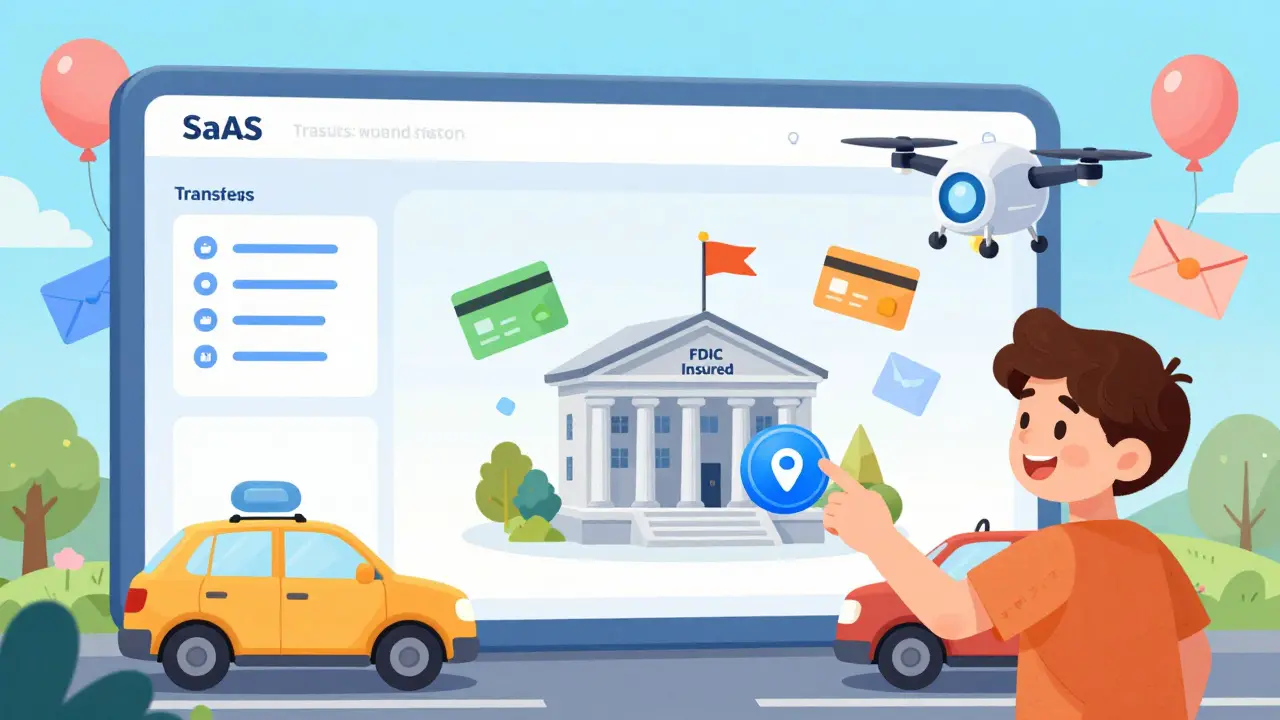
Customers don’t care if the bank behind the service is Unit or Solarisbank. They care that the experience feels seamless. BaaS platforms let you fully white-label everything: the app interface, the email notifications, the card design, even the customer support chatbot.
Thunes reports that 95% of BaaS solutions offer full branding control. That means your customers never see a third-party logo. They think the banking feature is yours. This builds trust and loyalty. A study by Forrester found that businesses using white-label embedded finance saw 28% higher customer lifetime value than those without.
Think of it like Apple’s App Store. You don’t see Google or Amazon when you download an app-you see Apple’s design. That’s the power of white-labeling.
More Revenue, Better Retention
Financial services aren’t just a cost center-they’re profit centers. When you embed banking into your product, you create new revenue streams.
Imagine a fitness app that offers users a savings account tied to their workout goals. Every time they hit a milestone, the app automatically transfers $5 into their account. The app earns a small fee from the BaaS provider for each deposit. Now you’re making money every time your users succeed.
Or consider a logistics company that offers instant payouts to drivers. They charge a 1% fee for same-day transfers. That’s a new line of income with near-zero marginal cost.
And retention? Customers stick around longer when they can do more within your app. A European e-commerce brand saw a 18% increase in average order value after adding “buy now, pay later” powered by BaaS. Users didn’t leave to find financing elsewhere-they stayed and spent more.
Scalability Built In
Traditional banking systems struggle to scale. Adding a new feature might require months of internal approvals and infrastructure upgrades.
BaaS platforms are built for scale. Modern APIs handle up to 10,000 transactions per second. Uptime is 99.95%. Payment processing takes under 230 milliseconds. You don’t need to worry about server crashes during Black Friday or holiday spikes.
One delivery app in Southeast Asia went from 500 to 2 million users in 14 months. Their BaaS provider scaled automatically. No downtime. No extra hiring. No panic.
Challenges to Watch Out For
BaaS isn’t magic. There are real hurdles.
Integration can be tricky if you’re using old software. About 41% of users report difficulties connecting BaaS APIs to legacy systems. Documentation quality varies. Some providers have excellent guides; others leave you guessing.
Regulatory differences matter. If you expand from the U.S. to Europe, you need to comply with PSD2. If you go to Asia, local rules change again. BaaS providers help, but you still need to understand the landscape.
And vendor lock-in is real. If you build deeply into one provider’s API, switching later can be costly. 37% of businesses say it’s hard to move away from their BaaS partner. Always design with portability in mind-use standardized APIs like ISO 20022 and avoid proprietary features unless absolutely necessary.
Who’s Using BaaS Right Now?
It’s not just fintechs. Here’s who’s winning with BaaS:
- E-commerce: 67% use it for payments and BNPL (buy now, pay later).
- Fintech startups: 89% rely on it for core banking features like accounts and cards.
- SaaS platforms: 52% embed financial tools to boost retention.
- Logistics: Use it for instant driver payouts.
- Healthcare: Offer payment plans without needing a banking license.
Even traditional banks are using BaaS. JPMorgan’s Finn platform and BBVA’s Open Platform let non-banks access their infrastructure. It’s not just a trend-it’s becoming the new normal.
The Future: AI, DeFi, and Global Expansion
BaaS is evolving fast. By 2025, 72% of providers plan to add AI-driven features like real-time fraud detection and automated credit scoring. Unit already launched a fraud API with 99.2% accuracy.
In Europe, the ECB is standardizing API rules, making it easier for providers to operate across borders. In Africa and Southeast Asia, digital banking is growing at 24% a year-and BaaS is the fastest way to get there.
Long-term, some providers are exploring connections to decentralized finance (DeFi). Imagine a BaaS account that lets users earn interest in both USD and crypto. That’s not far off.
The global BaaS market hit $15.8 billion in 2023. By 2032, it’s projected to hit $68.4 billion. That’s not hype-it’s infrastructure being rebuilt.
Is BaaS Right for Your Business?
If you’re a company that:
- Wants to offer financial features but doesn’t want to become a bank
- Needs to move fast and stay competitive
- Wants to increase customer retention and revenue
- Has a tech team that can handle APIs
Then BaaS isn’t just an option-it’s your advantage.
Start small. Add a payment option. Then a savings feature. Then a lending product. Each step adds value without risk. You don’t need to boil the ocean. Just plug in, test, and scale.
The future of finance isn’t in branches or apps alone. It’s in the spaces between them. And BaaS is the bridge.
What’s the difference between BaaS and a Payment Service Provider (PSP)?
A Payment Service Provider (PSP) like Stripe Payments or Square only handles payments-sending and receiving money. BaaS goes further. It lets you offer full banking services: bank accounts, debit cards, interest-bearing balances, lending, and compliance tools. Think of PSPs as just one feature inside a BaaS platform.
Do I need a technical team to use BaaS?
Yes, but not a huge one. You need at least 1-2 developers familiar with REST APIs. Most BaaS providers offer SDKs and documentation that make integration easier. If your team has experience with JavaScript, Python, or Node.js, they can get started in under 10 hours. Complex setups (like multi-currency or compliance-heavy features) may require more time.
Is BaaS safe for my customers’ money?
Yes-if you choose a reputable provider. BaaS partners are always licensed banks. That means customer funds are protected under FDIC insurance (in the U.S.) or equivalent schemes in Europe. Your customers’ money isn’t sitting in your company’s account-it’s held in the bank’s insured accounts. You’re just the interface.
Can I use BaaS outside the U.S.?
Absolutely. Many BaaS providers operate in Europe, Canada, Australia, and parts of Asia. But regulations vary. In Europe, PSD2 requires open banking APIs. In the U.S., you need to comply with state-level banking laws. Choose a provider with licenses in your target markets. Some, like Unit and Railsbank, support multi-jurisdictional operations out of the box.
How much does BaaS cost?
Costs vary. Basic payment processing might cost $0.25 per transaction. Card issuance is around $0.50 per card. Enterprise plans start at $50,000/year and can go over $500,000 for full white-label solutions with dedicated support. Most providers charge based on volume, so you only pay for what you use. No upfront infrastructure costs.
What happens if my BaaS provider goes out of business?
Your customers’ money is still safe-it’s held by the licensed bank, not the BaaS provider. However, switching providers can be complex. That’s why it’s important to use standardized APIs and avoid proprietary features. Plan for migration early. Most top providers offer data export tools and support transition planning.


Manish Yadav
December 5, 2025 AT 15:38This is just banks outsourcing their mess to startups. You think your customers care who's behind it? They just want their money to work. And now you're letting some API do your banking? Pathetic.
Vincent Cameron
December 6, 2025 AT 19:35It's not about the technology. It's about the redefinition of trust. When a company you buy coffee from suddenly becomes your bank, you're not just changing services-you're changing the social contract of commerce. We're moving from transactional relationships to embedded existential dependencies.
Noriko Robinson
December 8, 2025 AT 08:39I love how this makes small businesses feel empowered. I run a tiny Etsy shop and just added a buy-now-pay-later option through a BaaS provider. My customers are spending 30% more and I didn't need to hire a single lawyer. It feels like the future is finally here, and it's quiet and simple.
ronald dayrit
December 8, 2025 AT 11:59The underlying philosophical shift here is profound: the erosion of institutional authority in finance and its replacement by algorithmic intermediaries. We no longer trust banks because we don't need to-what we trust now is the seamless interface, the invisible hand of API integration, the silent governance of compliance-as-a-service. This isn't innovation, it's the quiet death of financial sovereignty, repackaged as convenience.
Yzak victor
December 10, 2025 AT 01:16Honestly, I was skeptical until I tried it. My app had 300 users and I needed to pay contractors faster. Used Stripe Treasury, set up accounts in a weekend. Now my freelancers get paid same-day, no more waiting. No crazy fees. No headaches. Just works. People act like this is rocket science-it's not. It's just better.
Josh Rivera
December 11, 2025 AT 10:40Oh wow, so now my local laundromat is gonna offer me a savings account? Next thing you know, my Uber driver will be issuing me a credit card and asking for my SSN. This isn't innovation, it's corporate identity theft disguised as UX.
Neal Schechter
December 13, 2025 AT 09:38In Nigeria, we’ve been doing this for years with mobile money-MTN, Airtel, Paga. You don’t need a bank to move money. What’s new here is that American startups are finally catching up to what Africans built out of necessity. BaaS isn’t revolutionary-it’s just American capitalism finally noticing what was already working.
Adam Bosworth
December 13, 2025 AT 16:18They say 'no upfront costs' but they don't tell you the hidden fees. Every time someone uses your embedded card, they take 0.50%. Then they charge you for failed transactions. Then they charge you for chargebacks. Then they charge you for 'compliance monitoring'. You think you're saving money? You're just paying in invisible installments until you're broke and locked in.
Renelle Wilson
December 13, 2025 AT 23:55The ethical implications of embedding financial services into non-financial platforms cannot be overstated. When a fitness app begins to influence your creditworthiness through workout data, or a grocery app assesses your spending habits to determine loan eligibility, we are moving toward a system where economic opportunity is algorithmically mediated by corporate interests. This requires robust regulatory frameworks-not just technical integration.
Elizabeth Miranda
December 14, 2025 AT 19:37I’ve used BaaS for my SaaS product and it was seamless. The docs were clear, the support was responsive, and the uptime was perfect. The only hiccup was when we tried to add EUR support-had to switch providers mid-project. Lesson learned: always check jurisdiction coverage before committing.
Chloe Hayslett
December 15, 2025 AT 12:48So now we’re letting Silicon Valley tech bros run our banking system? Next they’ll be printing our money. This is why America’s economy is crumbling. We outsource everything-from manufacturing to finance-and then wonder why nothing works anymore.
Jerry Perisho
December 15, 2025 AT 19:00BaaS saves time and money. End of story. If your team can't handle an API integration, maybe you shouldn't be building financial features. Simple.
Holly Cute
December 17, 2025 AT 06:21Everyone’s acting like this is the future, but let’s be real-this is just a way for tech companies to become unregulated banks without the oversight. You think your customer’s money is safe? What happens when the BaaS provider gets hacked? Or gets bought by a hedge fund? Or just decides to freeze accounts because they 'suspect fraud'? You’re not building trust-you’re building a house of cards with FDIC insurance as the glue.
Richard T
December 19, 2025 AT 03:35I’m curious-how do you handle KYC for international users? I’m thinking of expanding to Brazil and Mexico. Do BaaS providers handle local ID verification, or is that still on us?
Frank Cronin
December 19, 2025 AT 12:31Oh look, another 'disruptive' tech solution that makes the rich richer and the poor more indebted. Buy now, pay later? That’s just predatory lending with a sleek UI. And you people are celebrating this? You’re not innovating-you’re just making exploitation more comfortable.
Nina Meretoile
December 20, 2025 AT 17:54In India, we’ve had UPI for years-peer-to-peer payments through your phone number, no bank app needed. BaaS is just the Western version of that, but with more paperwork and less culture. The real innovation isn’t the tech-it’s the mindset shift: finance should be invisible, not intimidating.
Chris Jenny
December 22, 2025 AT 12:49This is all a lie. The government is using BaaS to track every dollar you spend. Your 'savings account' is really a surveillance tool. The banks? They’re just puppets. The real power is in the data. They know what you buy, when you buy it, how much you save. And they’re selling it. Wake up.
Uzoma Jenfrancis
December 23, 2025 AT 22:08I don't care what you say. If you're not building your own banking system, you're not building anything real. This is just renting someone else's infrastructure. Real companies build their own. This is for people who want to be CEOs without doing the work.