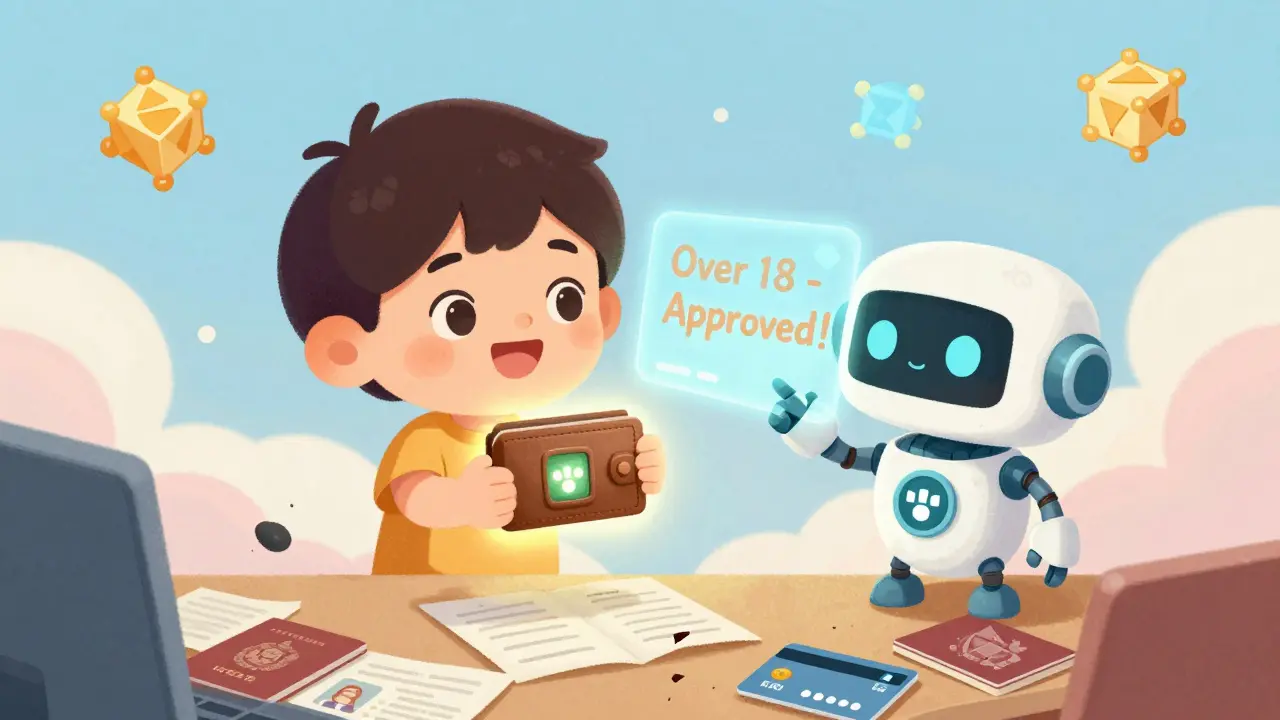
Imagine being able to prove you’re over 18 without showing your ID card. Or applying for a loan without handing over your entire credit history. Or logging into a government service without giving them your birth certificate, passport, or social security number. This isn’t science fiction. It’s what blockchain digital identity solutions make possible today.
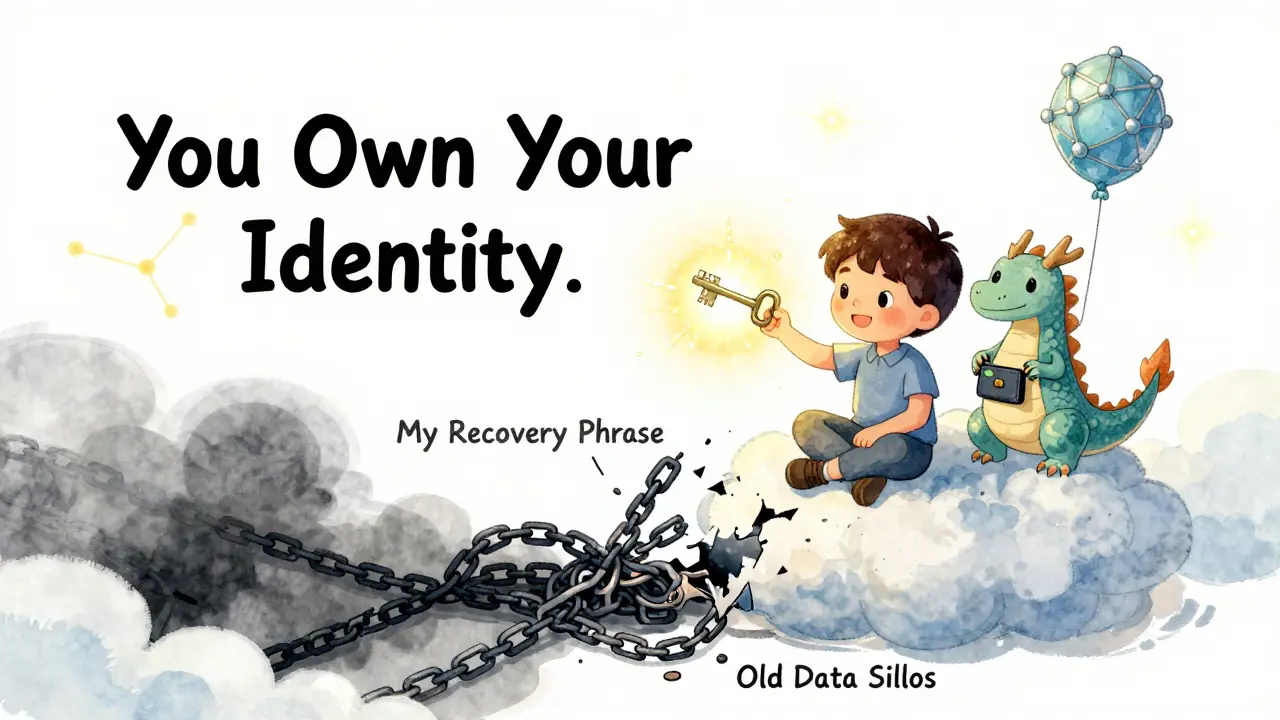
For decades, your identity has been locked in silos - held by banks, governments, hospitals, and social media platforms. Each one stores your data separately, each one is a target for hackers, and each one controls what you can and can’t do with your own information. Blockchain flips that model. Instead of giving your data away, you keep it in your own digital wallet. When you need to prove something - like your age, your degree, or your right to work - you share only the proof, not the document. No one else holds your data. No one else can lose it. That’s the core idea behind self-sovereign identity (SSI).
How Blockchain Digital Identity Actually Works
At the heart of blockchain digital identity are three key pieces: Decentralized Identifiers (DIDs), Verifiable Credentials, and cryptographic proofs.
A DID is like a username that doesn’t belong to any company. You create it. You control it. It’s stored on a blockchain - not as your name or birthdate, but as a unique string of characters linked to your public key. Think of it as your digital fingerprint, but one you can use without revealing who you are.
Verifiable Credentials are the documents you earn - your university diploma, your driver’s license, your vaccination record. These aren’t scanned PDFs. They’re encrypted digital files signed by trusted issuers - like a university or a government agency. When you need to prove you graduated, you don’t send the diploma. You send a cryptographically signed statement that says, “This person holds a valid credential issued by XYZ University.”
The magic happens when the verifier checks that signature against the blockchain. No database lookup. No server connection. Just a quick mathematical proof that the credential is real and hasn’t been tampered with. This whole process takes 1.2 to 2.8 seconds, according to Dock.io’s 2025 benchmarks. Compare that to traditional KYC, which can take days or even weeks.
Why This Matters More Than You Think
Every time you hand over your personal data to a company, you’re taking a risk. In 2023, over 1.2 billion records were exposed in data breaches globally, according to IBM’s Cost of a Data Breach report. Most of those breaches happened because companies stored too much data in one place.
Blockchain identity changes that. Healthcare providers using this system saw a 40% drop in patient data leaks during the pandemic, as reported by EveryCred’s 2025 whitepaper. Why? Because hospitals no longer store your full medical history. They only store a hash - a digital signature - that confirms you’ve been verified by your trusted issuer.
In finance, JPMorgan cut identity verification time from five days to under two hours after switching to blockchain-based credentials. That’s not just faster. That’s cheaper. Their KYC costs dropped by 65% in the first year.
And it’s not just corporations. Estonia’s e-Residency program reduced verification time from two weeks to 48 hours after integrating blockchain identity. That’s a real-world example of how governments are using this tech to serve citizens better - not just monitor them.
Who’s Using It Right Now?
The adoption isn’t theoretical. It’s happening.
Financial services lead the pack, with 48% of institutions in North America and Western Europe already piloting or fully deploying blockchain identity solutions. Why? Because fraud and compliance costs are eating into profits. A single false positive in AML checks can cost a bank over $10,000. Blockchain reduces those errors by tying identity to immutable, verifiable data.
Healthcare is next. The sector is projected to grow at 87.8% CAGR from 2025 to 2032, according to Fortune Business Insights. Why? Because during the pandemic, millions of people couldn’t prove they were vaccinated or had recovered. Paper cards got lost. Digital systems didn’t talk to each other. Blockchain identity fixed that. Now, your vaccine record is a Verifiable Credential you carry in your wallet - and any clinic, pharmacy, or airline can verify it instantly.
Government agencies are testing it too. The UNJSPF and UNICC launched a blockchain-powered Digital Certificate of Entitlement (DCE) system in September 2025. It slashed pension fraud by 37% and sped up payments by 82%. That’s not just efficiency. That’s justice.
Even consumers are starting to use it. Reddit users in r/blockchain report 68% satisfaction with the control they now have over their data. One user, u/CryptoGuardian, wrote: “Finally controlling which attributes to share without surrendering my entire identity to corporations.”
The Hard Truth: Why It’s Not Everywhere Yet
Here’s the problem: most people still don’t know how to use it.
Trustpilot reviews of consumer blockchain identity apps average just 3.2 out of 5 stars. Why? Because managing a digital wallet isn’t like logging into Facebook. If you lose your recovery phrase, you lose your identity. No customer service line can help you. And 22% of users make mistakes during setup, according to UNICC’s 2025 white paper.
Enterprise adoption faces its own hurdles. 73% of financial institutions report reduced fraud. But 41% of employees resist the change because workflows got more complex. Training costs are high. 63% of companies need specialized education just to get staff up to speed.
Integration is another nightmare. 72% of organizations struggle to connect blockchain identity systems with old HR platforms, payroll software, or legacy databases. And regulatory uncertainty? That’s the biggest blocker. In the EU, eIDAS 2.0 creates a patchwork of rules that make cross-border identity verification messy. Companies don’t know if they’re compliant - or if they’ll be fined next year.
And let’s not forget: blockchain isn’t magic. It can’t handle millions of transactions per second like Visa. Some networks still lag under load. And if your DID system goes down? You’re locked out. That’s why the best solutions combine blockchain with off-chain backups and user-friendly interfaces.
What’s Coming Next?
The next wave isn’t just about identity - it’s about control.
Four trends are shaping the future:
- Biometrics on-chain: Your fingerprint or face scan is now being linked to your DID as a secure verification layer. Growth? 92% year-over-year.
- Regulatory sandboxes: 17 countries now run test zones where cross-border identity verification is allowed. Think of it as a playground for governments to try new rules without legal risk.
- AI fraud detection: AI layers now analyze behavior patterns to catch fake credentials before they’re even used. In pilot programs, false positives dropped by 63%.
- Data monetization: You can now earn money by letting companies verify your identity - and only if you say yes. A pilot in Canada lets users earn crypto tokens for verified employment data. No more selling your data silently.
By 2028, Gartner predicts blockchain identity will be mandatory for 75% of enterprise digital interactions. That doesn’t mean everyone will use it. But if you’re applying for a job, opening a bank account, or signing a lease - you’ll likely be asked to use a digital wallet.
Where Do You Start?
If you’re an individual, start with a wallet that supports W3C Verifiable Credentials. Try Sovrin, ION, or Microsoft’s ION. Download an app like uPort or Polygon ID. Get a DID. Save your recovery phrase. Practice sharing a credential - like your university degree - with a test verifier.
If you’re a business, begin with a pilot. Pick one process - maybe onboarding new employees or verifying contractor credentials. Use Consensys’ Identity Developer Kit. It’s rated 4.7/5 for documentation. Hire a blockchain dev - salaries in North America average $150,000. Train your compliance team. Don’t try to replace everything at once. Start small. Measure the time saved. Track the fraud reduced.
The shift from custodial identity to self-sovereign identity isn’t just technical. It’s cultural. It’s about who owns your data. And for the first time, the answer is: you.
What is self-sovereign identity (SSI)?
Self-sovereign identity (SSI) is a model where individuals control their own digital identity using blockchain technology. Instead of relying on companies or governments to store and verify personal data, users hold encrypted credentials in their own digital wallets. They decide exactly what information to share - and with whom - without giving away their entire identity.
How is blockchain digital identity different from traditional ID systems?
Traditional systems store your data in centralized databases - like a bank’s server or a government database. If that server is hacked, your data is stolen. Blockchain digital identity stores your credentials in your personal wallet. Verification happens through cryptographic proofs on the blockchain, not by pulling data from a central server. No one else holds your information. That makes it more secure and private.
Can I lose my blockchain identity?
Yes - if you lose your private key or recovery phrase. Unlike traditional systems where a company can reset your password, blockchain identity has no central authority to recover your access. That’s why user education is critical. Always back up your recovery phrase offline, and never store it online. Some newer wallets offer social recovery options - where trusted contacts help you regain access - but these are still emerging.
Is blockchain digital identity legal?
In many countries, yes. The EU, Canada, Singapore, and Estonia have legal frameworks recognizing blockchain-based credentials. The U.S. has no federal law yet, but states like Vermont and California are testing pilot programs. The key is whether the credential issuer (like a university or government) is trusted. If they’re officially recognized, the digital credential holds legal weight.
Which industries benefit most from blockchain identity?
Financial services lead because of strict KYC rules and high fraud costs - blockchain cuts verification time by 90% and reduces costs by 60-70%. Healthcare benefits from secure, portable health records. Government agencies use it to reduce fraud in benefits and pensions. Education uses it to verify degrees without paper transcripts. Any sector that handles sensitive personal data can benefit.


Bryanna Barnett
March 4, 2026 AT 15:30Finally, someone gets it. I’ve been using my Sovrin wallet for months now-no more handing my SSN to every random SaaS startup. The freedom? Unbelievable. I shared my degree credential last week to apply for a remote job. Took 47 seconds. No forms. No PDFs. Just a signed proof. This isn’t tech. It’s liberation.
Also, why are we still using passwords? We’re living in 2025, not 2005.
Josh Moorcroft-Jones
March 6, 2026 AT 15:17Okay, but let’s be real-this whole ‘self-sovereign identity’ thing is just a fancy way of saying ‘you’re now responsible for your own security.’ You lose your recovery phrase? Tough luck. No customer service. No ‘forgot password?’ link. Just… poof. Gone. And don’t even get me started on the fact that blockchain networks can’t handle more than 15 TPS. You think your ‘instant verification’ works when 10,000 people try to log in at once? Please. The infrastructure is a house of cards made of Ethereum gas fees and optimism.
Basil Bacor
March 7, 2026 AT 17:04Look, I’m all for privacy, but this sounds like a cult. Who the hell is gonna help me if I forget my 12-word passphrase? My grandma? My dog? This isn’t empowerment-it’s abandonment. And don’t tell me about ‘social recovery’-that’s just phishing waiting to happen. You think your ‘trusted contacts’ won’t get hacked? Newsflash: everyone gets hacked. This isn’t progress. It’s a trap for the tech-bro elite.
Emily Pegg
March 9, 2026 AT 01:45I just tried uPort. I spent 45 minutes trying to scan my driver’s license. The app froze. Then it asked me to upload a selfie with my passport. Then it said ‘verification failed.’ I cried. I’m not tech-illiterate. I just want to go to the DMV without a 3-hour wait. This isn’t helping. It’s adding layers. And now I have to remember a phrase? In my head? Like a medieval monk? 😭
Ethan Grace
March 9, 2026 AT 07:32It’s interesting how we’ve conflated decentralization with autonomy. But autonomy without infrastructure is just isolation. The blockchain doesn’t care if you’re locked out. It doesn’t feel your panic. It doesn’t offer a lifeline. We’ve replaced one master-corporate data brokers-with another: the immutable ledger. And that ledger? It’s cold. Silent. Unforgiving. Are we really free if our identity can vanish because we miskeyed a word?
Jamie Hoyle
March 11, 2026 AT 04:24Oh wow, another blockchain fairy tale. Let me guess-JPMorgan ‘cut costs by 65%’? Yeah, right. They just shifted the labor to the user. Now YOU’RE the IT department. And ‘reduced fraud by 37%’? That’s because fraudsters switched from hacking banks to hacking *you*. You think your grandma’s recovery phrase is safe? Nah. She wrote it on a sticky note next to her coffee mug. And now she’s got no pension. Congrats, tech bros. You just outsourced identity theft to the elderly.
Jeffrey Dean
March 11, 2026 AT 08:59It’s not about technology. It’s about power. The moment you hand control of your identity to a ‘wallet,’ you’re still being controlled. By whom? By the developers. By the standards. By the protocols. There’s no such thing as ‘self-sovereign’ if you need a PhD in cryptography to log into your own life. This isn’t freedom. It’s a new kind of gatekeeping. And the gatekeepers? They’re the same people who built the old system. They just changed the logo.
Brian T
March 11, 2026 AT 09:33I read the whole thing. Honestly? I’m not convinced. The stats are nice. But what about the 22% of users who mess up setup? What about the 41% of employees who hate the new workflow? What about the people who can’t afford a smartphone? This isn’t inclusive. It’s exclusion disguised as innovation. And don’t get me started on ‘data monetization’-that’s just surveillance with a tip jar.
Nash Tree Service
March 12, 2026 AT 23:59Let me state, with the utmost formality, that the premise of self-sovereign identity presumes a level of digital literacy, infrastructural access, and cognitive bandwidth that is neither universal nor equitable. The notion that a digital wallet is a viable replacement for state-issued identification is, in many socio-economic contexts, not merely impractical-it is ethically indefensible. One cannot be sovereign if one lacks the tools to wield sovereignty. This is not progress. It is privilege.
Jane Darrah
March 14, 2026 AT 00:38Okay, I get the hype, but let’s talk about the emotional toll. I’m a single mom. I’ve got two kids, a part-time job, and zero tech support. I tried setting up a DID. I got lost in a 17-step tutorial. I panicked. I thought I lost my identity. I cried. I didn’t sleep. And then I realized-this isn’t for me. It’s for people who have time, money, and patience. I just want to get my flu shot without 5 apps and 3 QR codes. Why can’t we just… make it easier? Why does everything have to be a blockchain?
Denise Folituu
March 15, 2026 AT 08:31THIS IS A SCAM. I saw a video where someone said ‘you own your data.’ But then they sold me a $99 ‘Secure Identity Bundle’ with a pre-loaded DID. That’s not self-sovereign. That’s a pyramid scheme with a blockchain sticker. And don’t even get me started on ‘verifiable credentials’-who’s verifying the verifiers? The same companies that got us into this mess? LOL. This isn’t revolution. It’s rebranding. And we’re all paying for the upgrade.
jack carr
March 16, 2026 AT 13:35Man, this is actually kinda cool. I’ve been using my Polygon ID for a year now. No more giving my birth certificate to DoorDash. Just a quick proof. Took me 2 minutes to set up. My cat even approved. 🐱✌️
Eva Gupta
March 17, 2026 AT 01:30In India, we’ve been dealing with identity chaos for decades. Aadhaar was supposed to fix it, but now we have 30 different apps for 30 different services. This blockchain thing? It could be a game-changer-if it’s designed for us. Not for Silicon Valley. For the rickshaw driver, the street vendor, the schoolteacher. If it works offline, if it’s in Hindi, if it doesn’t need a credit card to sign up… then yes. This could be real. But right now? It’s still a luxury.
Nancy Jewer
March 17, 2026 AT 16:45From a compliance standpoint, the shift to verifiable credentials is transformative. The reduction in KYC friction, the elimination of redundant data storage, the cryptographic immutability of issuance chains-all of this aligns with ISO 27001, NIST SP 800-53, and GDPR Article 25. The real bottleneck isn’t tech-it’s governance. Organizations need to redefine their data minimization policies, update their consent frameworks, and train their auditors. This isn’t a tool. It’s a paradigm shift in identity governance.
Ken Kemp
March 18, 2026 AT 06:01Hey, I tried this with my contractor team. We switched to blockchain creds for background checks. Took a week to train everyone. But now? No more fake degrees. No more fake licenses. One guy had a forged electrician cert. We caught it in 12 seconds. Saved us $22k in liability. I’m sold. Just… maybe make the app a little less glitchy? My phone kept crashing. 🤞
Julie Potter
March 18, 2026 AT 14:29Oh my GOD. This is the most beautiful thing I’ve ever read. I’ve been waiting for this since 2017. I’m not just a user-I’m a digital citizen. I control my data. I choose who sees it. I’m not a product. I’m not a data point. I’m a person. And for the first time… I feel human again. 💔➡️❤️
Leah Dallaire
March 20, 2026 AT 14:19So… this is just a cover for mass surveillance. You think governments aren’t going to mandate this? You think they won’t track every credential you share? ‘Self-sovereign’? More like ‘state-verified.’ They’ll require a DID to buy groceries, to use public transit, to vote. And if you don’t comply? Your ‘identity’ gets revoked. Welcome to digital serfdom. They’re not giving you freedom. They’re giving you a leash with a blockchain tag.
prasanna tripathy
March 21, 2026 AT 13:21I love this. In India, we’ve got millions who don’t have bank accounts but have phones. Imagine if your Aadhaar could be a verifiable credential-no need for physical cards, no need for agents. Just scan, verify, done. And if you lose your phone? Use your friend’s. Social recovery works here. We’ve been doing community trust for centuries. This tech? It’s not foreign. It’s familiar.
James Burke
March 22, 2026 AT 08:03I’ve been using this for my freelance work. Clients verify my credentials instantly. No more sending PDFs. No more ‘can you send me a screenshot?’ It’s clean. Simple. I’ve even started sharing my vaccination status on my profile. People appreciate it. It’s not magic-but it’s better. And yeah, I backed up my phrase. On paper. In a drawer. Like my grandpa taught me.
Jonathan Chretien
March 23, 2026 AT 04:00Wow. Just… wow. This is the future. I’m not just a user-I’m a philosopher of autonomy. The blockchain doesn’t lie. It doesn’t manipulate. It doesn’t sell you out. It just… is. And in a world of lies, that’s the most radical thing of all. 🌌✨
Bill Pommier
March 24, 2026 AT 04:13Let me formally address the fallacy embedded in this narrative: the assumption that decentralization inherently equates to security. In reality, decentralized systems introduce new attack vectors: private key theft, wallet phishing, sybil attacks, and consensus manipulation. The 40% reduction in healthcare data leaks? Likely due to reduced storage-not inherent security. The real win? Lowering the attack surface. The real cost? Shifting liability to end users. This is not innovation. It is risk transference.
Olivia Parsons
March 24, 2026 AT 05:51I’m just trying to understand: if I can’t access my DID, I lose my identity. But what if I’m in a coma? What if I’m elderly and can’t remember the phrase? Is there a legal process? Can my daughter get access? Or is that against ‘sovereignty’? I’m not against this-I just want to know: who takes care of the vulnerable?
Nick Greening
March 24, 2026 AT 11:36Everyone’s acting like this is the second coming. But let’s be real-most people don’t care. They just want to log in. They don’t want a wallet. They don’t want a phrase. They just want to watch Netflix. This isn’t for them. It’s for people who think ‘decentralized’ sounds smarter than ‘simple.’ And honestly? I’m tired of being told I’m ‘backward’ for not wanting to manage my own keys.
Issack Vaid
March 25, 2026 AT 13:34How quaint. A Western-centric utopia disguised as global innovation. Meanwhile, in the Global South, people are still being denied IDs because they lack birth certificates. You’re offering blockchain wallets while they’re still fighting for paper records. This isn’t progress-it’s digital colonialism. The solution isn’t more tech. It’s justice. And justice doesn’t live in a DID.
Shawn Warren
March 26, 2026 AT 02:38This is the future. No more waiting. No more bureaucracy. No more paper. Just instant, secure, verifiable identity. It’s time to move forward. The old world is gone. Embrace the new. The time is now. The revolution is here. Let’s build it together. One credential at a time.
Jackson Dambz
March 27, 2026 AT 09:42Let’s be honest: this is just another way for corporations to offload their compliance costs onto the public. You think JPMorgan really cares about your ‘sovereignty’? No. They care about their bottom line. And now you’re the one paying for it-with your time, your stress, your lost recovery phrase. This isn’t empowerment. It’s exploitation dressed in crypto.
Megan Lutz
March 28, 2026 AT 16:47I’ve spent years studying digital governance. This isn’t about technology. It’s about epistemology-who gets to define truth in a digital world? Who issues the credentials? Who audits the issuers? Blockchain doesn’t solve legitimacy. It just makes it harder to fake. The real question isn’t ‘can we verify?’ It’s ‘who do we trust to verify?’ And that’s a political, not technical, question.