
When COSS first launched in 2017, it promised something rare in the wild west of crypto exchanges: a one-stop solution. No need to juggle multiple apps for trading, storing, or launching tokens. COSS bundled everything - exchange, wallet, and IEO platform - into one interface. At the time, it looked like a smart move. The trading fees were low, the maker fees were zero, and holding the native COS token gave you half of all trading fees back. For a while, it worked. But by 2021, that promise had collapsed. Today, COSS isn’t just inactive - it’s a cautionary tale.
What COSS Actually Offered (Before It Broke)
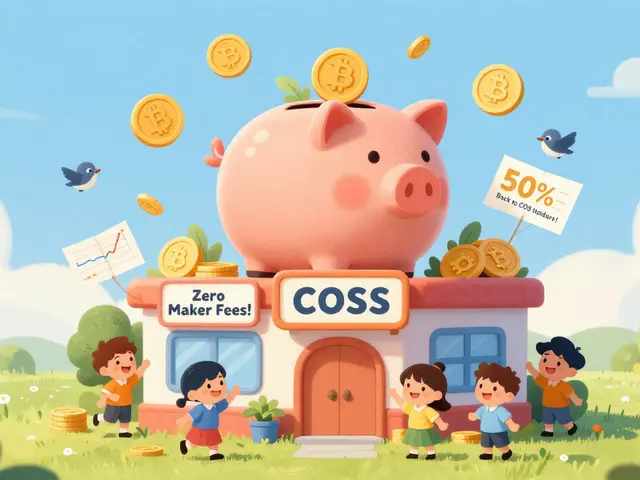
COSS wasn’t just another exchange. It had three core parts: the COSS Exchange for trading, the COSS Wallet for storing crypto across multiple blockchains, and COSS Lift-Off for launching new tokens. That’s unusual. Most exchanges focus on trading. COSS tried to be the whole ecosystem. The trading fees stood out early on. Takers paid 0.25%, which was average. But makers? Zero fees. That’s better than Binance’s 0.10% and Kraken’s 0.16%. If you were placing limit orders to add liquidity, you got paid to trade. High-volume traders could drop their taker fee to 0.15%. That’s attractive for active traders. Withdrawal fees were also competitive. Sending Bitcoin cost 0.0004 BTC - lower than Binance and Kraken at the time. And the real kicker? 50% of all trading fees went straight to COS token holders. That model was copied from BNB, but COSS didn’t have the user base or infrastructure to make it sustainable. The COSS Wallet was another attempt at differentiation. It let you swap tokens inside the app, recharge your phone with crypto, and even send crypto to someone nearby using GPS. Sounds cool? It was - on paper. But the wallet never got the adoption it needed. Most users stuck with MetaMask or Trust Wallet, which were free, open-source, and didn’t tie you to a failing exchange.The Downward Spiral: When Everything Went Silent
By mid-2021, users started reporting the same thing: they couldn’t withdraw their funds. The exchange went into what it called “audit mode.” No explanation. No timeline. Just a message saying withdrawals were paused for “security reviews.” But here’s the problem - audits don’t last months. They last days. This went on for over a year. Support channels vanished. The compliance email listed in their terms didn’t respond. The Telegram groups went quiet. The official forum disappeared. Users on Reddit’s r/CryptoCurrency started threads like “Anyone else stuck with COSS exchange?” - and hundreds said yes. One user on Trustpilot wrote: “Had traded at COSS since it opened shop and never once believed that Rune would one day scam us all. Now all my cryptos with COSS are in their audit mode - which means little or no chance of returning back to me.” The platform claimed it was migrating to a new system. Then it said the COSS DEX (decentralized exchange) was live. But when users clicked the link, it either showed an error or redirected to a random site. The API documentation, once available, vanished. The website became a ghost town.Why COSS Failed When Others Survived
It’s not just that COSS had technical problems. It failed because it skipped the basics that every trustworthy exchange must get right. First - no regulatory license. COSS was based in Singapore, but it never applied for a Payment Services Act license, which became mandatory in January 2020. That meant it operated in a legal gray zone. No oversight. No accountability. Second - no transparency. While Binance published proof-of-reserves and Kraken shared quarterly audits, COSS never released a single financial statement. When users asked where their funds were, the answer was always silence. Third - no community trust. Even in the early days, COSS didn’t have the developer activity, community engagement, or marketing muscle of its rivals. It didn’t sponsor events, hire influencers, or build partnerships. It relied on low fees and a catchy pitch. That’s not enough. Compare that to Kraken, which survived multiple bear markets and even kept operating after the FTX collapse. Or Coinbase, which went public in 2021 and still handles billions in daily volume. COSS had peak daily volume of $5-10 million. That’s less than 1% of what Coinbase did. When the market cooled, COSS had no buffer.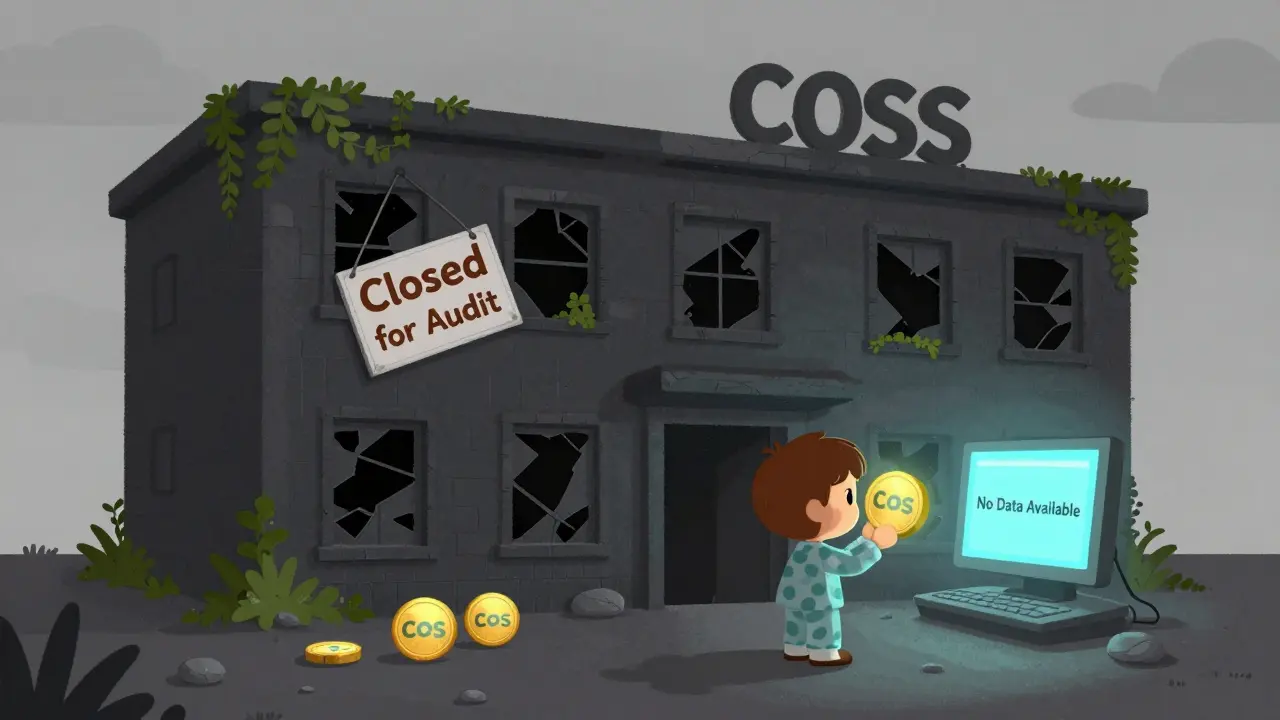
The COS Token: A Dead Asset
The COS token was supposed to be the glue holding the ecosystem together. Hold it, get 50% of trading fees. Simple. Elegant. But without a functioning exchange, the token became worthless. No one was trading. No one was earning rewards. The price dropped to near zero. Today, COS has no market data on CoinMarketCap or CoinGecko. It’s not listed anywhere. The token contract still exists on the blockchain, but it’s a digital relic - like a banknote from a closed bank. Some people still hold it, hoping for a revival. There isn’t one. The team stopped communicating. No updates. No announcements. No social media activity since 2021. The COS token is dead.What Users Lost - And What They Can’t Get Back
Users didn’t just lose access to their crypto. They lost time, trust, and money. Many had been with COSS since 2017. They trusted the platform. They moved funds in, bought COS tokens, and even staked them. When the withdrawal freeze hit, they waited. They checked daily. They emailed support. Nothing. By August 2021, Trustpilot ratings dropped to 2.0 stars. The majority of reviews called it an “exit scam.” That’s not hyperbole - it’s the word users used themselves. There’s no legal recourse. COSS Pte. Ltd. still exists on paper, but it’s inactive. No lawyers are taking cases. No regulators are investigating. The company has vanished. The only thing left is the website - frozen in time. The last archived version from May 2021 still shows API docs and support links. But they don’t work. It’s like visiting a house where the lights are on, but no one’s home.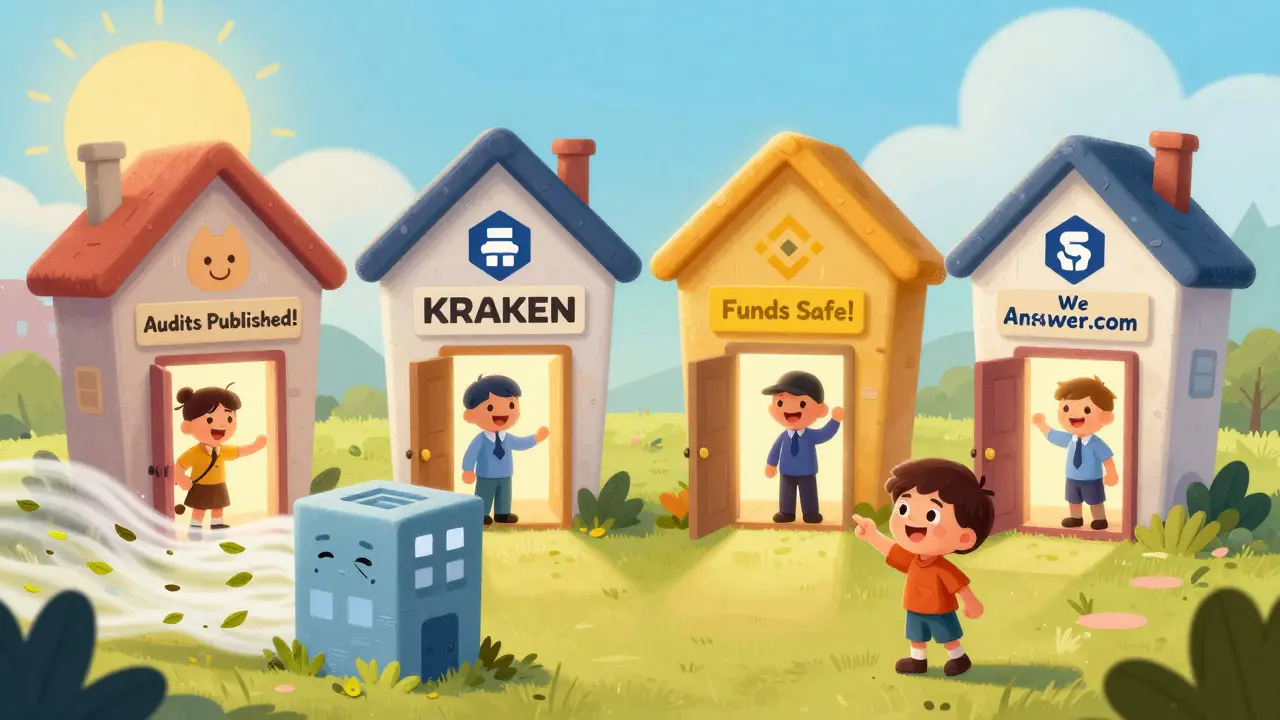
Alternatives That Actually Work
If you’re looking for a reliable exchange, don’t waste time on COSS. Here are four that still operate with full functionality:- Coinbase: Best for beginners. Simple interface, fiat on-ramps, insured custody.
- Kraken: Strong security, low fees, margin and futures trading, transparent audits.
- Binance: Highest liquidity, lowest fees, wide coin selection - but watch the regulatory risks.
- Crypto.com: Good mobile app, rewards program, Visa card integration.
Final Verdict: Don’t Even Consider COSS
COSS isn’t just a bad exchange. It’s a failed experiment that left users with nothing. The low fees, the token rewards, the wallet features - all of it was smoke and mirrors. The company vanished. The funds are gone. The trust is shattered. If you’re thinking about using COSS because you saw an old review or a YouTube video from 2019 - don’t. That information is outdated. The platform is dead. The crypto industry has seen many collapses. Mt. Gox. FTX. Terra. And now COSS. Each one teaches the same lesson: never trust a platform that doesn’t show its books, doesn’t answer your questions, and doesn’t have a license. Stick to exchanges with real track records. Your crypto is too valuable to risk on a ghost.Is COSS crypto exchange still operational?
No, COSS is not operational. As of 2023, all trading pairs show "No data available" on CoinMarketCap. Withdrawals have been blocked since mid-2021, support channels are closed, and the official website no longer functions as a trading platform. Users report their funds are locked in "audit mode" with no path to recovery.
Can I recover my funds from COSS?
There is no known way to recover funds from COSS. Multiple users have tried contacting support, filing complaints with regulators, and even hiring lawyers - but no action has been taken. COSS Pte. Ltd. remains a registered company in Singapore, but it has ceased operations and shows no signs of returning funds. The platform is widely regarded as an exit scam.
Was COSS regulated or licensed?
No, COSS never obtained a license under Singapore’s Payment Services Act, which became mandatory in January 2020. While the company was legally registered, it operated without oversight from any financial authority. This lack of regulation made it vulnerable to collapse and left users with no legal protection.
What happened to the COS token?
The COS token lost all value after COSS stopped functioning. Since no trading occurred, no fee rewards were distributed, and the token was delisted from all exchanges, its market value dropped to near zero. As of 2026, COS is not listed on any major crypto data platform and has no active trading volume.
Why did COSS fail when other exchanges survived?
COSS failed because it lacked transparency, regulatory compliance, and user trust. It offered low fees and a novel token model, but never proved it held user funds. Unlike Binance or Kraken, it never published audits, responded to concerns, or adapted to market changes. When users couldn’t withdraw, the platform disappeared instead of fixing the issue.
Are there any legal actions against COSS?
As of 2026, there are no known public legal actions or investigations against COSS. While users have reported the platform to consumer protection agencies and filed complaints on Trustpilot, no government body or financial regulator has taken formal action. The company’s silence and lack of assets make legal recovery nearly impossible.

Jon Martín
January 12, 2026 AT 01:05Man I remember when COSS was the hot new thing everyone was talking about
Zero maker fees, 50% fee rebates, phone recharges with crypto - it felt like the future
Now it’s just a ghost site with a broken wallet and a dead token
How many of us lost everything and just moved on?
I still get angry thinking about it
Mujibur Rahman
January 12, 2026 AT 15:55COSS wasn’t just a failure - it was a textbook exit scam disguised as innovation
No license under PSA, zero proof of reserves, no audits, no communication
They didn’t fail because of market conditions - they failed because they were never legit
Same playbook as FTX, just smaller scale and less media attention
Don’t let the low fees fool you - if they won’t show their books, they’re stealing
Danyelle Ostrye
January 13, 2026 AT 11:35I held COS tokens for two years hoping it’d bounce back
Turned out I was just holding digital dust
Worst part? I told my mom about it and she invested $2k
She still asks if I’ve heard anything
I haven’t. And I don’t want to hear anything
Jennah Grant
January 14, 2026 AT 16:32The COS tokenomics were elegant on paper - 50% fee redistribution to holders
But without liquidity, compliance, or infrastructure, it was a Ponzi waiting to happen
They built a house on sand and called it a platform
And now the tide’s come in - and the foundation’s gone
It’s not a tragedy, it’s a consequence
Becky Chenier
January 15, 2026 AT 22:19It’s sad how many people trusted COSS because it looked professional.
The website was clean. The whitepaper sounded smart.
But trust shouldn’t be based on design - it should be based on transparency.
And COSS had none.
That’s the real lesson here.
Not about crypto.
But about human psychology.
Tracey Grammer-Porter
January 16, 2026 AT 18:48Hey if you still have COS tokens - don’t delete them
Just archive them somewhere safe
Maybe one day someone will resurrect the chain or do a token swap
Or maybe not
But holding onto it feels like holding onto hope
And sometimes that’s all we’ve got left
Also - if you’re new to crypto, learn from this
Never put all your eggs in one basket - even if the basket looks fancy
LeeAnn Herker
January 17, 2026 AT 11:25COSS was a government-backed operation all along
Think about it - they vanished right after the 2021 crypto crackdown
They knew the SEC was coming
So they quietly pulled the plug and disappeared into the blockchain ether
They didn’t scam us - they were protecting us from worse
Just saying
Maybe the real scam is believing the narrative
Sherry Giles
January 18, 2026 AT 18:57Can we talk about how Canadians got hit harder by this than Americans?
COSS had a whole marketing push here - billboards, Reddit ads, even a Toronto meetup
And now? Nothing
Our government does nothing while Americans get Coinbase insurance
Meanwhile we’re left with dead tokens and silent regulators
It’s a disgrace
Andy Schichter
January 18, 2026 AT 20:37COSS didn’t fail - it evolved
It became a metaphor
A digital ghost story for the crypto age
Where dreams of passive income turn into silent wallets
And trust becomes a liability
Maybe the real innovation was the way it made us question everything
Even our own stupidity
So thanks COSS
You were the worst teacher
But the most unforgettable one
Caitlin Colwell
January 20, 2026 AT 15:25I still have the email they sent in 2021 saying "withdrawals are paused for security reasons"
It’s in my spam folder
Every time I see it, I just sigh
Nothing else to say
Charlotte Parker
January 22, 2026 AT 04:47They didn’t lose trust - they never had any to begin with
It was always a performance
Low fees to lure you in
Token rewards to keep you hooked
Then silence when they were done
It’s not crypto that’s broken
It’s the people who thought a website with a nice UI could be trusted
Wake up
Calen Adams
January 22, 2026 AT 04:48Look - COSS had real tech. The wallet integration was actually ahead of its time
The GPS send feature? Genius
The API docs? Clean
But they skipped the boring stuff - compliance, KYC, reserves
And in crypto, the boring stuff is the only thing that keeps you alive
They built a Lamborghini with no brakes
And wondered why it crashed
Dennis Mbuthia
January 22, 2026 AT 07:36Let me be clear: COSS was a criminal enterprise wrapped in a startup hoodie.
They didn’t just disappear - they laundered your money into offshore shell companies.
They used your funds to pay for luxury condos in Singapore, private jets, and crypto influencers.
They had 30 employees in 2020 - and ZERO compliance officers.
And now you’re sitting here like it’s a tragedy?
It’s a crime - and you’re the victim who didn’t read the fine print.
Don’t cry for COSS.
Cry for yourself.
Dave Lite
January 24, 2026 AT 00:26Big shoutout to the COSS team for teaching us one thing:
Never trust a platform that doesn’t have a live Discord with 50k people screaming at support
COSS was like a library with no librarians - beautiful shelves, zero help
Now I only use exchanges where I can DM a human and get a reply in 2 hours
And yes - I still use Binance, but I keep 90% in cold storage
Lesson learned 😅
sathish kumar
January 24, 2026 AT 13:21The COSS incident underscores the critical importance of regulatory compliance and institutional accountability in the digital asset ecosystem.
Operational opacity, absence of audited proof-of-reserves, and non-adherence to jurisdictional licensing frameworks constitute fundamental breaches of fiduciary duty toward retail participants.
It is imperative that future platforms adopt transparent governance models, third-party attestation, and legally enforceable user protection mechanisms.
Otherwise, the global adoption of blockchain technology will remain hindered by systemic mistrust.
Regulatory clarity is not an obstacle - it is the foundation.
jim carry
January 24, 2026 AT 22:37Did you know COSS’s CEO used to work at a dating app?
That’s why the platform felt so... emotionally manipulative
"You’re special, here’s 50% back!"
"We’re building the future!"
"Just wait a little longer..."
It was love bombing with crypto
And now we’re all the ones left holding the receipts
And the worst part?
They never even liked us
They just wanted our money