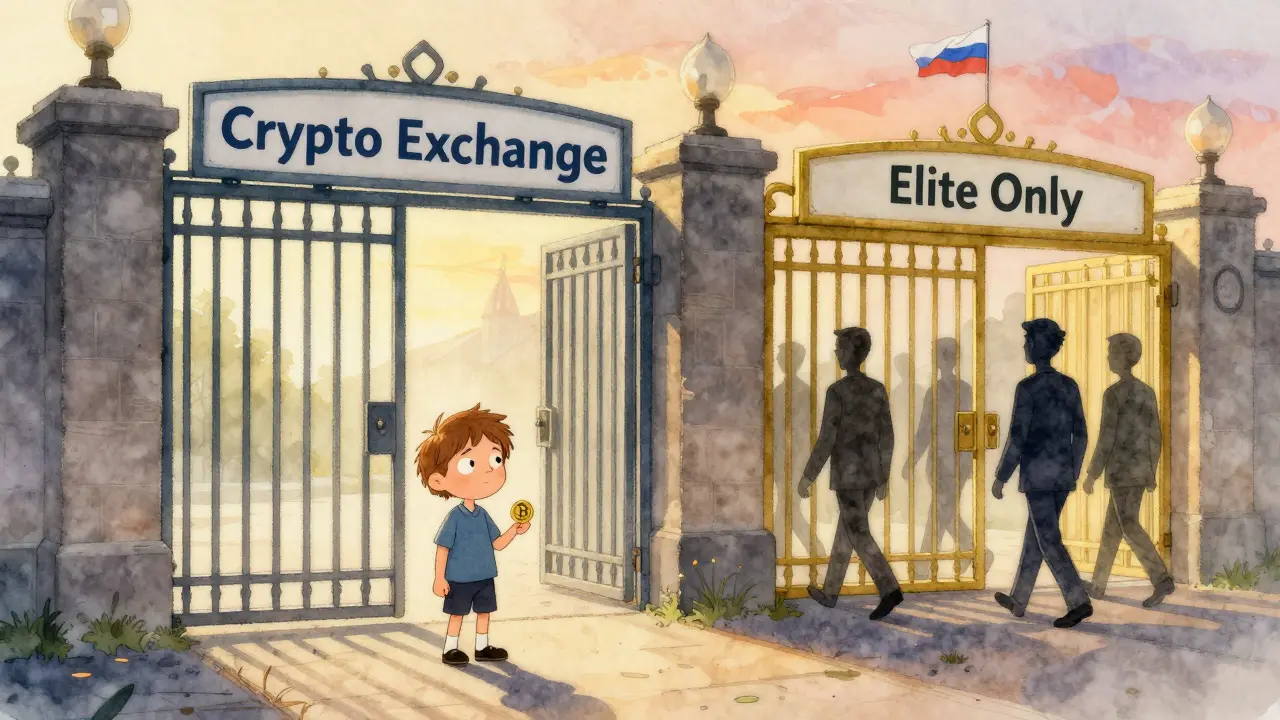
If you're a Russian citizen trying to buy, sell, or hold cryptocurrency in 2025, you're navigating one of the most hostile regulatory environments in the world. It's not that crypto is illegal - it's that the system has been designed to make it nearly impossible for ordinary people to participate legally. While the government quietly lets a handful of elite investors and sanctioned companies use digital assets for international trade, the average Russian faces blocked bank accounts, impossible verification checks, and the constant threat of having their money frozen by exchanges complying with Western sanctions.
What’s Actually Allowed for Russian Citizens?
The Russian government doesn’t outright ban owning Bitcoin or Ethereum. But owning it and being able to use it are two completely different things. Since January 2021, Russian law has prohibited using cryptocurrency for any domestic payments - meaning you can’t pay for groceries, rent, or even a coffee with Bitcoin, even if the seller is willing. That’s not the worst part. The real barrier is the Central Bank of Russia’s refusal to let banks, payment processors, or financial institutions support any retail crypto activity.
In 2023, the government created the Experimental Legal Regime (ELR), which lets approved companies use crypto for cross-border trade. But these companies are vetted, monitored, and tightly controlled. They’re not meant for individuals. This is a state-sanctioned loophole for sanctioned businesses to move money internationally - not a path for citizens to protect their savings or invest.
For everyone else? The rules are brutal. To legally trade crypto on a Russian-licensed platform, you’d need to be classified as a “highly qualified investor.” That means either having a portfolio worth at least 100 million rubles (about $1.1 million USD) or earning over 50 million rubles annually (roughly $550,000 USD). That’s less than 0.1% of the population. For the rest, the system is built to exclude.
How Exchanges Are Blocking Russian Users
Major global exchanges like Binance, Coinbase, and Kraken have fully complied with international sanctions. That means Russian citizens are being locked out - not just from trading, but from even accessing their accounts.
Coinbase has frozen over 25,000 Russian accounts since 2022. Users report being asked for proof of address, passports from non-Russian countries, or even bank statements from foreign institutions - documents most Russians don’t have. On Trustpilot, Coinbase has a 2.1 out of 5 rating from Russian users, mostly because their funds are stuck with no way to appeal.
Binance, once the most accessible platform for Russians, now requires full KYC verification. Before 2023, you could trade without ID. Now, Russian users face constant verification failures. A September 2025 thread on Reddit’s r/CryptoRussia with nearly 300 comments details how users are rejected for “incomplete documentation,” even when they’ve submitted everything. The platform now limits users with crypto holdings over €10,000 to minimal services - effectively freezing large balances.
Even if you get in, you’re not safe. The Bank of Russia has warned that frequent small P2P trades - the kind ordinary people use to buy Bitcoin with rubles - can trigger automatic bank account blocks. That means using LocalBitcoins or Paxful isn’t just risky - it’s legally dangerous.
The Black Market Is Booming
When legal access is shut down, people find other ways. Russia has an estimated 17.7 million crypto owners - the 8th highest in the world. But less than 13% of those transactions happen through regulated channels. The rest? Peer-to-peer (P2P) trading, crypto ATMs in underground networks, and decentralized exchanges.
P2P trading has grown 217% in Russia between 2022 and 2025, according to Chainalysis. People meet in person, use Telegram groups, or trade via messaging apps. You pay in cash or bank transfer, and the seller sends crypto. But this isn’t safe. Scams are common. Buyers get robbed. Sellers get reported to authorities. And if you trade too often, your bank may freeze your account - no warning, no explanation.
There’s also a growing underground market for fake IDs and foreign bank accounts. Some Russians pay thousands of dollars to get a passport from a Caribbean country or open a bank account in Armenia or Georgia just to bypass KYC. It’s expensive, risky, and often illegal - but it’s the only way for many to access crypto.
Why This System Doesn’t Work
The Russian government claims these restrictions protect financial stability and prevent money laundering. But the data tells a different story. In 2025, 87% of all crypto transactions in Russia occur outside regulated systems. That means the rules aren’t stopping bad actors - they’re just pushing everyone into the shadows.
Western sanctions aren’t being undermined by Russian crypto. In fact, the Bitcoin Policy Institute says Bitcoin won’t save Russia from sanctions. Large-scale laundering through crypto is expensive, slow, and easy to trace. Blockchain analytics firms like Chainalysis and Elliptic work with law enforcement globally. Every transaction leaves a trail. The real winners? Criminals and offshore middlemen - not ordinary Russians.
Meanwhile, the Russian financial system is losing out. Domestic crypto exchanges don’t exist. Innovation is dead. Young developers leave the country. Investors look elsewhere. The government’s strategy isn’t controlling crypto - it’s killing any chance of a legitimate digital economy.
What Can Russian Citizens Do Now?
If you’re trying to access crypto in Russia in 2025, your options are limited - but not zero.
- Use a VPN to access offshore exchanges. But don’t assume it’s foolproof. Many platforms now detect VPN usage and block accounts anyway.
- Try P2P platforms like LocalBitcoins or Paxful - but only trade small amounts, and never store large sums on these platforms.
- Use self-custody wallets like Ledger or Trezor. If you can get crypto in, keep it offline. Don’t leave it on an exchange.
- Learn DeFi. Decentralized exchanges like Uniswap or PancakeSwap don’t require KYC. But they’re complex. One wrong move and you lose everything.
- Don’t trust Russian “crypto banks”. Any platform claiming to be a “licensed Russian crypto exchange” is either a scam or a front for sanctioned activity.
The only people who’ve succeeded are those with international connections, advanced tech skills, and serious capital. For everyone else, crypto in Russia is a high-risk gamble with no safety net.
The Future Is Unclear
In October 2025, the Bank of Russia announced banks could start operating in the crypto sector - but only with strict limits. They can’t make it a “dominant” business. That’s not an opening - it’s a cage. The same rules still apply. The same barriers remain.
Some analysts think Russia might slowly relax rules for the wealthy. Others believe the underground market will keep growing until the system collapses under its own contradictions. Either way, the message is clear: if you’re not part of the financial elite, crypto in Russia is not a tool for freedom - it’s a trap.
The world watches as Russia tries to control something it can’t - decentralized, borderless, and unstoppable. The result? Millions of citizens are left behind, while the state builds a financial fortress with no one inside but the chosen few.

Dustin Bright
December 20, 2025 AT 08:12this is wild. i just lost my entire bag last year trying to use p2p. now i just hodl in a cold wallet and pretend it's not there. 😔
Helen Pieracacos
December 21, 2025 AT 14:15Oh, so the government is protecting us from... ourselves? Brilliant. Next they'll ban oxygen because some people breathe too hard.
Sophia Wade
December 21, 2025 AT 18:23The architecture of exclusion here is not accidental-it is epistemological. The state constructs a legal labyrinth not to regulate, but to render agency invisible. Crypto, in its essence, is a refusal of hierarchy. And hierarchies fear what they cannot control.
What we witness is not merely policy failure, but the collapse of legitimacy. When the only path to autonomy is through deception, the system has already lost.
Melissa Black
December 22, 2025 AT 01:24The ELR is a regulatory shell game. State-sanctioned crypto for oligarchs = centralization disguised as innovation. Meanwhile, retail users are forced into DeFi labyrinths with zero consumer protections. This isn't financial sovereignty-it's financial apartheid.
Steve B
December 22, 2025 AT 07:24Why do Russians even care about crypto? They should focus on fixing their own economy instead of chasing digital fantasies.
Amit Kumar
December 23, 2025 AT 17:53bro in india we have our own chaos but at least we can buy crypto on wazirx without getting our bank account shut down. russian gov is straight up evil. 🤡
chris yusunas
December 24, 2025 AT 14:34kinda feels like watching a castle get built with sand while the tide rolls in. everyone knows it’s gonna wash away but they keep shoveling anyway
Naman Modi
December 24, 2025 AT 22:47LMAO. Crypto is a scam. Just buy gold.
Tyler Porter
December 26, 2025 AT 03:30Okay, let’s take a breath. This is hard. Really hard. But you’re not alone. If you’ve got a wallet, you’ve got hope. Small steps. Keep it safe. You’re doing better than you think.
Rishav Ranjan
December 26, 2025 AT 05:50Too much text. No one cares.
Brian Martitsch
December 26, 2025 AT 06:21If you’re using P2P, you deserve to get scammed. No KYC = no accountability. Amateur hour.
Rebecca F
December 26, 2025 AT 16:29This is why the West is right to isolate them. You don’t get to have freedom while your government bombs civilians. Cry me a river.
Rachel McDonald
December 27, 2025 AT 12:49I just lost my life savings because a ‘trusted’ P2P seller vanished. Now I can’t even get my passport renewed because my bank says I’m ‘high risk’. I’m not a criminal. I’m just trying to survive.
Vijay n
December 28, 2025 AT 10:00This is all a CIA psyop to destabilize Russia. Crypto is a Western weapon. The Central Bank is just doing its job. You think Bitcoin is decentralized? It’s all controlled by Satoshi’s ghost and the NSA.
Alison Fenske
December 28, 2025 AT 15:34I used to think crypto was the future. Now I see it as a mirror. It reflects how broken the system is. We’re not fighting for money-we’re fighting to be seen as human.
Dusty Rogers
December 29, 2025 AT 14:26i read all of this. i'm just sitting here with my ledger. i don't know what to do. but i'm still here.
Kevin Karpiak
December 31, 2025 AT 06:46Russia deserves this. They invaded Ukraine. No sympathy.
Mmathapelo Ndlovu
January 1, 2026 AT 21:34i’m from south africa. we’ve had our own financial exile for decades. i see you. i feel you. the same pain, different borders. hold on. your story isn’t over yet. 🌍❤️
Grace Simmons
January 2, 2026 AT 09:43The Russian Federation has every right to enforce its monetary sovereignty. Foreign interference through decentralized finance is a national security threat.
Collin Crawford
January 4, 2026 AT 04:21You missed the point entirely. The real issue is that blockchain technology is incompatible with centralized governance. This isn't about sanctions-it's about the inevitable obsolescence of nation-states. The elites know this. That's why they're hoarding Bitcoin while you're stuck in P2P hell.
Jayakanth Kesan
January 6, 2026 AT 02:08bro i know it’s rough but you guys are still ahead of most countries. at least you have options. keep learning, keep safe, keep going. we’re rooting for you 🙌
Aaron Heaps
January 7, 2026 AT 23:31The only winners here are the blockchain analytics firms. They’re the real beneficiaries. You’re just collateral damage in a billion-dollar surveillance economy.