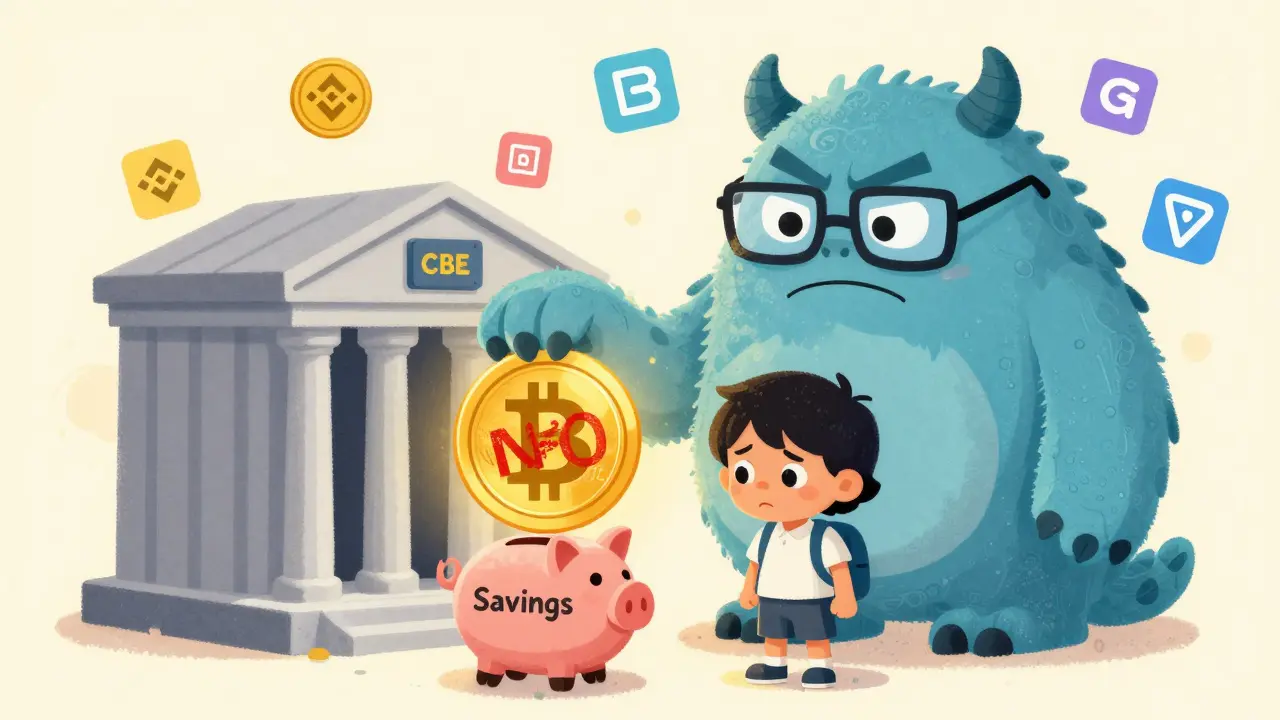
If you live in Egypt and try to send money to Binance or Bitget, your bank might freeze the transaction. Not because you did something wrong-but because Egyptian banks are legally required to stop it. Since 2020, the Central Bank of Egypt (CBE) has made it clear: no licensed bank can touch cryptocurrency. Not trade it, not promote it, not even process payments to crypto exchanges. But here’s the twist-while banks are forbidden from dealing with crypto, ordinary people still use it. And that’s where the real challenge begins.
Why Egyptian Banks Can’t Touch Crypto
The rules aren’t vague. Banking Law No. 194 of 2020 made it a crime for any financial institution in Egypt to issue, trade, or promote cryptocurrencies without CBE approval. That means if a bank employee helps a customer buy Bitcoin through a local broker, they could face criminal charges. The law doesn’t just target shady operators-it applies to every licensed bank, from National Bank of Egypt to CIB and QNB Al Ahli. The CBE didn’t just drop this rule out of nowhere. It had been warning people since 2018. But by 2020, the warnings turned into penalties. The reasoning? Cryptocurrencies lack any official backing. No central bank guarantees their value. No regulator protects your money if a platform collapses. And worst of all-crypto transactions are nearly impossible to trace. That’s a nightmare for authorities trying to stop money laundering or terrorist financing. The Financial Regulatory Authority (FRA) added fuel to the fire in May 2025. They issued a public warning about the sudden rise in online ads promoting crypto investments. These ads, often run by unlicensed influencers, promise quick profits. But the FRA stressed: if you lose money, you have zero legal recourse. Not from the bank. Not from the government. Not from any authority.How Banks Detect Crypto Transactions
Banks don’t have a button that says “block crypto.” Instead, they use complex monitoring systems that look for patterns. If you send $500 to a wallet address linked to Binance, your transaction gets flagged. If you make three small transfers in a week to different crypto exchange domains, that’s suspicious. If your account suddenly starts sending money to countries known for crypto hubs-like Turkey, Nigeria, or the UAE-that raises red flags. These systems don’t just watch for direct payments. They also track indirect signals. For example, if you regularly pay for a VPN subscription, then send money to a crypto exchange, the bank’s algorithm might connect the dots. Some banks even use third-party tools from international compliance firms to identify known crypto-related addresses and IP addresses. The result? Customers report getting calls from their bank’s compliance team. “Why did you send money to Rain?” “What is this payment for?” “Can you provide documentation?” If you can’t explain it, your account might be frozen-or worse, reported to the FRA.What Happens When You Get Caught
There’s no public list of people punished for buying crypto. But legal experts say enforcement is growing. In 2024, at least three cases were referred to prosecutors after banks flagged repeated crypto-related transfers. One man in Alexandria sent over $12,000 to Bitget over six months. His account was closed. He was asked to appear at the bank’s compliance office. He wasn’t arrested-but he lost access to his savings for weeks while the investigation ran. The real risk isn’t jail. It’s financial isolation. If your bank closes your account, getting a new one is nearly impossible. Egyptian banks share compliance data. Once you’re flagged, other institutions will hesitate to work with you. And if you try to use foreign banks, you’re still not safe. Many international banks now screen incoming transfers from Egypt for crypto-linked activity.
How Egyptians Still Access Crypto
Despite the rules, crypto use hasn’t disappeared-it’s gone underground. Egyptians still buy Bitcoin, Ethereum, and stablecoins. But they do it differently. Many use peer-to-peer platforms like Paxful or LocalBitcoins, where buyers and sellers trade directly. Payments are made through mobile wallets like Fawry or Vodafone Cash, then converted into crypto. Others use international debit cards linked to foreign accounts to buy crypto on Binance or Bybit. Some even hire intermediaries-people who collect cash in Egypt and send it abroad in small, untraceable amounts. These methods aren’t foolproof. Banks have learned to spot them. A pattern of small, irregular payments to the same mobile wallet number? Flagged. Multiple transfers to the same foreign card issuer? Flagged. Frequent use of a single VPN server location? Flagged. The irony? The more people try to hide their activity, the more attention they draw. Banks are training teams to recognize these evasion tactics. One compliance officer told a local news outlet, “We’re not trying to catch everyone. We’re trying to catch the ones who make it easy.”Why This Matters for the Economy
Egypt’s economy is under pressure. The pound has lost over 60% of its value since 2022. Inflation is above 30%. Many Egyptians see crypto as a way to protect their savings. But the government fears capital flight. If people start moving large sums out of the country to buy crypto, it could worsen the currency crisis. That’s why the CBE’s stance is so strict. It’s not just about crime. It’s about control. By blocking crypto access through banks, they keep money inside the system. They force people to use the official financial channels-even if those channels are unreliable. Meanwhile, neighboring countries like the UAE and Saudi Arabia are building regulated crypto markets. Egypt is doubling down on prohibition. Experts say this might backfire. As crypto adoption grows globally, Egyptians who want to participate will find ways-legal or not. The banks, caught in the middle, are forced to become digital detectives.
What You Should Know If You’re in Egypt
If you’re thinking about buying crypto in Egypt, here’s the reality:- Your bank will monitor your transactions. Don’t assume they won’t notice.
- Using a VPN won’t hide your payment destination. Banks track where the money goes, not how you connect.
- Stablecoins like USDT are just as risky as Bitcoin under Egyptian law.
- There is no legal protection if you get scammed. No refund. No recourse.
- Even small, occasional purchases can trigger account reviews.
What’s Next for Egypt and Crypto?
Don’t expect the rules to loosen anytime soon. The FRA’s 2025 warning was the strongest yet. Religious authorities like Dar Al-Ifta continue to say Bitcoin isn’t “real money” because it’s not issued by the state. The CBE has no plans to launch a digital currency like other central banks. Instead, they’re investing more in monitoring technology and training. Banks are hiring compliance staff with backgrounds in cybersecurity and blockchain forensics. Some are partnering with firms in the U.S. and Europe to build better detection tools. The goal isn’t to ban crypto forever-it’s to make it so hard to use through the banking system that most people give up. But as long as inflation stays high and the pound keeps falling, people will keep looking for alternatives. The battle isn’t between technology and law. It’s between survival and control.Is it illegal to buy crypto in Egypt?
No, it’s not illegal for individuals to buy or hold cryptocurrency. But it is illegal for Egyptian banks and financial institutions to facilitate those transactions. You won’t be arrested for owning Bitcoin, but if you use your bank account to send money to a crypto exchange, your transaction may be blocked, your account may be reviewed, or you could be reported to regulators.
Can Egyptian banks freeze my account for crypto activity?
Yes. Banks are required by law to monitor for crypto-related transactions. If your account shows patterns linked to crypto exchanges-like repeated transfers to Binance, Bitget, or Paxful-your bank can freeze your account temporarily while they investigate. In some cases, accounts are permanently closed if the activity is deemed suspicious or repeated.
Why do Egyptian banks block transfers to crypto exchanges?
Because the Central Bank of Egypt (CBE) banned banks from dealing with cryptocurrency under Banking Law No. 194 of 2020. Banks must prevent any activity that supports crypto trading, including payments to known exchange wallets. Failure to comply can result in fines, license suspension, or criminal charges for bank employees.
Are stablecoins like USDT treated the same as Bitcoin in Egypt?
Yes. Egyptian regulators treat all cryptocurrencies the same, regardless of whether they’re volatile like Bitcoin or stable like USDT. Any transaction tied to a crypto wallet or exchange is subject to monitoring and potential blocking. Stablecoins are not considered legal tender and offer no regulatory protection.
Can I use a foreign bank account to buy crypto without getting flagged?
Not reliably. Egyptian banks monitor outbound transfers to countries known for crypto activity, even if the money goes to a foreign account. If your transfers follow patterns linked to crypto purchases-such as regular payments to the same foreign bank or payment processor-you may still be flagged. Some banks now use third-party tools that detect these patterns automatically.
What should I do if my bank asks why I sent money to a crypto exchange?
Be honest but cautious. If you’re using your account for crypto, you risk having your account closed or reported. If you’re not involved in crypto, explain the real reason-like paying for a service, online purchase, or family support. Never lie to your bank. Compliance officers are trained to spot inconsistencies. A clear, truthful explanation is your best protection.
Is there any legal way to invest in crypto through Egyptian banks?
No. As of 2026, no Egyptian bank offers legal crypto investment products. All forms of crypto trading, staking, or lending through local financial institutions are prohibited. Any service claiming to offer regulated crypto access in Egypt is either misleading or operating illegally.
How do Egyptian banks know if I’m using crypto?
Banks use transaction monitoring software that identifies known crypto exchange wallets, payment processor domains, and suspicious transfer patterns. For example, multiple small transfers to the same overseas address, or payments to platforms like Bitget or Rain, trigger alerts. Some banks also partner with global compliance firms that track blockchain activity linked to Egyptian IP addresses or bank accounts.


Rachel Stone
January 28, 2026 AT 14:05So banks are basically AI-powered crypto snitches now? Cool.
Gurpreet Singh
January 29, 2026 AT 14:46This is why I use P2P with Fawry. No bank account involved. Just cash in hand, QR code, done. Simple.
Elizabeth Jones
January 30, 2026 AT 16:48The real tragedy isn't the ban-it's that the state assumes control equals stability. But control without trust is just a cage. People don't flee crypto because they're reckless-they flee because the system failed them first.
Pamela Mainama
January 31, 2026 AT 04:18Inflation hits hard. People aren't choosing crypto because it's cool-they're choosing it because it's the only thing that doesn't vanish overnight.
Will Pimblett
February 1, 2026 AT 08:13Let me guess-next they'll ban WhatsApp because it's 'unregulated'. Classic.
Freddy Wiryadi
February 2, 2026 AT 18:48I used to think VPNs were just for Netflix... now they're my financial lifeline. 🤷♂️
Richard Kemp
February 3, 2026 AT 10:04my bank called me last week after i sent 200 to binance. i said it was for a 'web hosting service' and they just said 'ok' and hung up. i think they're tired of this game too.
laurence watson
February 4, 2026 AT 06:36I just want to say-this isn’t about crime. It’s about fear. Fear of losing control. Fear of people finding a way out. But you can’t stop people from seeking safety, especially when the system they’re told to trust keeps failing them. I’ve talked to so many Egyptians who are just trying to feed their families. Crypto isn’t their dream-it’s their backup plan.
Meenal Sharma
February 5, 2026 AT 10:33This is all part of the New World Order’s plan to digitize and track every dollar. The CBE isn’t protecting citizens-it’s preparing them for the Great Reset. Mark my words: next they’ll require biometric verification to buy bread.
Rob Duber
February 5, 2026 AT 14:33Imagine being a bank employee in Egypt. You’re stuck between a rock and a hard place: your job says ‘block crypto’ but your cousin’s kid needs to buy USDT to pay for his sister’s insulin. That’s not compliance-that’s cruelty dressed up as policy.
Brianne Hurley
February 7, 2026 AT 02:46I can’t believe people still think this is a ‘personal choice.’ You’re not just risking your account-you’re risking the entire financial ecosystem. This isn’t rebellion, it’s reckless. And honestly? It’s embarrassing to watch.
Christopher Michael
February 8, 2026 AT 09:02Banks use blockchain analytics firms like Chainalysis and Elliptic to flag crypto transactions. They don’t need to see the wallet-they just need to see the pattern: 3 transfers to ‘binance.com’ in 14 days? Flagged. 2 payments to a Nigerian Vodafone Cash number? Flagged. Even if you use a proxy, the metadata stays. It’s not magic. It’s math.
Gustavo Gonzalez
February 9, 2026 AT 17:26Let’s be real: if you’re using crypto in Egypt, you’re either a criminal, a fool, or both. The pound is garbage, sure-but that doesn’t mean you should gamble your life savings on a meme coin run by a guy in a Discord server with 12 followers. Wake up.
Edward Drawde
February 10, 2026 AT 16:31yall act like crypto is the only way out. have u heard of stocks? bonds? savings accounts? no? of course not. because you'd rather be a crypto bro than a responsible adult.
Calvin Tucker
February 12, 2026 AT 07:09The irony is that Egypt’s banks are doing the exact job the Fed should’ve done: preventing financial chaos. But instead of building a better system, they’re just blocking exits. That’s not regulation. That’s surrender.
Wayne mutunga
February 13, 2026 AT 05:04I’ve seen this play out in other countries. When you crush the informal economy, you don’t stop the behavior-you just make it more dangerous. People will find ways. The question is: will we help them do it safely? Or just punish them for trying?
Gavin Francis
February 13, 2026 AT 20:15If you're using crypto in Egypt, you're not breaking the law-you're outsmarting it. And honestly? Respect. 🙌
christal Rodriguez
February 14, 2026 AT 05:59This is all a distraction. The real issue is the government printing money like it’s confetti. Crypto is just the symptom.
Freddy Wiryadi
February 16, 2026 AT 02:23Just got a call from my bank. They asked if I was buying crypto. I said ‘no, just buying coffee online.’ They said ‘okay, have a nice day.’ I think they know. They just don’t care anymore.