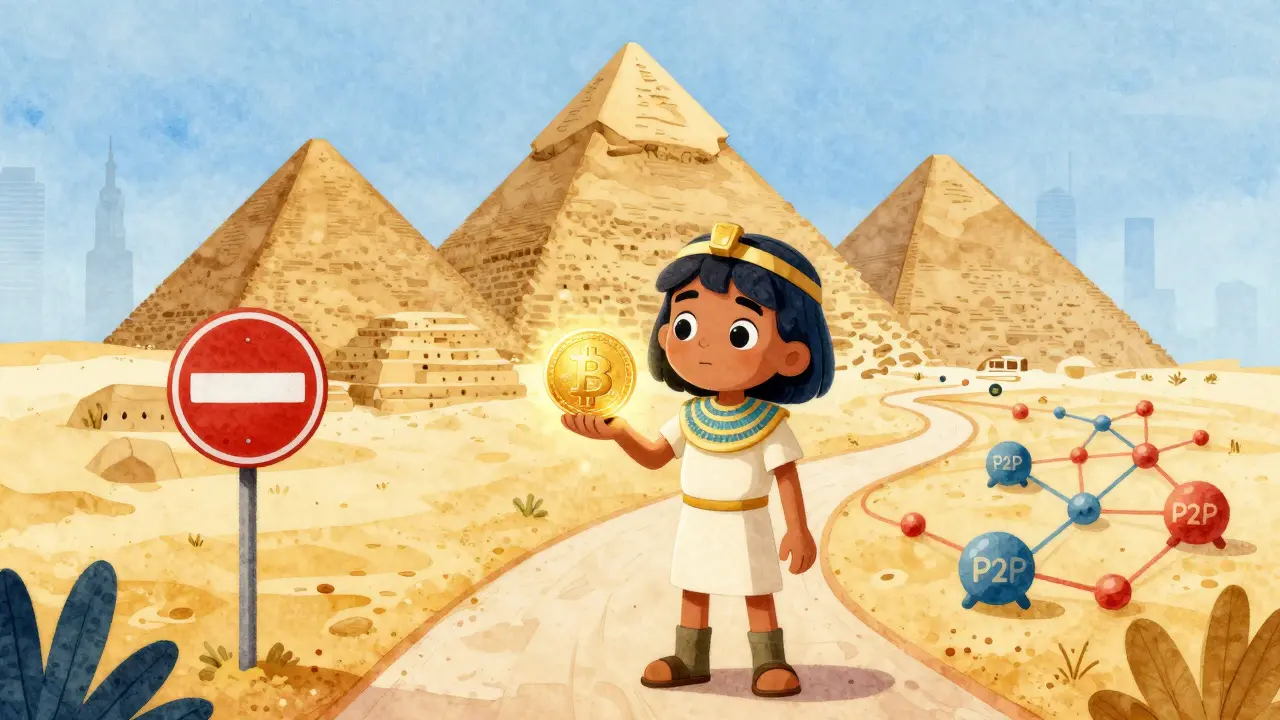
If you live in Cairo or Alexandria and want to buy Bitcoin, you can’t just walk into your local bank and ask for it. In fact, if you try to transfer Egyptian pounds (EGP) directly to a cryptocurrency exchange account, the transaction will likely get blocked. The Central Bank of Egypt has made its stance clear: traditional banks are forbidden from processing payments related to digital assets. This creates a massive problem for millions of citizens who still want to invest in crypto. So, how do they actually do it? The answer lies in a sophisticated, decentralized network known as peer-to-peer (P2P) trading.
Despite strict regulations, Egypt’s crypto market is booming. Projections suggest the market could generate $690 million in revenue by 2025, with over 11 million users actively participating. This isn’t a niche hobby anymore; it’s a vital financial tool for many Egyptians looking to hedge against inflation or access global markets. But because domestic exchanges are virtually non-existent due to regulatory pressure, traders have had to innovate. They’ve moved the activity underground, utilizing international platforms and direct user-to-user transactions that bypass the banking system entirely.
The Regulatory Gray Area: Why Trading Is Technically Restricted
To understand why Egyptians trade underground, you first need to look at the law. The primary obstacle is Law No. 194 of 2020. This legislation prohibits issuing, trading, or promoting digital currencies without prior approval from the Central Bank. Here is the tricky part: buying and selling crypto isn’t explicitly illegal for individuals. However, operating an exchange or facilitating trades without a license is strictly forbidden. This ambiguity pushes most trading activity into a gray market.
The Central Bank of Egypt (CBE) has maintained this restrictive stance since 2018. Initially, they spoke out against crypto, and by 2019, they declared that only unlicensed trading would be restricted. Today, the Banking Sector Law enforces stringent rules that make it nearly impossible for local companies to operate licensed crypto exchanges. As a result, Egyptians cannot rely on domestic infrastructure. They must look abroad. This legal vacuum forces users to self-regulate and stay constantly informed about evolving guidelines to avoid potential legal repercussions.
Religious considerations also play a subtle role in this landscape. Historically, Dar al-Ifta, the official body for Islamic jurisprudence in Egypt, declared Bitcoin haram (forbidden). However, recent interpretations have softened this stance. Many scholars now argue that crypto could be considered halal (permissible) if it is properly regulated and economically safe. This shift has helped legitimize crypto adoption among conservative communities, provided the trading methods align with Islamic finance principles, such as avoiding interest-based lending.
How P2P Trading Works in Egypt
Since banks won’t help, traders use Peer-to-Peer (P2P) platforms. These platforms act as intermediaries that connect buyers and sellers directly. You don’t send money to the exchange; you send it to another person’s bank account. The exchange holds the crypto in escrow until both parties confirm the transaction. This method effectively bypasses the Central Bank’s restrictions on institutional crypto transfers because the funds move between personal accounts, often labeled as generic transfers like "family support" or "goods purchase."
The process typically follows these steps:
- Select a Platform: Traders choose an international exchange that supports EGP and P2P trading.
- Choose a Merchant: Buyers browse a list of verified sellers based on completion rates and response times.
- Initiate Trade: The buyer locks the crypto amount on the platform. The seller provides their bank details.
- Transfer Funds: The buyer sends EGP via bank transfer, mobile wallet, or cash deposit to the seller’s account.
- Release Crypto: Once the seller confirms receipt of funds, they release the crypto from escrow to the buyer’s wallet.
This model offers flexibility. Traders can use various payment methods, including NILE PAY, Vodafone Cash, or direct bank transfers. It also allows for negotiation on prices, though most trades happen close to the market rate. The key advantage is speed and accessibility. You can buy crypto within minutes without needing a foreign currency card or navigating complex international wire transfers.

Top Platforms for Egyptian Traders
Not all exchanges work well in Egypt. Due to banking blocks, many popular global platforms restrict Egyptian users. However, a few key players dominate the underground market because they offer robust P2P ecosystems and support for the Egyptian Pound.
| Platform | Key Feature | Fee Structure | Payment Methods | Best For |
|---|---|---|---|---|
| Bybit | Zero P2P fees, Arabic interface | 0% P2P, 0.1% Spot | Bank Transfer, Apple Pay | Retail Traders |
| Binance | Largest liquidity, diverse options | Variable maker/taker | Vodafone Cash, Fawry | High Volume Traders |
| Bitget | User-friendly app, copy trading | Low spot fees | Local Bank Transfers | Beginners |
| Gate.io | Wide altcoin selection | Standard exchange fees | Multiple EPG channels | Altcoin Hunters |
Bybit has emerged as a favorite among Egyptian traders. It offers zero transaction fees on its P2P marketplace and supports multiple EGP deposit methods, including bank transfers and even Apple Pay. Crucially, it provides an Arabic interface and Shariah-compliant trading options, which addresses cultural and linguistic needs. Another major player is Binance, which remains the largest global exchange. Despite occasional regulatory pressures, Binance continues to offer diverse EGP deposit options through local payment providers like Vodafone Cash and Fawry, making it accessible to those without traditional bank accounts.
For more specialized traders, Gate.io offers access to over 3,700 cryptocurrencies, providing extensive selection options beyond just Bitcoin and Ethereum. Meanwhile, OKX is often recommended for institutional players or high-net-worth individuals who require advanced security features and larger trade volumes. Each platform has its strengths, but they all share one common goal: enabling Egyptians to trade despite the lack of local regulation.
Security Risks and How to Mitigate Them
Trading underground comes with risks. Since you’re operating in a regulatory gray area, you don’t have the protection of local consumer laws. If a seller scams you, you can’t call the police and expect them to recover your funds easily. Therefore, security is paramount. Traders must prioritize platforms with strong protocols, including two-factor authentication (2FA) and cold storage capabilities.
Here are the most common risks and how to handle them:
- Scams: Sellers may claim they haven’t received payment even after you’ve sent it. Always keep screenshots of your bank transfer confirmation. Never release crypto from escrow until you see the funds in your own account.
- Account Freezes: Banks may freeze your account if they detect frequent large transfers to unknown individuals. To mitigate this, vary your transaction amounts and avoid round numbers. Use different bank accounts if possible.
- Platform Bans: International exchanges can suddenly restrict Egyptian users due to regulatory changes. Always withdraw your funds regularly to a private wallet rather than leaving large sums on the exchange.
- Phishing: Hackers target active traders. Enable hardware keys or authenticator apps for 2FA. Never share your seed phrase with anyone, not even customer support.
Reputation matters. On P2P platforms, merchants build up completion rates and reviews. Only trade with merchants who have high completion rates (above 95%) and thousands of completed orders. New accounts with no history are risky. Additionally, communicate only within the platform’s chat system. This ensures that if a dispute arises, the platform’s customer support team has a record of the conversation to adjudicate fairly.
The Future of Crypto in Egypt: Will Regulations Change?
As of 2026, there is no sign of imminent regulatory clarity for retail crypto trading in Egypt. The government has explored blockchain technology for other purposes-such as supply chain management, land registration, and digital identity verification-but this doesn’t translate to permission for public crypto trading. The Central Bank maintains its restrictive stance on unlicensed operations.
However, the demand is too strong to ignore. With a projected user base of 11.3 million people, the underground ecosystem is likely to persist and evolve. Industry experts anticipate continued growth in P2P trading solutions as traditional banking restrictions remain in place. We might see the emergence of more localized fintech solutions that attempt to bridge the gap between traditional banking and crypto, perhaps through regulated stablecoins or central bank digital currencies (CBDCs), though this remains speculative.
For now, the underground market is the reality. Traders must remain agile, adapting to new banking policies, platform updates, and security threats. The community is highly engaged, sharing tips on Telegram groups and forums about which payment methods are currently working and which banks are tightening their scrutiny. This collective intelligence is what keeps the market alive.
Practical Tips for New Egyptian Traders
If you’re new to this space, start small. Don’t invest money you can’t afford to lose, especially given the volatile nature of both crypto prices and regulatory environments. Here is a checklist to get started safely:
- Verify Your Identity: Complete KYC (Know Your Customer) requirements on your chosen platform. While it feels counterintuitive to give ID data when trading underground, reputable platforms require it to prevent fraud.
- Start with Stablecoins: Consider buying USDT (Tether) first. It’s pegged to the US dollar and less volatile than Bitcoin. It’s easier to sell back to EGP later.
- Use Multiple Payment Channels: Don’t rely on just one bank or mobile wallet. Have backups ready in case one channel gets blocked.
- Monitor Exchange Rates: P2P prices fluctuate based on supply and demand. Compare prices across Bybit, Binance, and Bitget before executing a large trade.
- Stay Informed: Follow reliable news sources about Egyptian financial regulations. Sudden policy changes can impact your ability to withdraw funds.
Remember, you are responsible for your own security. There is no safety net. Treat every transaction with caution, double-check details, and never rush. The convenience of P2P trading shouldn’t overshadow the importance of diligence.
Is it illegal to buy crypto in Egypt?
Buying crypto itself is not explicitly illegal for individuals under current Egyptian law. However, Law No. 194 of 2020 prohibits operating exchanges or promoting crypto without Central Bank approval. This creates a gray area where individual trading is tolerated but lacks legal protection. Banks are forbidden from facilitating these transactions, forcing users to use P2P methods.
Which P2P platform is best for Egyptians?
Bybit is widely considered the best option due to its zero P2P fees, Arabic interface, and support for local payment methods like Apple Pay and bank transfers. Binance is also popular due to its high liquidity and support for Vodafone Cash and Fawry. Choose based on your preferred payment method and comfort level with the platform.
Can my bank account be frozen for trading crypto?
Yes, there is a risk. Egyptian banks monitor transactions for suspicious activity. Frequent transfers to unrelated individuals, especially around crypto price spikes, can trigger freezes. To reduce risk, vary transaction amounts, avoid round numbers, and maintain normal banking behavior alongside your crypto trades.
How do I avoid scams on P2P platforms?
Only trade with verified merchants who have high completion rates and positive reviews. Communicate exclusively through the platform’s chat system. Never release crypto from escrow until you have confirmed receipt of funds in your bank account. Keep screenshots of all transactions and communications as evidence in case of disputes.
Is crypto halal in Islam according to Egyptian scholars?
Initially, Dar al-Ifta declared Bitcoin haram. However, recent interpretations suggest it can be halal if it is properly regulated, economically safe, and used for legitimate transactions. Many Egyptian traders now view crypto as permissible, especially when using Shariah-compliant trading options available on platforms like Bybit.

Jan Gilmore
May 11, 2026 AT 13:57You think this is just about Egypt? Please. The entire global banking system is a house of cards waiting to collapse because they refuse to adapt. I’ve been trading on P2P since 2019 and let me tell you, the 'underground' market is actually more transparent than your local bank’s fee structure. Banks are parasites. They charge you for nothing while hiding behind regulations designed to protect their monopoly. Bybit isn’t just a platform; it’s a lifeline for anyone who understands that fiat currency is a joke. Stop listening to the fear-mongers and start looking at the liquidity charts. The truth is out there if you aren’t too scared to read it.
Samara McCallum
May 12, 2026 AT 22:34it is interesting how we define freedom when money moves through shadows instead of light
i suppose the gray area is where most people live anyway
not black or white but something in between
like the air we breathe
Gavin Wonnacott
May 13, 2026 AT 00:52Oh, look at you, Samara, playing deep with your little poetry. You’re missing the point entirely. This isn’t a philosophical debate about the nature of existence; it’s about survival in a broken economic system. While you sit there contemplating the 'shadows,' Egyptians are losing their savings to inflation every single day. Your pretentious nonsense is exactly why people ignore the real issues. Get off your high horse and realize that 'gray areas' are where the actual work gets done. It’s not poetic; it’s practical. And frankly, your lack of urgency is insulting to those actually fighting for financial autonomy.
Tricia Alach
May 14, 2026 AT 20:34i mean its kinda scary how easy it is to get banned though
my cousin lost his whole account just because he sent too much money at once
but i guess thats the risk u take right
maybe they should just use cash more often?
Sheldon Friesen
May 15, 2026 AT 14:28Tricia! Oh, Tricia! You have touched upon a very sensitive nerve indeed!!!
The issue of account freezes is not merely a 'scary' anecdote; it is a systemic flaw in the current banking architecture!!! When you send round numbers like 10,000 EGP, you are literally waving a red flag at the algorithmic watchdogs!!! You must vary your amounts!!! You must be clever!!!
I cannot stress enough how important it is to use multiple channels!!! If Vodafone Cash goes down, do you have Fawry ready??? Do you have a backup bank account from a different institution??? No??? Then you are gambling with your livelihood!!! Wake up!!! The banks are watching!!!
Caique Muniz
May 16, 2026 AT 14:41lol another article telling us how to break the law
why do these sites always sound so serious about illegal stuff
its just crypto bro
everyone knows binance is fine
stop making it complicated
robert Whitehead
May 17, 2026 AT 02:28You ignorant fool. Binance is not 'fine.' Binance is a ticking time bomb for Egyptian users. Do you think the Central Bank doesn’t have eyes on every transaction routed through their servers? You call it 'just crypto,' but I call it reckless endangerment of your own financial future. The fact that you dismiss the legal risks shows a profound lack of understanding of both international finance and local jurisprudence. Law No. 194 is not a suggestion; it is a prohibition. Your casual attitude is precisely what leads to mass confiscations. Educate yourself before you speak.
Bradley Geldenhuys
May 17, 2026 AT 09:44look man robert is being a bit harsh but hes right about the risk
u gotta respect the game
crypto is wild west
if u dont know the rules u get shot
simple as that
keep ur head down and trade smart
Kiran CS
May 19, 2026 AT 00:38One must observe the sheer audacity of such informal discourse. To suggest that one can simply 'trade smart' without acknowledging the intricate web of regulatory compliance is absurd. The concept of an 'underground' market is inherently flawed because it implies a legitimacy that does not exist. In reality, it is a parasitic activity that undermines the sovereign monetary policy of the nation. One should perhaps consider reading a book on macroeconomics rather than engaging in such trivial digital barter. It is quite pathetic, really.
Bijan Das
May 19, 2026 AT 03:22yeah sure kirans
you love talking big but i bet u never traded a cent
probably still using checks
typical elitist bullshit
go back to your library
Ashley Rodriguez
May 20, 2026 AT 03:57i was thinking about how hard it must be for the sellers too
they have to deal with all these angry buyers and banks freezing accounts
and they still have to keep their completion rate high
its a lot of pressure
maybe we should be nicer to them
instead of blaming everyone else
it seems like a tough job honestly
Bridget Coogle
May 20, 2026 AT 16:13ashley you are so right
we forget the human element
these merchants are taking huge risks
they deserve respect
let's try to be kinder
it makes the community better
thanks for saying that
Zara Zaman
May 22, 2026 AT 09:57This is disgusting. Foreigners commenting on Egyptian financial struggles like it’s a spectator sport. You don’t understand the pain of living under sanctions and strict capital controls. It’s not a 'game' for us. It’s survival. Keep your opinions to yourselves unless you’ve lived here. We don’t need your pity or your unsolicited advice. Go home.
Larry Port
May 23, 2026 AT 12:30Zara, I hear your frustration. It is valid. But anger won’t solve the problem. Information will. That is why articles like this are important. They share knowledge. Not pity. Knowledge. How to use Bybit. How to avoid scams. How to keep funds safe. These are tools. Use them. Don’t let hate blind you to the solutions available. Stay safe. Stay informed.
Jocelyn Garcia
May 24, 2026 AT 03:10the liquidity depth on bybit p2p is actually insane right now
way better than binance for epg pairs
slippage is minimal even on larger orders
just make sure u verify the merchant history properly
otherwise u might get stuck in escrow limbo
which sucks
Amit Varpe
May 24, 2026 AT 16:15india has similar issues with crypto
but our banks are even worse
they freeze everything instantly
so i feel for the eg guys
but yeah bybit is good
use it 😎
Bronwen Butler
May 25, 2026 AT 06:57bybit is overrated
binance has better volume
always has
people just follow trends
without understanding basics
stick to the biggest player
less risk
Michael Berggren
May 25, 2026 AT 14:47I completely agree with Bronwen 🙌 Binance is the giant for a reason. The liquidity is unmatched. However, for smaller transactions in Egypt, Bybit’s zero-fee model is a game-changer 💸. It’s not about following trends; it’s about optimizing costs. Both platforms have their place. Diversity is key in crypto 🚀. Stay safe out there!
Mike S
May 26, 2026 AT 15:37Oh, look at Michael, trying to be the peacemaker with his little emojis. 'Diversity is key'? Please. In a war zone, diversity gets you killed. You either pick the safest route or you get robbed. And let me tell you, leaving money on any exchange is suicide. Withdraw to cold storage. Every. Single. Time. Your optimism is naive and dangerous. Grow up.
H F
May 26, 2026 AT 20:24Mike, calm down! There is no need for such aggression! 😱 The point is that we all have different risk tolerances! Some people prefer the convenience of exchanges for small trades, while others go full HODL mode! It’s not black and white! Let’s celebrate the variety of strategies! That’s what makes the community vibrant! ✨