Every year, $1.82 trillion worth of fake products flood the market. Watches that look like Rolexes but cost $20. Designer handbags made in back-alley factories. Wine bottles with counterfeit labels that could be toxic. These aren’t just scams-they’re dangerous, and they’re everywhere. Traditional labels, holograms, and paper certificates? Easy to copy. Easy to lose. Easy to ignore. But what if your product came with a digital fingerprint you could verify with your phone-something no one could forge, delete, or alter? That’s where NFTs come in.
What NFTs Actually Do for Product Authenticity
NFTs aren’t just digital art you buy for thousands of dollars. At their core, they’re unique, unchangeable digital certificates. Think of them like a birth certificate for a physical product. Once a product is linked to an NFT on the blockchain, that connection is permanent. No one can change it. No one can fake it. The NFT holds all the proof: where it was made, who made it, when it shipped, who owned it before you, and even if it was repaired or resold. This isn’t theoretical. In January 2023, customs officials in Europe seized over $686,000 worth of fake luxury goods in a single raid. That’s just one snapshot. Brands are losing billions-not just in sales, but in trust. NFTs fix that by turning every product into a verifiable digital twin.How It Works: From Factory to Your Doorstep
Here’s how it actually works in practice. Let’s say a luxury watchmaker creates a new model. Before it leaves the factory, they assign it a unique NFT. That NFT is stored on a blockchain-probably Ethereum, Polygon, or a private enterprise chain like VeChain. The NFT includes:- Serial number
- Manufacturing date and location
- Materials used
- Quality control checks passed
- First owner’s details
- Any service or repair history
Why This Beats Old-School Authentication
Old methods? Holograms, serial numbers on paper, certificates in envelopes. All of them can be duplicated. A fake Rolex might come with a fake certificate that looks real. A counterfeit bottle of wine might have a fake barcode. But blockchain doesn’t work that way. Once data is written to the blockchain, it’s locked in. It can’t be edited. It can’t be deleted. And it’s visible to anyone with the right tools. That’s the key difference. No central authority controls it. No one can bribe a clerk to issue a fake certificate. The system is trustless, meaning you don’t have to trust the brand-you can verify the facts yourself. Take the wine industry. A single barrel of rare Bordeaux sold for $130,000 in 12 seconds-not because of the wine, but because the buyer got the NFT tied to it. That NFT proved the wine came from a specific vineyard, was aged in a specific barrel, and had never been opened or tampered with. Buyers weren’t just paying for wine. They were paying for certainty.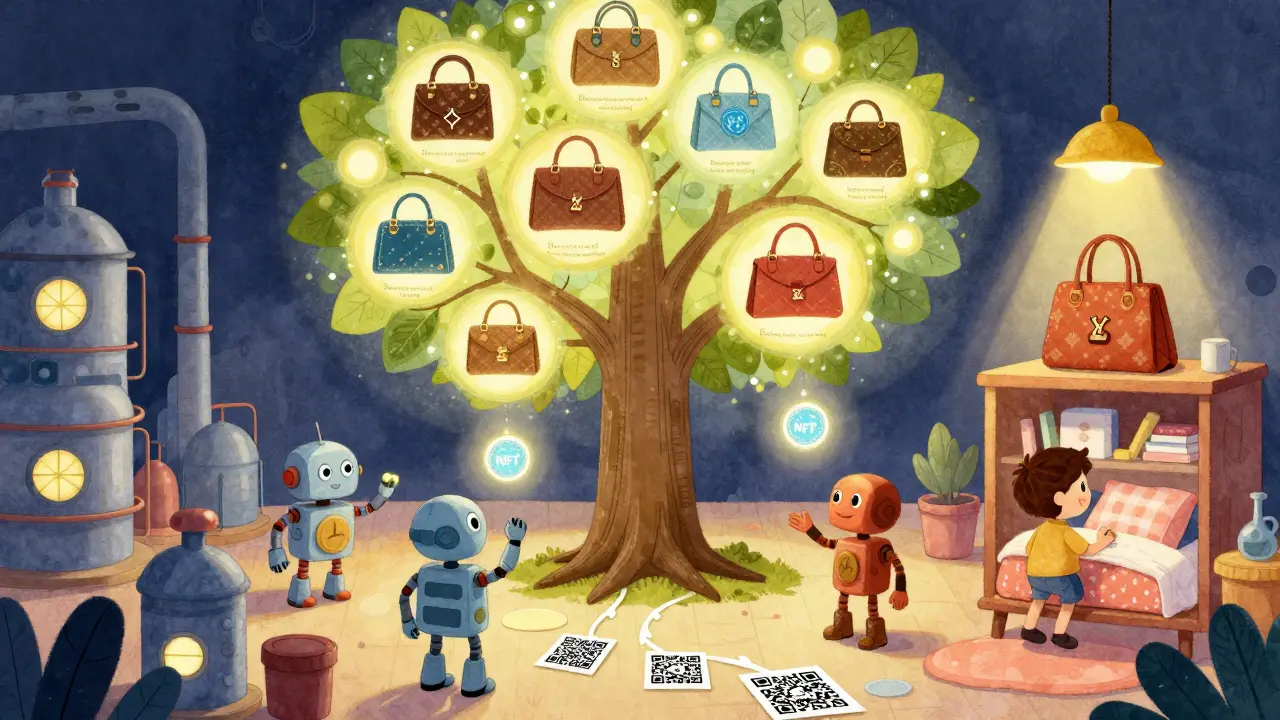
Who’s Using It Right Now
Luxury brands are leading the charge. Gucci, Louis Vuitton, and Prada have all launched NFT-based authentication systems. But it’s not just fashion. - Automotive: Companies like BMW and Porsche use blockchain to track parts and service history. If you buy a used Porsche, you can see every repair, every oil change, every recall. - Pharmaceuticals: In the U.S. and EU, drug manufacturers are testing NFTs to stop counterfeit medicines. A fake pill could kill you. An NFT can tell you it’s real. - Electronics: Apple and Samsung are exploring blockchain to verify refurbished devices and prevent fake chargers or batteries. - Real estate: Property deeds are being tokenized in places like Dubai and Switzerland. Your home’s ownership history is stored on-chain, making fraud nearly impossible. Even art galleries are using it. A painting might have an NFT that proves it was exhibited in a specific museum, owned by a known collector, and appraised at a certain value. That’s not just proof of authenticity-it’s proof of legacy.The Catch: It’s Not Perfect Yet
NFTs aren’t magic. They’re tools. And tools need to be used right. First, the tech has to be simple. If you have to download an app, create a wallet, understand gas fees, and navigate a blockchain explorer just to check if your sneakers are real-most people won’t bother. The best systems hide all that complexity. You scan a QR code. A green checkmark appears. Done. Second, it’s expensive to implement. A small brand can’t afford to build a blockchain system from scratch. That’s why platforms like VeChain, Aura, and ConsenSys offer plug-and-play solutions. They handle the tech. The brand just adds the NFT at the end of production. Third, consumer education is still weak. Many people think NFTs are just JPEGs. They don’t know how to verify them. Brands that succeed are the ones that explain it clearly: “Scan this code to see your product’s story.” They use simple icons, videos, and step-by-step guides. And finally, if the QR code is removed or the RFID chip is damaged, the NFT still exists-but the physical link is broken. That’s why top brands embed the NFT in multiple places: the tag, the packaging, the manual, and even the warranty card.
What’s Next for NFT Authentication
The next wave is automation. Imagine your smart fridge detects your milk carton’s NFT, checks its expiration date, and alerts you if it’s fake. Or your car’s system verifies the authenticity of every replacement part before allowing it to be installed. IoT sensors are already being paired with NFTs in high-end warehouses and shipping containers to track temperature, humidity, and location in real time. By 2030, experts predict most high-value goods will come with blockchain-based authenticity. Governments are starting to require it for pharmaceuticals and food imports. Insurance companies are offering lower premiums for products with verified NFTs. Banks are using them as collateral for loans. The goal isn’t to replace barcodes. It’s to replace lies with facts.Why This Matters for You
If you buy expensive things-watches, jewelry, art, cars, wine, electronics-you’re already at risk. Fake products aren’t just a problem for brands. They’re a problem for you. You could pay $1,000 for a “limited edition” sneaker that’s worth $50. You could drink wine that’s been tampered with. You could use a phone charger that catches fire. NFTs give you power. The power to know. The power to verify. The power to say, “I don’t trust the seller-I trust the blockchain.” You don’t need to understand cryptography. You don’t need to own crypto. You just need to scan a code. And if the system works right, you’ll never have to wonder again if what you bought is real.Can NFTs really stop counterfeit products?
Yes-if they’re implemented correctly. NFTs don’t physically prevent someone from copying a product, but they make it impossible to fake the proof of authenticity. A counterfeit handbag can still be made, but it won’t have the blockchain NFT tied to the original. Buyers can scan the QR code and instantly see it’s fake. This shifts the risk from the consumer to the counterfeiter, who now has to fake both the product and the digital record-something nearly impossible on a secure blockchain.
Do I need cryptocurrency to use NFT product authentication?
No. You don’t need to buy, own, or trade any cryptocurrency. Most consumer-facing NFT authentication systems work through simple apps or web portals. You scan a QR code, and the system shows you the product’s history. The blockchain handles the backend. You just see a green checkmark or a timeline of the product’s journey. No wallets, no crypto keys, no fees.
What happens if I lose the QR code or packaging?
The NFT still exists on the blockchain-it’s not tied to the physical label. But without the QR code or RFID tag, you can’t easily access it. That’s why brands often link the NFT to your email or account when you register the product. If you lose the packaging, you can log into the brand’s app and find your product’s digital record. Some even let you re-link the NFT to a new tag if the original is damaged.
Are NFTs secure from hacking?
The blockchain itself is extremely secure-Ethereum and similar chains have never been hacked at the protocol level. But the weak point is usually the interface: the app, the website, or the QR code system. If a hacker tricks you into scanning a fake QR code that points to a fake NFT, you could be misled. That’s why trusted brands use official apps and avoid third-party links. Always verify you’re on the brand’s official site or app before scanning.
Can I resell a product with its NFT?
Yes, and that’s one of the biggest benefits. When you sell your watch or handbag, you can transfer the NFT to the new owner. The blockchain updates automatically, showing the new owner’s name and the date of transfer. This makes resale easier, more trustworthy, and often more valuable. Buyers are willing to pay more for a product with a clear, unbroken chain of ownership.
Why don’t all brands use NFTs yet?
Cost and complexity. Setting up a blockchain authentication system requires technical expertise, partnerships with blockchain providers, and integration into existing supply chains. For low-cost products like T-shirts or phone cases, the cost of NFTs might outweigh the benefit. But for high-value items-where counterfeiting costs millions-the ROI is clear. As platforms get cheaper and easier to use, adoption will spread to more product categories.

Don Grissett
January 4, 2026 AT 23:46NFTs for product auth? Sounds like overkill. I mean, come on. You scan a QR code and get a green check? That’s not blockchain, that’s just a fancy database. And don’t get me started on the energy waste. We’re turning every damn sneaker into a crypto asset now? 😒
Katrina Recto
January 6, 2026 AT 21:27I’ve bought fake watches before and got scammed hard. This could actually save people from getting ripped off. Scan the code, see the whole history. Simple. No fluff. Just truth.
Veronica Mead
January 7, 2026 AT 18:51The notion that blockchain can eradicate counterfeit goods is, in its essence, a fallacious capitulation to technological determinism. The physical product remains susceptible to replication; only the metadata is immutable. One must question the epistemological validity of digital provenance when the physical object is still vulnerable to subterfuge.
Mollie Williams
January 7, 2026 AT 19:43It’s funny how we’ve turned trust into a ledger. We used to believe in brands, in craftsmanship, in reputation. Now we need a blockchain to tell us our coffee mug isn’t a knockoff. Are we losing something essential when we outsource our faith to code? The NFT doesn’t make the watch beautiful-it just proves it’s not fake. But beauty? That’s still yours to feel.
Surendra Chopde
January 7, 2026 AT 22:26In India, fake medicines kill people every day. If this tech can stop that, it’s not just smart-it’s lifesaving. Even if the app is simple, even if it’s just a QR scan, it’s a start. We need this more than luxury watches.
Tiffani Frey
January 9, 2026 AT 03:42I’ve worked in supply chain logistics for 18 years. This isn’t revolutionary-it’s evolutionary. We’ve had RFID for decades. What’s new is the blockchain layer: immutable, decentralized, transparent. But the real win? Consumer education. Brands must make this idiot-proof. No jargon. Just ‘scan → verify → trust.’
Tre Smith
January 10, 2026 AT 02:54Let’s be brutally honest: this only works if the brand controls the entire chain. If the factory worker can still swap the QR code or the logistics company can tamper with the data pre-blockchain, you’re just creating a new layer of illusion. And don’t even get me started on how many people will lose their phone and think their $5,000 watch just vanished from existence.
Ritu Singh
January 11, 2026 AT 19:04They say blockchain is secure but who really owns the servers? The same banks that crashed the economy? The same governments that spy on you? This isn’t authenticity-it’s digital colonization. They want you to trust the machine instead of your own eyes. And while you’re scanning QR codes, they’re harvesting your location, your purchases, your DNA… literally
kris serafin
January 12, 2026 AT 21:23This is actually brilliant 🚀 I’ve used VeChain for my sneaker collection. Scan the tag, see the whole journey-factory, ship, warehouse, me. My mom even uses it now. She doesn’t know what blockchain is but she knows her Jordans are real. That’s all that matters.
Jordan Leon
January 14, 2026 AT 04:10The philosophical underpinning here is fascinating. We are no longer verifying objects-we are verifying narratives. The NFT is not proof of authenticity so much as it is proof of consent: consent from the manufacturer, the transporter, the retailer, the owner. It is a social contract encoded in stone.
Rahul Sharma
January 14, 2026 AT 21:24In my country, many people can't afford smartphones. So how will they verify? This tech helps rich people. But for the poor? They still buy fake because they have no choice. NFTs are not for everyone. Yet.
Gideon Kavali
January 15, 2026 AT 09:55This is exactly why America needs to lead in tech innovation-not let China or the EU dictate our standards. If we don’t own the blockchain authentication infrastructure, we’re handing our economy over to foreign powers. This isn’t about watches-it’s about national security.
Allen Dometita
January 15, 2026 AT 16:33I love this. My dad bought a used Porsche last year and scanned the NFT tag. Saw it had been in a fender bender and got repaired. Saved him $12k. Now he’s got me scanning every single thing I buy. Phone charger? Scan. Shoes? Scan. Even my coffee beans. 😆
Brittany Slick
January 16, 2026 AT 03:27There’s something quietly magical about knowing your thing has a story. Not just who made it-but where it’s been. That little digital trail? It turns a product into a legacy. And honestly? That’s worth more than the price tag.
greg greg
January 17, 2026 AT 19:37I’ve been researching this for six months now, and what’s interesting is that the blockchain doesn’t actually prevent counterfeiting-it just shifts the burden of verification from the consumer to the producer, which in theory should incentivize better supply chain practices, but in practice, it creates a new class of gatekeepers who control access to the chain, and if those gatekeepers are centralized entities like VeChain or Aura, then we’re not really decentralized at all, we’re just outsourcing trust to a different kind of corporation, which ironically mirrors the very problem we’re trying to solve with traditional certification systems, which were also controlled by centralized institutions that could be bribed or corrupted, so really, what we’re seeing here is a rebranding of surveillance capitalism under the banner of transparency, which is deeply ironic because the entire premise of blockchain was supposed to eliminate intermediaries, not create new ones with better branding.
LeeAnn Herker
January 18, 2026 AT 23:50Oh wow, so now my handbag has a digital soul? Next they’ll be selling NFT ghosts for haunted houses. And don’t tell me I don’t need crypto-sure, you say that now, but when the government mandates NFTs for all imports, you’ll be begging for a wallet. Wake up. This is step one of the digital ID takeover.
Sherry Giles
January 19, 2026 AT 10:03Canada’s already doing this with cannabis. Every bud has a blockchain tag. You think they’ll stop there? Next it’s your milk, your pills, your kids’ toys. They’re building a surveillance grid and calling it ‘trust.’ I’m not scanning anything.
Andy Schichter
January 20, 2026 AT 07:39So let me get this straight. You’re telling me the solution to fake products is… more technology? And we’re supposed to be impressed? The real problem is greed. People want cheap stuff. Fix that. Don’t make the product into a blockchain puzzle.
Caitlin Colwell
January 21, 2026 AT 10:58My grandma just got her first smartphone. She scanned her new coat and saw it came from a factory that paid fair wages. She cried. That’s the real win.
Natalie Kershaw
January 23, 2026 AT 06:25This is the future of consumer empowerment. You’re not just buying a product-you’re joining a transparent ecosystem. Brands that do this well? They get loyalty. Repeat buyers. Advocates. It’s not tech for tech’s sake. It’s trust as a business strategy. And it’s working.
Jacob Clark
January 23, 2026 AT 11:12I’ve been saying this for years-NFTs are the future of everything. EVERYTHING. Your toothbrush? NFT. Your socks? NFT. Your dog? NFT. You think I’m joking? Wait till your fridge refuses to open because your milk’s NFT expired. You’re welcome.
Jon Martín
January 25, 2026 AT 00:16This is the kind of innovation that doesn’t just fix a problem-it changes how we relate to stuff. We stop seeing things as disposable. We start seeing them as stories. And that? That’s powerful.