
Why Collateral Matters More Than the Loan Amount
In DeFi, you don’t borrow money like you do from a bank. You lock up crypto as collateral to get a loan - and if that collateral drops too much in value, you lose it. It’s not about how much you need to borrow. It’s about what you’re willing to risk losing. Most people think they’re safe if they deposit $200 to borrow $100. But if the price of their collateral crashes 30% in an hour, that $200 becomes $140 - and suddenly they’re underwater. That’s when the liquidation bots kick in.
There’s no credit check. No call from a loan officer. Just code. And if your health factor dips below the threshold, your assets get sold automatically - often at a discount - to cover the loan. This isn’t theoretical. In September 2025, over 1,200 borrowers on Compound lost their ETH positions in a single day because the price feed lagged by 90 seconds during a volatility spike. They weren’t late. They weren’t careless. They just didn’t realize their liquidation price was only 2% away.
Understanding LTV and Liquidation Thresholds
Loan-to-value (LTV) tells you how much you can borrow relative to your collateral. If you deposit $1,000 in ETH and the platform allows a 70% LTV, you can borrow up to $700. Simple. But here’s what no dashboard makes obvious: your liquidation threshold is almost always higher than your LTV.
For example, Aave might let you borrow at 75% LTV on ETH, but the liquidation threshold is 80%. That means if your loan balance hits 80% of your collateral’s value, you’re in danger. That 5% gap sounds safe - until the market moves fast. During the 25% Bitcoin drop in September 2025, users who were at 78% LTV on volatile assets got liquidated within minutes. Why? Because the price feed didn’t update instantly. The system saw your position as safe - until it didn’t.
Stablecoins like USDC are the exception. They often allow 85-90% LTV because their price doesn’t swing. But if you’re using SOL, AVAX, or even stETH, treat every 1% drop like a warning siren. The higher the volatility, the tighter your buffer needs to be.
Which Assets Are Safe as Collateral?
Not all crypto is equal when it comes to collateral. Here’s how major platforms rate them as of late 2025:
| Asset | Max LTV (Aave) | Max LTV (Compound) | Liquidation Threshold | Notes |
|---|---|---|---|---|
| USDC | 85% | 75% | 80% | Most stable. Highest borrowing power. |
| ETH | 75% | 70% | 78% | Widely accepted. Volatility makes it risky. |
| stETH | 70% | 65% | 75% | Lower LTV due to redemption delays. |
| SOL | 65% | Not supported | 80% | High volatility. Kamino offers 75% LTV. |
| SHIB | 55% | Not accepted | 65% | Almost never used. High risk, low reward. |
Stablecoins are your best friend. They give you room to breathe. ETH is the next best thing - but only if you’re not borrowing close to the max. Anything else? Proceed with caution. Meme coins? Avoid them entirely. Even if a platform lets you use them, the liquidation risk is sky-high. In October 2025, a user on Kamino lost 8.2 SOL because they thought a 2% buffer was enough. The price dropped 15% in two hours. Liquidation hit at 80% LTV. They were at 78% - and still got wiped out.

Platform Differences: Aave vs. Compound vs. Kamino
Not all DeFi platforms are built the same. Your choice of platform changes how you manage collateral.
Aave offers the widest range of collateral - over 30 assets across 15 chains. It’s great if you’re holding tokens from different ecosystems. But that flexibility comes with complexity. Aave’s health factor isn’t just LTV. It includes price feeds, asset correlation, and even bridge risks. If you’re using ETH from Arbitrum and USDC from Polygon, you’re exposed to cross-chain delays. Aave V4, launching in early 2026, will fix this with real-time cross-chain monitoring.
Compound is the conservative choice. Its isolated markets mean each asset is treated like its own vault. If ETH crashes, your USDC loan stays safe. But that also means you can’t use your ETH as collateral for a USDC loan - you have to deposit it separately. Compound’s 70% LTV on ETH feels safe, but remember: in September 2025, 1,247 people got liquidated because the price oracle froze. Their position was technically fine - until the feed updated and the system realized they were underwater.
Kamino dominates on Solana. If you’re holding SOL, this is your go-to. It offers 75% LTV on SOL and 90% on USDC. But Kamino’s liquidation penalty can go up to 10% - meaning you lose more than just your collateral. You also pay a fee. And if you’re using SOL, you’re betting on Solana’s stability. When Solana went down in May 2025, Kamino users couldn’t withdraw or repay loans for 14 hours. That’s not a risk you can ignore.
How to Avoid Getting Liquidated
Here’s what actually works - based on real user behavior and data from 12 million DeFi loans:
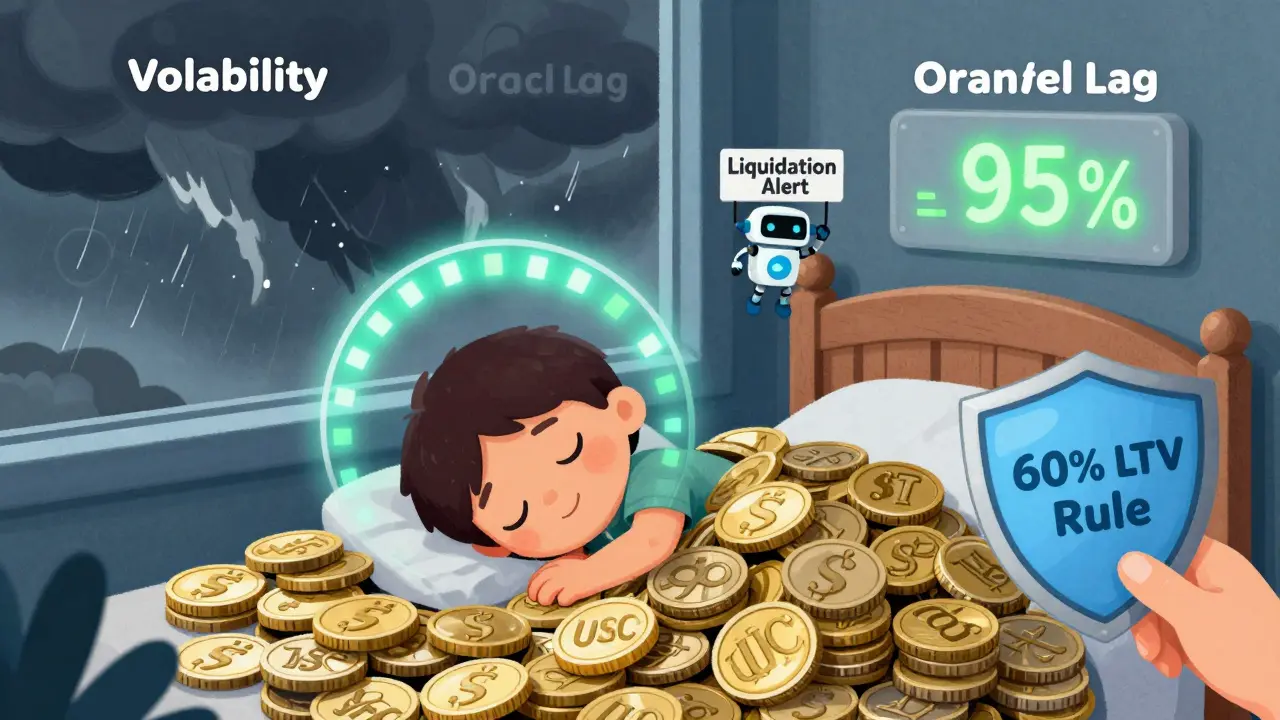
- Never borrow above 60% LTV on volatile assets. Even if the platform allows 75%, stay below 60%. That gives you a 15% buffer for price swings.
- Use multiple types of collateral. Borrowers who used only ETH saw 43% more liquidations during the August 2025 crash than those who mixed ETH with USDC and stETH. Diversification isn’t just for stocks - it’s for crypto loans too.
- Set alerts at 15% below your liquidation threshold. If your liquidation point is 80%, get notified at 65%. That gives you hours to act, not minutes.
- Check your liquidation price manually. Platforms show you a “health factor” - but it’s often outdated. Use this formula: Liquidation Price = (Collateral Amount × Liquidation Threshold) ÷ (Debt Amount × Current Price). Do it yourself. Trust no dashboard during a crash.
- Avoid borrowing between 2-5 AM UTC. That’s when most liquidations happen. Volume is low. Oracles lag. No one’s watching. If you open a position then, you’re gambling.
One user on Reddit posted: “I lost $18,000 because I trusted Aave’s dashboard. I was at 77% LTV. I thought I was safe. I didn’t check the math. The price feed was wrong for 47 minutes. When it updated, I was gone.”
What to Do If You’re Already Close to Liquidation
If your health factor is below 85%, you’re in danger. Don’t panic. Here’s your action plan:
- Add more collateral. Deposit more ETH, USDC, or stETH. Even a small amount can push you back above the threshold.
- Repay part of your loan. Paying back $500 might be cheaper than losing $5,000 in collateral.
- Switch to a higher-LTV asset. If you’re using SOL as collateral and your LTV is too high, swap some of it for USDC. That instantly improves your ratio.
- Don’t wait for a price rebound. If the market is falling, waiting is a trap. The longer you wait, the deeper you go.
There’s no second chance. Once liquidation starts, it’s irreversible. You can’t cancel it. You can’t appeal. The smart money acts before the system does.
Future Trends: What’s Changing in 2026
DeFi is evolving fast. Aave V4, launching in Q1 2026, will adjust LTVs automatically based on real-time volatility. If ETH starts swinging wildly, the system will lower your borrowing limit - without you doing anything. Compound is testing circuit breakers that pause liquidations during extreme price moves. MakerDAO is using AI to assess new collateral types before they’re added.
But the biggest shift? Real-world assets. Tokenized bonds, real estate, and even invoices are starting to appear as collateral. In Q4 2025, 23% of new DeFi lending protocols began accepting them. But here’s the catch: regulators are watching. The SEC and EU’s MiCA rules now require stricter disclosures. What’s allowed today might be banned tomorrow.
Final Rule: Don’t Borrow More Than You Can Afford to Lose
DeFi loans aren’t credit. They’re crypto bets. You’re not borrowing money - you’re using your holdings as a lever to take another position. If that position goes wrong, you lose everything.
The best borrowers don’t chase high LTVs. They don’t try to squeeze out every dollar. They use collateral like insurance - not leverage. They keep their ratios above 160%. They sleep at night. And when the market crashes, they’re still standing.
Remember: the goal isn’t to borrow the most. It’s to keep your assets - and your peace of mind.


Joshua Clark
January 31, 2026 AT 21:35Okay, I’ve been using Aave for over a year now, and I can’t stress this enough: never trust the dashboard’s health factor during a flash crash. I got liquidated once because I saw ‘92%’ and thought I was fine - turns out the oracle was stuck on a 15-minute-old price. I learned the hard way to manually calculate my liquidation price using the formula in the post. Now I keep a Google Sheet with real-time prices from CoinGecko and DeFiLlama. It’s annoying, but so is losing your ETH to a bot that doesn’t care if you’re a good person.
Also, the 2-5 AM UTC tip? 100% true. I’ve watched three positions get wiped out in that window. No one’s trading. No one’s monitoring. The system just auto-sells. I now only open loans after 6 AM EST. Sleep is worth more than 0.5 ETH.
Ramona Langthaler
February 1, 2026 AT 23:33USDC is the only safe collateral period. Anyone using SOL or ETH is just gambling with other peoples money. If you cant hold stablecoin then you dont belong in DeFi. Get a job.
Sunil Srivastva
February 2, 2026 AT 03:13Hey everyone, I’m from India and I’ve been using Kamino for SOL loans since early 2025. Honestly, the 75% LTV is tempting, but I’ve learned to never go above 60%. I lost a friend’s 12 SOL last year because he thought ‘it’ll bounce back’ - it didn’t. The 10% liquidation penalty hit hard.
My tip? Always keep at least 20% of your collateral in USDC. Even if you’re bullish on SOL, having a stable anchor lets you breathe. Also, set alerts at 70% LTV, not 80%. That extra 10% buffer gave me time to add more collateral during the May Solana outage.
And yes, the 2-5 AM UTC thing? Real. I got woken up twice by liquidation alerts in that window. Now I just sleep with my phone on silent. Better than losing everything.
Robert Mills
February 3, 2026 AT 03:59DONT BORROW TOO MUCH. USE USDC. SET ALERTS. YOU GOT THIS 💪
Jerry Ogah
February 3, 2026 AT 10:43Let me just say this - if you’re using meme coins as collateral, you’re not a DeFi user, you’re a casino addict. And if you’re trusting Compound’s ‘safe’ 70% LTV? You’re just waiting for your name to be in the next liquidation headline. I’ve seen people cry in Discord after losing their life savings because they ‘didn’t know’ the oracle lagged. Newsflash: you’re not a victim. You were lazy.
And don’t even get me started on stETH. That’s not collateral, that’s a time bomb with a redemption queue. If you’re holding it, you’re already one fork away from disaster.
DeFi isn’t for the careless. It’s for the paranoid. And if you’re not paranoid, you’re already losing.
Andrea Demontis
February 4, 2026 AT 20:13It’s fascinating how DeFi forces us to confront the illusion of control. We think we’re managing risk, but really, we’re just outsourcing our anxiety to algorithms that don’t care if we’re hungry, or sick, or grieving. The dashboard says ‘safe’ - but safety is a statistical fiction built on price feeds that can freeze, bridges that can fail, and oracles that can be manipulated.
What we call ‘collateral’ is really just a bet on the stability of systems we don’t understand. And when those systems break - and they will - we’re left with the raw truth: our assets were never ours to begin with. They were rented, on loan, from a machine that doesn’t forgive.
Maybe the real question isn’t ‘how much can I borrow?’ but ‘how much of myself am I willing to risk on a protocol that doesn’t see me as human?’
I don’t have an answer. But I do know this: I no longer sleep with my wallet open.
Raju Bhagat
February 5, 2026 AT 15:34Bro I lost 5000 USD on SHIB collateral last year and I still laugh about it lmao who even uses SHIB as collateral anyway its just a meme dude
Elizabeth Jones
February 5, 2026 AT 18:44I appreciate this breakdown. The part about checking your liquidation price manually is critical. I used to rely on the health factor until I saw a 0.3% price fluctuation trigger a liquidation because the dashboard hadn’t refreshed. I now use a simple Python script that pulls from CoinGecko’s API and compares it to my loan balance. It runs every 15 minutes.
Also, diversifying collateral isn’t just smart - it’s psychological. When your entire portfolio is ETH, every dip feels personal. But when you have USDC, stETH, and ETH, you stop seeing your loan as a single gamble. You see it as a portfolio. That mental shift changes everything.
And yes - 2-5 AM UTC is the devil’s window. I’ve never opened a loan then. I don’t care how good the chart looks. That’s when the bots hunt.
Edward Drawde
February 6, 2026 AT 22:18Stablecoins are for cowards. If you cant handle volatility you shouldnt be in crypto period. ETH is the only real collateral. USDC is just fiat in disguise.
Richard Kemp
February 8, 2026 AT 14:09i read this whole thing and i still dont know if im safe or not. maybe i should just hold and not borrow at all lol
Gary Gately
February 9, 2026 AT 16:20Guys I just want to say - I used to think I was smart borrowing 75% LTV on ETH. Then I got liquidated during the Sept 2025 crash. Lost 8.7 ETH. It hurt. Bad.
Now I use 55% LTV max and always have 30% of my collateral in USDC. I also set alerts at 70% LTV. I know it sounds boring. But I’m still here. And I still have my coins.
DeFi isn’t about being the loudest. It’s about being the last one standing.
Brandon Vaidyanathan
February 9, 2026 AT 16:53Let me be the first to say this: anyone who uses Kamino is asking for trouble. Solana’s network has been down 17 times since 2023. And you’re using it as collateral? That’s not risk management - that’s masochism.
And if you’re using stETH? You’re basically giving your ETH to a black box that might not return it for months. That’s not DeFi. That’s a Ponzi with a blockchain sticker.
Real DeFi users only use ETH and USDC. Everything else is a trap for people who watch YouTube tutorials and think they’re investors.
Gareth Fitzjohn
February 10, 2026 AT 06:35Interesting post. The point about cross-chain collateral in Aave is often overlooked. I’ve used ETH from Arbitrum and USDC from Polygon simultaneously - and yes, the delay in bridge confirmation can cause a false health factor reading. I now wait 15 minutes after depositing cross-chain assets before taking a loan.
Also, the 160% collateral ratio rule mentioned at the end? That’s not just conservative - it’s the only way to sleep at night. I’ve never been liquidated. Not once. Because I never pushed it.
Katie Teresi
February 12, 2026 AT 00:22If you're not using 90% LTV on USDC then you're literally leaving money on the table. Everyone else is leveraged and you're just holding? Pathetic. Get with the program.
Moray Wallace
February 12, 2026 AT 20:15One thing I’ve noticed - most people treat DeFi like a stock market. But it’s not. It’s a game of chess with invisible opponents. The bots aren’t just watching prices. They’re watching *when* you open positions, *how long* you hold, and *where* your collateral comes from.
I used to think I was clever borrowing right before a weekend. Turns out, that’s when the liquidation algorithms are most aggressive. Now I only act on weekdays, during peak hours. I don’t fight the system. I just play by its rules.
And yes - always check the manual liquidation price. Dashboards lie. Always.