
When you hear "provide liquidity" in DeFi, it sounds simple: deposit two tokens into a pool, earn trading fees, and watch your returns grow. But then someone mentions impermanent loss - and suddenly, it doesn’t feel so easy anymore. Is this loss real? Can you actually make money after all the math? And more importantly - is it worth the risk?
What Is Impermanent Loss, Really?
Impermanent loss isn’t a glitch. It’s a mathematical consequence of how automated market makers (AMMs) like Uniswap, SushiSwap, and Balancer work. When you deposit assets into a liquidity pool, you’re not just giving them away - you’re locking them into a fixed 50/50 value ratio. If the price of one asset changes dramatically compared to the other, the pool automatically rebalances to keep that ratio intact. And that’s where your portfolio can fall behind. Let’s say you put in 1 ETH and 2,000 USDT when ETH is $2,000. Total value? $4,000. A week later, ETH hits $3,000. The pool adjusts: some ETH gets sold off to buyers, and more USDT comes in to maintain balance. You end up with 0.8 ETH and 2,400 USDT. That’s $4,800 total. Sounds good, right? But if you’d just held your original 1 ETH and 2,000 USDT, you’d have $5,000. That $200 gap? That’s your impermanent loss. The word "impermanent" is key here. If ETH drops back to $2,000, the loss disappears. But if you withdraw before that happens? The loss becomes permanent. It’s not about losing your coins - it’s about losing out on what you could’ve had if you just held them.Why Do Some People Still Do It?
Because fees can cover it. Liquidity providers don’t just sit around waiting for prices to move. Every trade that happens in the pool pays them a cut. In high-volume pools like ETH/USDT or WBTC/USDT, these fees add up fast. During periods of heavy trading - think crypto bull runs, major NFT drops, or big exchange listings - fee income can easily outpace impermanent loss. Data from DeFiLlama shows that ETH/USDT pools on Uniswap V3 generated over $1.2 billion in fees in 2024 alone. Some providers who stuck with these pools for 6-12 months reported net gains of 8-15% annually, even after accounting for losses. That’s better than most savings accounts. But here’s the catch: it’s not the same for every pool. A new altcoin pair like $SHIB/$PEPE? You might earn 50% APY - but if one token crashes 70%, your impermanent loss could hit 40%. And those fees? They vanish when trading volume drops.Which Pools Are Safe? Which Are Risky?
Not all liquidity pools are created equal. The risk depends on two things: volatility and correlation.- Low risk: Stablecoin pairs like USDT/USDC or DAI/USDC. Prices barely move. Impermanent loss? Nearly zero. Fees? Low, but steady. Great for beginners.
- Moderate risk: ETH/USDT, WBTC/USDT. These have high volume and moderate volatility. Fees often outweigh losses over time. Many experienced providers focus here.
- High risk: Any pair with a small-cap token - especially if it’s uncorrelated with Bitcoin or Ethereum. A 200% pump can lead to a 30% impermanent loss. A 50% crash? You could lose half your stake.

How to Protect Yourself
You don’t need to be a quant to avoid big losses. Here’s what works in practice:- Start with stablecoin pairs. Learn how the system works before risking volatile assets.
- Use Uniswap V3’s concentrated liquidity. Instead of spreading your funds across a wide price range, pin them to a narrow band around current prices. This boosts fees - but if the price moves outside your range, your liquidity stops earning. You’ll need to monitor it.
- Set a loss threshold. If your impermanent loss hits 10%, consider withdrawing. Don’t wait for it to hit 20%.
- Don’t chase APY. A 50% APY pool is usually a trap. High yield = high risk. Look at fee history, not just the headline number.
- Diversify. Put 60% in ETH/USDT, 30% in USDT/USDC, 10% in something risky. If one tanked, the others keep you afloat.
What About Impermanent Loss Insurance?
Some protocols now offer protection. For example, LayerZero and Olympus DAO have experimented with insurance pools that reimburse losses up to a limit. But these aren’t foolproof. They’re often undercapitalized, slow to pay, or come with their own fees and lock-ups. Think of them like car insurance - you pay monthly, and you hope you never need it. Most providers don’t use them. Why? Because if you’re choosing your pools wisely, you shouldn’t need it.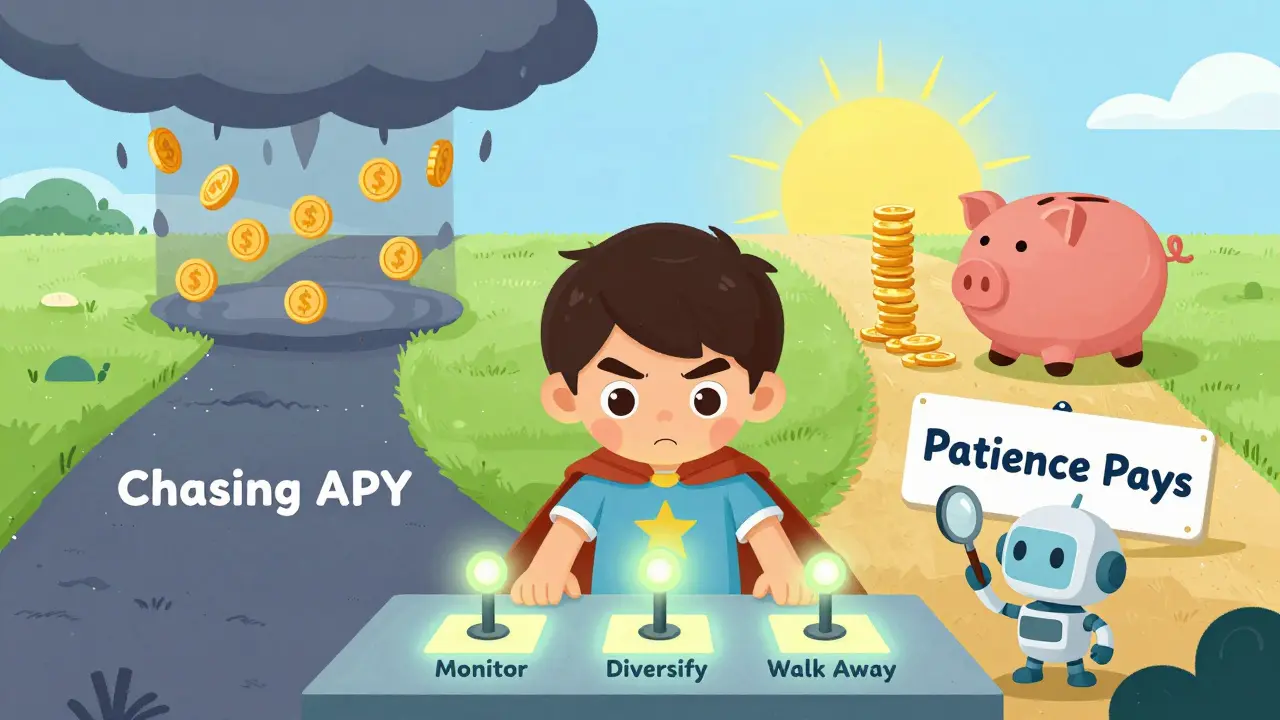
Real Numbers: Did It Pay Off?
In early 2024, a user in Bristol (same city as me) deposited $5,000 into an ETH/USDT pool. Over six months:- ETH rose from $2,800 to $3,600 - a 28% increase.
- Impermanent loss: $312.
- Fees earned: $624.
- Net gain: $312 (6.2% return).
So, Is It Worth It?
Yes - if you’re smart about it. Providing liquidity isn’t passive income. It’s a trading strategy with a side of math. If you treat it like a side hustle - monitor prices, pick low-volatility pairs, and move fast when things shift - you can make money. If you just deposit and forget? You’re gambling. The best time to provide liquidity isn’t during a crypto frenzy. It’s during calm markets. When everyone’s scared, trading slows, fees drop, and volatility stays low. That’s when you can earn steadily without getting wrecked. And if you’re still unsure? Start with $100. Test it. Watch how the numbers move. Learn before you bet big.Is impermanent loss real money I lose?
No - not until you withdraw. Impermanent loss is an opportunity cost. If you hold your assets outside the pool, you might have made more. But if you leave your liquidity in and prices return to where they started, the "loss" disappears. It only becomes real when you exit at a lower value than your original deposit.
Can I avoid impermanent loss completely?
Only if you provide liquidity with assets that don’t move - like USDT/USDC. Any price change between two different tokens creates some level of impermanent loss. But for stablecoin pairs, it’s so small (under 0.5%) that it’s negligible. For volatile pairs, it’s unavoidable - but manageable with smart positioning.
Do I pay gas fees every time I adjust my liquidity?
Yes. Every time you add, remove, or shift your liquidity range on Uniswap V3, you pay Ethereum gas fees. That’s why many providers only adjust positions every few weeks or months. Too many moves can eat into your profits. Always calculate if the fee is worth the expected gain.
What’s the best DeFi platform for beginners?
Start with Uniswap V2 for ETH/USDT or USDT/USDC. It’s simple, has high volume, and doesn’t require complex price range settings. Once you’re comfortable, try Uniswap V3 with concentrated liquidity - but only after you’ve watched a few price cycles.
Should I provide liquidity during a bull market?
It’s risky. Bull markets mean big price swings - which means big impermanent losses. But they also mean high trading volume and big fees. The key is timing: if you enter early in the rally, you might earn enough to cover losses. If you jump in late, you’re more likely to get crushed when the top hits. Many experienced providers wait for the first 30% rally before entering.
Are there tools to calculate impermanent loss automatically?
Yes. Tools like DeFi Saver, Zapper.fi, and Zerion show real-time impermanent loss on your positions. You can also use free calculators like impermanentloss.com. Just input your starting ratio and current prices - it does the math for you. Use them weekly to stay aware.



monique mannino
February 11, 2026 AT 20:19I started with $50 in USDT/USDC and just watched it sit there 😊 Turns out, boring is beautiful. No drama, no stress, just steady little fees piling up like pennies in a jar. Seriously, if you’re new, this is your gateway drug to DeFi. No need to chase moonshots.
Peggi shabaaz
February 12, 2026 AT 15:42i just let mine ride and check in every few weeks. if the price moves too far i move it back. its not hard. you dont need to be a wizard. just patient.
Andrea Atzori
February 13, 2026 AT 17:55The fundamental misunderstanding among retail participants is the conflation of yield with profit. Impermanent loss is not a loss-it is an opportunity cost. To measure success, one must compare the value of the liquidity position against the counterfactual of holding the underlying assets. This is not finance. This is economics.
Donna Patters
February 13, 2026 AT 17:58I find it appalling that people treat DeFi like a casino. You don't just 'throw money in' and hope for the best. If you don't understand AMM mechanics, you shouldn't be near a liquidity pool. This isn't a game. It's a market structure.
Joe Osowski
February 15, 2026 AT 15:34All this math? In America we just buy ETH and hold. Why complicate things? You people overthink everything. Just HODL. That’s the American way. No need for spreadsheets and calculators.
Ben Pintilie
February 16, 2026 AT 04:13lol i tried it once. lost 20% on a shiba pool. still got 180 in fees. so... net loss? yeah. but i got memes. worth it?
Gaurav Mathur
February 16, 2026 AT 06:24The system is rigged. Central banks control fiat. DeFi is the only truth. But the protocols are controlled by whales. You think you are earning fees? You are feeding the machine. The rich get richer. The poor get liquidity.
Elizabeth Choe
February 18, 2026 AT 00:43OMG I DID THE THING. I put 100 bucks in ETH/USDT and watched it grow. I didn’t even touch it for 4 months. FEE MONSTER. My dog even got a treat because of it 🐶💸. Start small. Be chill. Let the algos do the work.
Beth Trittschuh
February 19, 2026 AT 00:21Impermanent loss... it’s a poetic term. Like ‘temporary sorrow’ or ‘ephemeral regret.’ But in practice? It’s the quiet erosion of potential. We chase yield like moths to a flame, forgetting that the flame doesn’t care if we burn. The market is indifferent. We are the drama.
Jeremy Lim
February 19, 2026 AT 06:11I... I just don’t know anymore. I read the article. I looked at the charts. I checked the calculators. I opened my wallet. I closed it. I opened it again. I think I need a nap.
Benjamin Andrew
February 19, 2026 AT 07:58The data is clear: 72% success rate for ETH/USDT providers. The bottom 30%? They didn’t read the fine print. They chased APY like toddlers chasing candy. This isn’t finance-it’s behavioral psychology. And most people fail because they’re emotionally incompetent.
Will Lum
February 19, 2026 AT 09:03If you're reading this and still scared? Good. That means you're not reckless. Start with 10 bucks. See how it feels. Learn the rhythm. Then scale. This isn't about being rich tomorrow. It's about being smart next year.
Ace Crystal
February 21, 2026 AT 00:55You think you’re being smart by sticking to ETH/USDT? Nah. That’s the herd. The real edge is in monitoring on-chain flow, tracking whale wallets, and entering when volume is low and volatility is rising. That’s when fees spike before the pump. You don’t wait for the party. You show up before the bouncer.
Michelle Cochran
February 21, 2026 AT 08:06I used to think impermanent loss was just math. Then I saw a friend lose $8,000 on a PEPE pool. She cried. Not because of the money. Because she believed she was "doing DeFi right." We don’t need more yield. We need more humility. And maybe therapy.
John Doyle
February 22, 2026 AT 20:40I’ve been doing this for 2 years. My first pool? A 200% APY token. Lost 60%. My second? ETH/USDT. Made 12% net. I don’t chase hype anymore. I chase consistency. The market rewards patience. Not genius. Just steady hands.