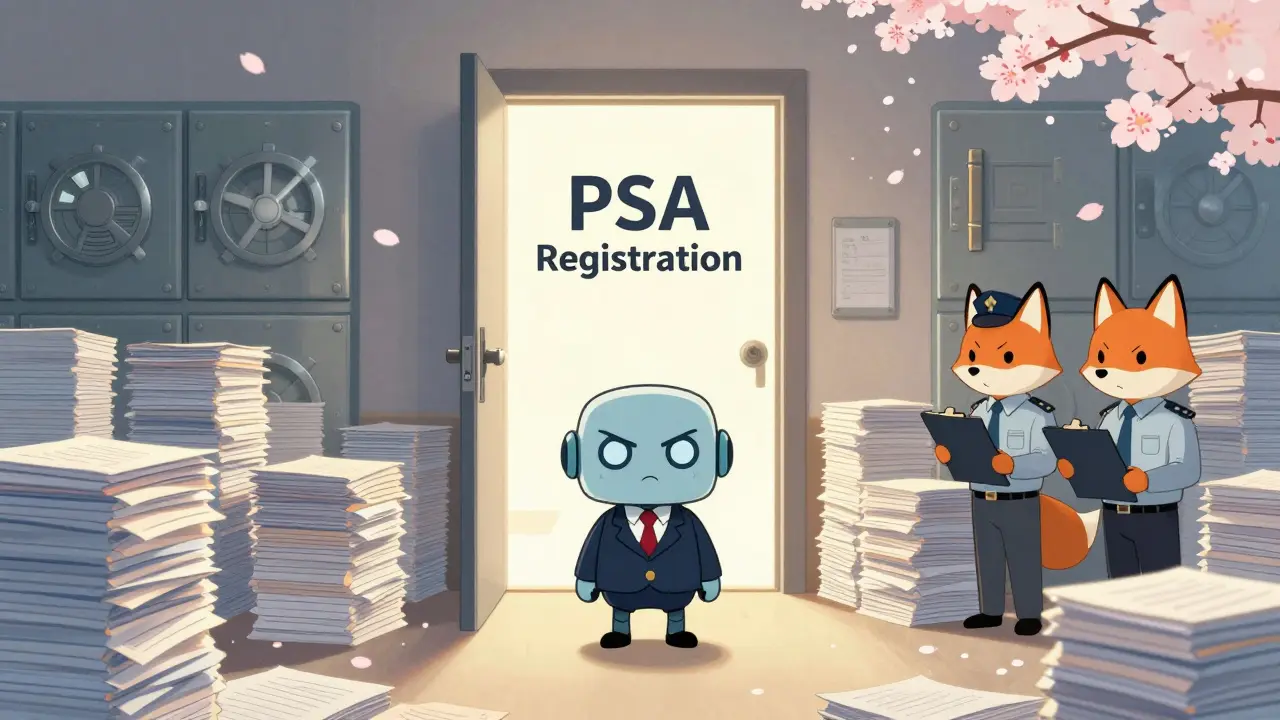
If you're thinking about running a cryptocurrency exchange in Japan, you need to know one thing upfront: PSA registration isn't just a formality. It's a full-scale compliance operation that takes months, millions of yen, and airtight systems. There's no shortcut. No gray area. And operating without it? That’s a crime.
What Exactly Is the Payment Services Act (PSA)?
The Payment Services Act (PSA) is Japan’s legal backbone for cryptocurrency exchanges. Passed in 2016 and updated since, it’s the law that says: if you buy or sell crypto as a business, you must register with the Financial Services Agency (FSA). It doesn’t matter if you’re based in Tokyo, New York, or Singapore-anyone offering crypto trading to Japanese users needs this registration.The PSA defines crypto-assets as digital payment tools not tied to yen or any other fiat currency. That means Bitcoin, Ethereum, Solana-all of them qualify. But prepaid cards backed by yen? Not crypto. Bank-issued digital coins? Also not crypto. The line is clear: if it’s not tied to government money, it’s under the PSA.
Who Needs PSA Registration?
Any company that engages in crypto trading as a business must register. That includes:- Exchanges that let users trade crypto for fiat (JPY, USD, etc.)
- Platforms that swap one crypto for another
- Wallet services that hold crypto on behalf of users
- Any entity acting as an intermediary in crypto transactions
Even if you’re a foreign company with no physical office in Japan, if you accept Japanese customers, you’re subject to the PSA. There’s no exception for small operators or startups. The law doesn’t care how big you are-it cares whether you’re doing business here.
Registration Requirements: The Hard Facts
Getting registered isn’t about filling out a form. It’s about proving you’re built to last. Here’s what the FSA demands:- Corporate Structure: You must be a kabushiki-kaisha (Japanese stock company). Foreign firms can’t register as branches-they must set up a wholly owned subsidiary in Japan. No exceptions. Every single registered foreign exchange has done this.
- Minimum Capital: You need at least JPY 10 million (about $65,000 USD) in paid-in capital. But that’s just the floor. The FSA also requires positive net assets, meaning your liabilities can’t exceed your assets.
- Management & Compliance: You need a clear organizational structure. Directors and officers must pass background checks. No history of fraud, money laundering, or financial crimes. You also need a dedicated compliance officer who understands Japanese financial law.
- Operational Systems: You must document every step of your business: how you onboard users, how you verify identities, how you handle deposits and withdrawals, how you monitor transactions for suspicious activity. Every process must be written, tested, and auditable.
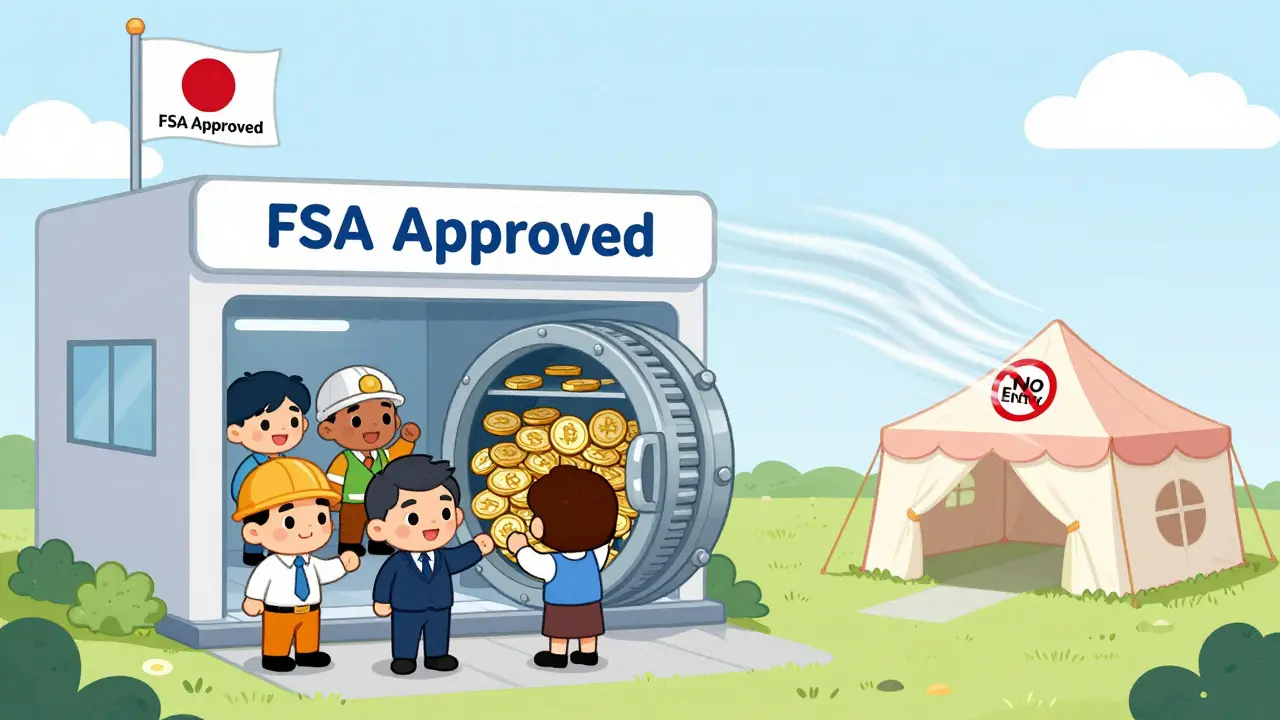
- Asset Segregation: This is non-negotiable. Customer crypto must be kept completely separate from your company’s funds. The FSA requires at least 95% of user assets to be stored in cold wallets-offline, air-gapped, and physically secured. The rest can be in hot wallets for liquidity, but you must prove you can cover losses if they happen.
- Outsourcing Rules: If you use third parties for anything-KYC, security, tech support-you must disclose them and prove they meet FSA standards. You can’t outsource your responsibility.
The application package can run over 200 pages. It includes company bylaws, financial statements, IT system diagrams, anti-money laundering policies, customer dispute procedures, and more. The FSA doesn’t just read it-they test it. They simulate hacks. They ask: “What if your server goes down?” “What if a director gets arrested?” “How do you recover user funds if you go bankrupt?”
The Timeline: Six Months Is Just the Start
The FSA says the review process takes about six months. But that’s only the clock starting after you submit. Most companies spend 8 to 12 months preparing. Why? Because building compliant systems takes time.You can’t just buy software and call it done. You need internal audits, staff training, legal reviews, and multiple rounds of revisions. Many applicants get rejected on their first try-not because they’re dishonest, but because their documentation is sloppy or incomplete. One company spent nine months rewriting their asset segregation plan just to meet FSA expectations.
And once you’re registered? The work doesn’t stop. The FSA does unannounced inspections. They check your logs. They interview your staff. They demand proof that your cold wallets are secure. Miss one requirement, and you could face suspension-or worse.
What Happens If You Don’t Register?
Operating without PSA registration is a criminal offense. Before June 1, 2025, the penalty was up to three years in prison and a fine of up to JPY 3 million. Now, under Japan’s updated Penal Code, imprisonment is replaced with “confinement punishment” (koukin-kei)-a form of detention without incarceration, but still a serious legal consequence.But the real damage isn’t legal-it’s reputational. Japan’s crypto market is small but highly trusted. Users only use exchanges with the FSA stamp. If you’re unregistered, no Japanese customer will touch you. No bank will open an account for you. No payment processor will work with you. You’re locked out of the market before you even start.
PSA vs. FIEA: When Do You Need More Than Just PSA?
Not all crypto is treated the same. The PSA covers spot trading of tokens like Bitcoin and Ethereum. But if your token acts like a security-offering dividends, profit-sharing, or investment returns-it falls under the Financial Instruments and Exchange Act (FIEA).FIEA registration is harder. It requires:
- Higher capital requirements
- More complex reporting
- Strict disclosure rules for investors
- Ongoing audits by certified accountants
Most exchanges stick to PSA because it’s predictable. But if you’re launching a tokenized asset, a yield product, or a staking service that pays returns, you’ll need FIEA too. Many companies end up applying for both.
Why Japan’s Rules Are So Strict
Japan was one of the first countries to regulate crypto after the 2014 Mt. Gox collapse. That disaster wiped out hundreds of millions in user funds. Since then, the government has built a system designed to prevent that from ever happening again.The result? A market where users trust their exchanges. Japan has one of the highest rates of crypto adoption in Asia-not because it’s easy to start a business, but because people know their money is safe.
It’s not about stifling innovation. It’s about making sure innovation doesn’t come at the cost of consumer protection. The FSA doesn’t ban new tokens. It doesn’t cap trading volume. It just says: if you want to operate here, you have to do it right.

Who Can Actually Afford This?
The PSA registration process favors big players. The JPY 10 million minimum is just the start. Factoring in legal fees, tech infrastructure, compliance staff, and ongoing audits, the total cost to launch can easily exceed JPY 50 million ($300,000 USD). That’s why most registered exchanges are either Japanese financial institutions or well-funded global firms like BitFlyer, Coincheck, and Zaif.Small startups? It’s nearly impossible. You can’t just hire a freelance developer and call it a day. You need lawyers, auditors, cybersecurity experts, and compliance officers-all on payroll. That’s why Japan’s crypto market is dominated by a handful of licensed players. The system isn’t broken-it’s designed that way.
What’s Changing in 2025?
In early 2025, Japan submitted new amendments to the PSA to strengthen enforcement. The changes give the FSA direct power to issue orders-like freezing assets, shutting down services, or mandating system upgrades-without going through court. This isn’t just about punishment anymore. It’s about real-time control.Also, the FSA is pushing for more transparency. Registered exchanges now must publicly disclose their cold wallet addresses. They must report any security breaches within 24 hours. And they must prove they’ve tested their systems against simulated cyberattacks.
These aren’t suggestions. They’re requirements. And they’re being enforced.
Bottom Line: It’s Not About Getting Licensed. It’s About Being Trustworthy.
PSA registration isn’t a license to trade crypto. It’s a certification that you’re serious about protecting users. The FSA doesn’t care how fancy your website is or how many influencers you pay to promote you. They care about your cold wallets. Your audit trails. Your employee training records. Your backup plans.If you’re serious about operating in Japan, don’t think of registration as a hurdle. Think of it as your foundation. Build it right, and you earn trust. Build it wrong, and you don’t just lose your license-you lose your future in the market.
Japan’s crypto rules are strict. But they work. And for anyone who wants to play here long-term, that’s the only path that matters.
Can a foreign company register for PSA without setting up a Japanese subsidiary?
No. Foreign companies must establish a Japanese subsidiary in the form of a kabushiki-kaisha (stock company). The FSA has never approved a registration for a foreign branch. All registered foreign exchanges operate through locally incorporated subsidiaries.
Is there a minimum amount of crypto assets I need to hold to get registered?
No. The FSA doesn’t require you to hold any specific amount of crypto. But you must prove you can securely store customer assets and segregate them from your own. The 95% cold storage rule applies to user funds, not your company’s holdings.
What happens if my PSA registration is denied?
If denied, the FSA will provide a written explanation of the deficiencies. You can reapply after fixing the issues. Many companies are rejected on their first attempt due to incomplete documentation or weak compliance systems. There’s no appeal process, but you can resubmit as many times as needed.
Do I need to register if I only trade crypto for personal use?
No. The PSA only applies to businesses. Individuals buying or selling crypto for personal investment don’t need registration. But if you’re operating a platform-even a small one-that connects buyers and sellers, you’re considered a business and must register.
Can I use offshore wallets to store user funds and still comply?
No. All customer crypto assets must be stored in wallets under the control of your Japanese subsidiary. The FSA requires full visibility and control over cold storage. Offshore wallets, even if owned by your parent company, are not permitted for holding Japanese user funds.
How often does the FSA inspect registered exchanges?
Inspections are unannounced and can happen at any time. Most registered exchanges receive at least one full audit per year, but some face multiple inspections if there are complaints, security incidents, or compliance concerns. The FSA also monitors transaction patterns in real time through mandatory reporting.
Are staking services allowed under PSA registration?
Staking services are permitted, but they fall into a gray area. If staking offers guaranteed returns or resembles an investment contract, it may trigger FIEA regulations instead of PSA. Most exchanges avoid offering staking unless they’ve obtained FIEA licensing as well. The FSA has warned that unlicensed staking services could be considered illegal securities offerings.
Can I advertise crypto trading with promises of high returns?
No. The FSA strictly prohibits any advertising that implies guaranteed profits, quick gains, or low-risk returns. Marketing must be factual, clear, and free of misleading language. Violations can lead to fines, suspension, or revocation of registration.

Aaron Heaps
December 22, 2025 AT 23:41This whole PSA thing is just state-sponsored rent-seeking. They don't care about security-they care about controlling who gets to play. Big banks own the FSA. Small players? Out of luck.
Meanwhile, everyone in DeFi just uses offshore wallets and laughs.
Japan's crypto market is a museum, not a marketplace.
Tristan Bertles
December 23, 2025 AT 19:49I’ve watched a few startups try to go through this. It’s brutal. Not because the rules are unfair, but because the paperwork is designed to break you. One guy I know spent 11 months rewriting his KYC flow just to get a single rejection letter.
It’s not about compliance-it’s about endurance.
Earlene Dollie
December 24, 2025 AT 11:59Why does anyone even care about Japan anymore? The whole crypto world moved on. We’ve got real regulation in the EU, real innovation in Singapore, real freedom in Switzerland.
Japan’s still stuck in 2017 with their cold wallets and their 95% rule and their ‘trust us’ vibe.
I miss the wild west.
Dusty Rogers
December 24, 2025 AT 12:59People act like PSA is a barrier, but it’s actually a filter. It weeds out the scammers, the fly-by-nights, the guys who think they can just copy-paste a website and call it an exchange.
The ones who make it through? They’re the only ones you can actually trust.
That’s worth the cost.
Kevin Karpiak
December 24, 2025 AT 17:26Japan thinks it’s special. It’s not. The US has better laws. The UK has clearer rules. Even South Korea lets you operate with less red tape.
This is protectionism dressed up as consumer safety.
They’re scared of competition. That’s it.
Amit Kumar
December 25, 2025 AT 00:56As an Indian who’s worked with Japanese fintech teams, let me tell you-this isn’t bureaucracy, it’s discipline.
They don’t say ‘trust me’-they show you the audit logs, the cold wallet signatures, the staff training videos.
That’s why when you say ‘BitFlyer’ in Tokyo, people nod like you said ‘Sony’.
Respect the process.
chris yusunas
December 26, 2025 AT 22:21Man, I saw a Nigerian startup try this last year. They thought they could register as a branch. Got laughed out of the FSA office.
They came back with a Tokyo subsidiary six months later. Still haven’t heard from them.
Either they gave up or they’re building something real.
Either way, respect the grind.
Mmathapelo Ndlovu
December 27, 2025 AT 06:06It’s funny how we all want freedom but then get mad when freedom comes with responsibility.
Japan didn’t ban crypto. They just said: if you want to touch our money, you have to be ready to protect it.
That’s not oppression. That’s maturity.
🥺
Jordan Renaud
December 27, 2025 AT 11:29Look, I get why this feels overwhelming. But think of it this way: every time you use a Japanese exchange and don’t get hacked, that’s the PSA working.
It’s not glamorous. It’s not viral. But it’s the quiet backbone of a market that still works.
That’s worth something.
Ellen Sales
December 28, 2025 AT 02:26so like... the fsa is basically the crypto version of a strict mom who checks your phone every night?
also why is everyone acting like this is new? its been like this since 2017 lmao
we all knew japan was gonna be a walled garden
but hey at least your coins dont vanish into the void
roxanne nott
December 29, 2025 AT 00:13PSA registration requires a Japanese stock company? That’s not regulation-that’s corporate colonialism.
Foreign firms can’t even register as branches? You’re not protecting users-you’re protecting Japanese incumbents.
And the 95% cold storage? That’s not security, it’s liquidity suicide.
Anyone who says this is ‘fair’ hasn’t tried to raise capital in 2025.
Rachel McDonald
December 30, 2025 AT 13:48And yet... people still trust Japanese exchanges more than any other.
Why? Because they didn’t cut corners.
You want to make money fast? Go to Binance.
You want to sleep at night? Go to BitFlyer.
There’s a reason the FSA doesn’t need to scare people.
They already know.
Vijay n
December 31, 2025 AT 09:36PSA is just the beginning. Next they’ll require all crypto wallets to have government backdoors. Then they’ll track every transaction. Then they’ll ban DeFi. Then they’ll ban Bitcoin.
It’s a slippery slope. The FSA doesn’t want to regulate-they want to own.
Don’t be fooled by the ‘trust’ narrative. This is control.
They’re just being polite about it.
Alison Fenske
January 1, 2026 AT 17:09I used to think Japan was too rigid until I lost my life savings to an unregulated exchange in 2022.
Now I get it.
It’s not about how hard the rules are.
It’s about who’s left standing when the dust settles.
And Japan? They’re still here.
Collin Crawford
January 2, 2026 AT 06:57The notion that PSA is a barrier to innovation is fundamentally flawed.
Regulation does not inhibit innovation-it defines the playing field.
Without clear boundaries, markets devolve into chaos.
Japan has chosen order over opportunism.
That is not a weakness. It is strategic foresight.
And those who cannot adapt? They are not victims. They are irrelevant.
Tyler Porter
January 4, 2026 AT 05:20Let’s be real. The JPY 10 million minimum? That’s nothing compared to the legal bills.
And the cold wallet audits? You’re talking $200k just in third-party certs.
It’s not a barrier-it’s a wall.
But hey, if you’ve got the cash, go for it.
Just don’t cry when your startup dies because you didn’t hire a compliance officer who speaks Japanese.
SHEFFIN ANTONY
January 5, 2026 AT 09:01Japan is a joke. They think they’re the gold standard? Look at the trading volume. Look at the user base.
They’re clinging to 2017 while the rest of the world is building on-chain identity, zk-proofs, and decentralized custody.
This isn’t regulation. It’s nostalgia.
And nostalgia doesn’t pay bills.
Zavier McGuire
January 6, 2026 AT 09:33People don’t get it. This isn’t about crypto.
This is about sovereignty.
Japan doesn’t want foreign companies controlling how its citizens store value.
They want their own rules. Their own banks. Their own tech.
That’s not evil.
That’s pride.
Sybille Wernheim
January 8, 2026 AT 01:43Yes it’s hard. Yes it’s expensive. But look at the results.
No major exchange hacks. No customer fund losses. No scandals.
That’s not luck.
That’s discipline.
And honestly? We need more of that.
Not less.
Luke Steven
January 9, 2026 AT 23:21What if we stopped seeing PSA as a gatekeeper and started seeing it as a covenant?
It’s not a contract with the state.
It’s a promise to users.
You want to touch our money? You promise to protect it like it’s your own.
That’s not regulation.
That’s honor.
And in crypto? That’s rare.
vaibhav pushilkar
January 10, 2026 AT 16:49One thing people miss: the FSA doesn’t just check your systems.
They check your culture.
Do your employees know what to do if a user calls in panic?
Do your devs understand AML? Do your managers know the difference between a security and a utility token?
That’s the real cost.
Not the money.
The mindset.