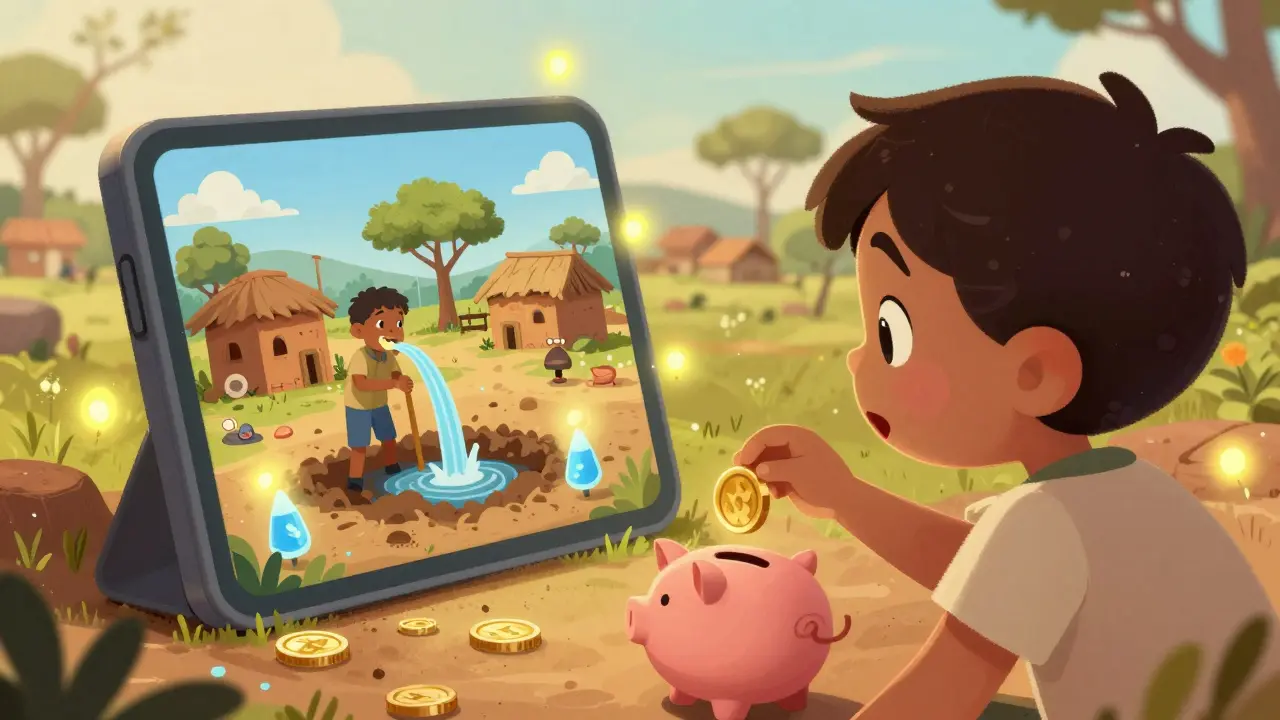
Imagine giving $500 to build a well in Kenya - and being able to watch, in real time, as sensors confirm the well was dug, water flowed, and the community started using it. Only then does the money get released. No guesswork. No middlemen. No doubt. This isn’t science fiction. It’s what smart contracts for conditional donations do today.
What Exactly Are Smart Contracts for Conditional Donations?
A smart contract is just code running on a blockchain. But when you tie that code to a donation, it becomes something powerful: a digital promise that only pays out if certain conditions are met. Think of it like a vending machine for charity. You insert your crypto, set the rules - say, ‘pay out only when 100 school uniforms are delivered’ - and the system automatically checks if the rule was followed. If yes, the money moves. If not, it stays locked. This isn’t about trust. It’s about proof. Traditional charities often spend 15-25% of donations on admin, reporting, and overhead. Donors rarely see exactly where their money goes. A 2022 Cone Communications survey found only 23% of donors had high confidence in how charities used their funds. Smart contracts flip that. Every step - from donation to delivery - is recorded on a public ledger. You don’t have to take anyone’s word for it. You can see it.How Do They Actually Work?
Most conditional donation smart contracts run on Ethereum, which handles about 68% of charitable blockchain projects as of mid-2024. Here’s the basic flow:- You send cryptocurrency (like ETH or USDC) to a smart contract address.
- You define the condition: ‘Release funds when IoT sensors confirm water is flowing at Site A,’ or ‘Pay $10,000 after 500 children are enrolled in the program.’
- The contract waits. It doesn’t move money until the condition is verified.
- Real-world data (like sensor readings, signed receipts, or satellite images) is fed into the contract through an ‘oracle’ - usually Chainlink, the most trusted one in this space.
- If the data matches the rule, the contract automatically sends the funds to the charity’s wallet.
Why This Beats Traditional Giving
Traditional donations rely on reports, audits, and trust. Smart contracts rely on data and code. That’s a huge difference. Take matching gifts. In the old system, if a donor says, ‘I’ll match every $100 donated to this clinic,’ the charity has to collect all donations, calculate totals, then manually trigger the match. It takes weeks. With a smart contract, the moment the first $100 hits, the matching $100 is instantly sent - all in under a minute. The United Way tested this in 2023 and cut matching time from 60 days to 15 minutes. Costs drop too. Charities using smart contracts keep 95-98% of every donation. Traditional models leave them with just 75-85%. That’s because you cut out banks, payment processors, and manual reconciliation teams. Firefly Giving’s 2024 data shows transaction fees for smart contracts are just 2-5%, compared to 15-25% for credit card processing. And speed? XDC Network’s blockchain settles transactions in 5-8 seconds. International bank transfers? 3-5 business days.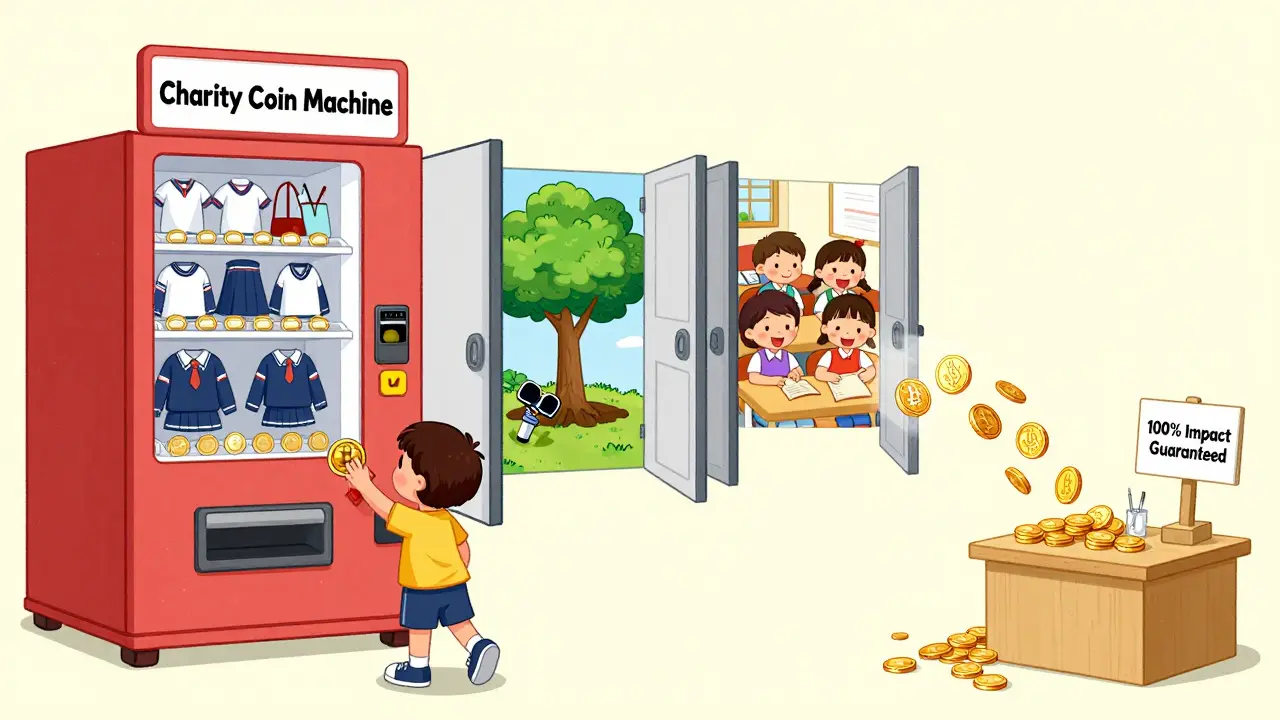
Where It Works Best
Conditional donations shine when outcomes are measurable. Here are real examples:- Disaster relief: Funds release only after drones confirm food supplies reached a flooded village. (UNICEF tried this in Pakistan in 2022 - but the contract couldn’t adapt when conditions changed. More on that later.)
- Education: Money is unlocked only when attendance records show 90% student participation for three months.
- Environmental projects: Carbon credits are issued only after satellite images confirm tree planting targets were met.
- Medical aid: Vaccines are delivered only after local health officials verify cold-chain storage was maintained.
The Big Problems
This isn’t magic. It’s code. And code can’t handle messy human reality. The biggest flaw? Rigidity. In 2022, UNICEF’s smart contract for flood relief in Pakistan couldn’t redirect funds when roads were washed out. The contract said, ‘Pay when supplies reach Village X.’ But Village X was cut off. The system didn’t know how to pivot. $220,000 sat frozen while people suffered. Then there’s the digital divide. 72% of the world’s population doesn’t have access to cryptocurrency, according to the World Bank’s 2024 report. That means most of the people who need aid the most can’t even participate in this system. And many donors don’t know how to use a wallet. One charity reported 12 potential donors walked away during a campaign because MetaMask confused them. Small charities are especially stuck. Setting up a smart contract can cost $8,000-$25,000 and take 6-8 weeks. A nonprofit with a $300,000 budget can’t afford a $150/hour blockchain developer. TechSoup’s 2024 survey found 68% of small charities say the tech barrier is too high. And legal uncertainty? It’s real. A January 2025 court case, Bryant v. JPMorgan Chase Bank, ruled that ‘conduct can manifest acceptance’ of smart contract terms - but only if those terms were clearly presented. Many early systems buried the rules in Solidity code. Donors never saw them. Courts might not enforce those contracts. Lawyers are now warning charities: if you don’t make the terms visible and understandable, you could be sued.Who’s Using It - And Who’s Not
Adoption is uneven. Big players are in. Among Fortune 500 foundations, 41% have piloted or launched smart contract donations. Deloitte reports 67% of major banks now offer them to wealthy clients because they generate IRS-compliant records 92% faster than paper. But community nonprofits? Only 8% have tried it. Platforms like Firefly Giving, Bloom Solutions, and CharityChain dominate the market. Firefly alone handles 32% of all conditional donation contracts. The gap isn’t just about money. It’s about knowledge. Charity staff need 40-60 hours of training just to manage basic contracts. Donor interfaces have improved - 82% of users can now complete a donation with minimal help - but the backend is still a black box for most.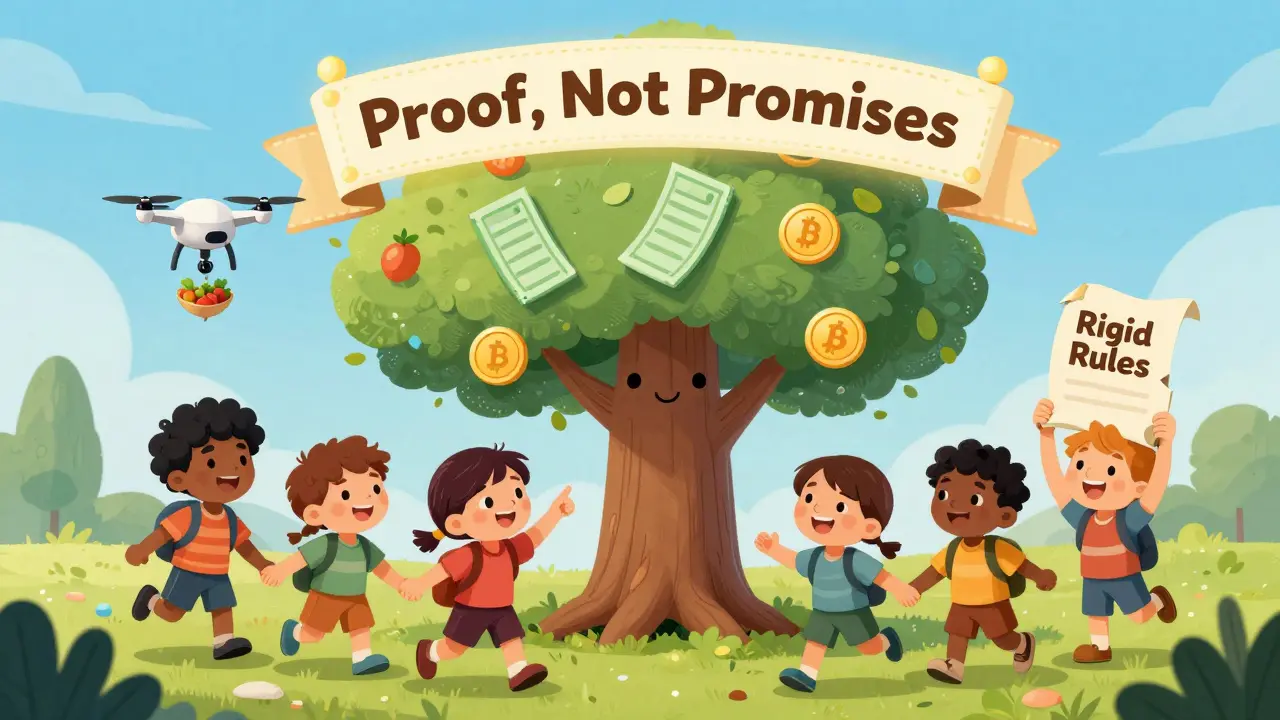
What’s Changing Fast
The tech is evolving quickly. In February 2024, Ethereum launched ERC-7217 - a new standard called the ‘Philanthropy Module.’ It gives developers ready-made templates for conditional donations, cutting development time by 40%. That means lower costs and faster setup. The ISO is also stepping in. By late 2025, ISO 23026 will become the first global standard for blockchain-based charitable giving. That means clearer rules, better security, and more trust. Gartner predicts that by 2027, 35% of charities with budgets over $1 million will use some form of smart contract donation. The market, worth $280 million in 2023, is expected to hit $940 million by 2027.Should You Use It?
If you’re a donor who cares about proof, not promises - and you’re comfortable with crypto - then yes. Smart contracts give you control you’ve never had before. You can track every dollar. You can see the impact. You can stop funding guesswork. If you’re a small nonprofit with limited tech resources? Maybe not yet. The setup cost and complexity are still too high. But if you’re part of a larger organization with a tech team, or you partner with a platform like Firefly Giving, it’s worth exploring. The future of giving isn’t about more money. It’s about more trust. Smart contracts don’t solve every problem. But they solve one that’s been broken for decades: the lack of transparency in charity.Frequently Asked Questions
Can I cancel a smart contract donation if I change my mind?
No. Once a smart contract is deployed and funded, the code runs automatically. You can’t reverse it. That’s why it’s critical to review all conditions and terms before sending funds. Some platforms let you draft and preview the contract before finalizing, but once it’s live on the blockchain, it’s final.
Do I need to be a crypto expert to use this?
No. Donors only need a crypto wallet like MetaMask or Trust Wallet and an internet connection. Most platforms now have simple, guided interfaces that walk you through setting up a conditional donation in minutes. You don’t need to understand Solidity or blockchain mechanics. Just set the condition and send the crypto.
What happens if the real-world condition can’t be verified?
The funds stay locked. Smart contracts require external data (like sensor readings or signed documents) to trigger payments. If that data never arrives - say, because a drone failed or a report was delayed - the money doesn’t move. This prevents fraud, but it also means charities need reliable ways to report progress. That’s why most systems use trusted oracles like Chainlink to bridge the real world and the blockchain.
Are smart contract donations tax-deductible?
In the U.S., yes - if the charity is a registered 501(c)(3). The IRS treats cryptocurrency donations like property. You get a deduction based on the fair market value at the time of donation. Smart contract platforms like Firefly Giving automatically generate IRS-compliant receipts, making record-keeping easier than traditional donations.
Can a charity change the conditions after the contract starts?
No. Once a contract is live, its rules are fixed. That’s the whole point - to prevent manipulation. If a charity needs to change the goal, they must create a new contract. This ensures donor intent is honored, even if it limits flexibility. Some newer platforms are testing ‘upgradable’ contracts with multi-signature approval, but these are still experimental.
Is this just for big charities?
Not anymore. Platforms like Firefly Giving and Bloom Solutions now offer plug-and-play templates for small nonprofits. You don’t need to hire a developer. You can set up a conditional donation in under an hour using their interface. The cost is still higher than PayPal, but the transparency and reduced fees make it worthwhile for donors who demand accountability.

Patricia Amarante
December 17, 2025 AT 02:45This is actually kind of beautiful. No more guessing if your donation did anything. Just seeing it happen? That’s the kind of transparency we’ve been screaming for.
Love it.
Abby Daguindal
December 18, 2025 AT 19:23Oh great. Now we’re outsourcing charity to code. Next they’ll replace social workers with AI chatbots who say ‘sorry, your condition wasn’t met’ in a robotic voice.
People aren’t variables in a smart contract, you know.
SeTSUnA Kevin
December 19, 2025 AT 00:19Smart contracts are not ‘trustless’-they’re trust-optimized. The real issue is that most donors don’t understand cryptography, and that’s not the system’s fault.
Blaming the tool because the user is incompetent is a classic fallacy.
Timothy Slazyk
December 19, 2025 AT 18:18Let’s not romanticize this. A smart contract can’t tell if a child is learning or just sitting in a classroom. It can’t feel hunger, or loneliness, or hope.
It’s a ledger, not a conscience. The moment we outsource moral responsibility to immutable code, we’ve already lost the soul of giving.
Transparency without empathy is just surveillance with a blockchain sticker on it.
Madhavi Shyam
December 20, 2025 AT 15:03Oracles are the single point of failure here. Chainlink’s not a magic bullet-it’s a centralized node masquerading as decentralized. You’re still trusting a third party to feed data into your ‘trustless’ system.
It’s crypto theater.
Mark Cook
December 20, 2025 AT 19:13So you’re telling me the next thing is gonna be ‘I donated $100 to feed orphans… but the AI said they didn’t smile enough so the money got refunded?’ 😂
Bring on the robot overlords.
Jack Daniels
December 22, 2025 AT 02:32I just… I don’t know if I can trust this. What if the sensors break? What if someone hacks the data feed? What if the whole thing just… vanishes?
I used to feel good about giving. Now I just feel scared.
Bradley Cassidy
December 22, 2025 AT 12:04yo this is wild but also kinda genius?? like imagine if your donation to plant trees actually showed you a pic of the saplings growing?? 🌱
also i typoed ‘sattelite’ in my last donation and it still worked lol
Samantha West
December 24, 2025 AT 06:57While the technological architecture presents an elegant solution to the problem of donor accountability, one must not overlook the epistemological implications of delegating ethical agency to algorithmic systems.
Is the act of giving reduced to a transactional event, or does it retain its intrinsic moral weight when mediated by blockchain?
Craig Nikonov
December 25, 2025 AT 02:25Blockchain charity? Sure. Next they’ll say the CIA is using it to track donors. And the Fed? They’re already in the backdoor. You think they don’t have access to every wallet? Wake up.
This isn’t freedom. It’s a digital leash.
Donna Goines
December 26, 2025 AT 10:39They’re using this to collect your crypto wallet data. Every time you donate, they log your IP, your device, your habits. Then they sell it to advertisers. And the charities? They’re just front men for the surveillance state.
I’ve seen the leaks. Don’t be fooled.
Greg Knapp
December 26, 2025 AT 15:04why do we even need this
people just want to feel good about giving
they dont care if the well works
they just want the photo with the smiling kid
Shruti Sinha
December 28, 2025 AT 12:29Interesting. In India, we’ve seen similar systems with SMS-based verification for rural aid. The tech isn’t new-just the blockchain wrapping. The real challenge is literacy, not code.
Cheyenne Cotter
December 29, 2025 AT 00:21Okay, but let’s be real-how many people actually understand what a smart contract is? I read the whole article and I still don’t know if I’m supposed to send ETH or USDC or SOL or what. And why does it matter? Isn’t money just money? Why does it need to be on a blockchain? Why can’t we just use PayPal with a better reporting system? Why does everything have to be crypto? Why is everyone so obsessed with decentralization? Why can’t we just… fix the existing systems? Why is tech always the answer? Why is everyone so excited about this? Why do we keep thinking new tech will fix old problems? Why do we keep ignoring the fact that the problem isn’t the system-it’s the people running it? Why? Why? Why?
I’m just… tired.
Sean Kerr
December 30, 2025 AT 05:02you got this!! 🙌
smart contracts are the future of giving-yes it’s new, yes it’s weird, yes you might mess up your wallet once (i did 😅)
but think about it: you’re not just donating-you’re *participating*. it’s like being a co-pilot in someone’s life-changing moment.
you got this. you’re doing great.
❤️
Heather Turnbow
December 30, 2025 AT 11:54While the efficiency gains are undeniable, the ethical implications of automated disbursement require careful consideration. The absence of human discretion in humanitarian contexts may inadvertently exacerbate systemic inequities.
Transparency must be paired with compassion.
Jesse Messiah
December 31, 2025 AT 02:54hey i just set up my first conditional donation using firefly giving-took like 8 minutes and i got a receipt that looks like a space alien wrote it but it’s legit 😄
don’t let the tech scare you. just pick a project you care about and hit ‘send’. they’ll walk you through it. you’re gonna feel amazing.
Rebecca Kotnik
January 2, 2026 AT 00:45There is something profoundly moving about the idea that a child in Kenya can be enrolled in school, and a donor in Ohio can know, with absolute certainty, that their contribution made that possible-not because someone told them, not because they were shown a glossy brochure, but because the data, immutable and public, confirmed it.
Perhaps this isn’t just about efficiency or transparency. Perhaps it’s about redefining what it means to care. To care enough to verify. To care enough to demand proof. To care enough to let the truth speak for itself.
That, more than any code, is the revolution.
Dionne Wilkinson
January 3, 2026 AT 06:54It’s nice to know your money isn’t vanishing into a black hole. But… what if the sensors lie? What if the satellite image is outdated? What if the charity’s internet goes down for a week? What if the person who needs help the most… doesn’t have a phone?
I just hope we don’t forget the humans behind the data.
Emma Sherwood
January 4, 2026 AT 21:20For those of us in the Global South, this tech feels like a foreign gift wrapped in privilege. Who gets to define what ‘success’ looks like? Who decides the conditions? What if the community wants a school, but the donor wants a well?
Technology doesn’t fix power imbalances. It just makes them look cleaner.
Florence Maail
January 6, 2026 AT 05:16So… this is how they’re tracking us. Every donation. Every wallet. Every click. They’re building a database of who gives to what, then selling it to insurers and governments. Next thing you know, your credit score drops because you donated to a ‘high-risk’ cause.
And the ‘charities’? They’re just front companies for the surveillance-industrial complex. 🕵️♀️
I’m done giving. I’m done trusting.