
Imagine trying to send money to a friend without calling a bank, using PayPal, or logging into an app. You just hand them the cash, and it’s done. Now imagine doing that with digital information-without any middleman checking if you’re allowed to do it. That is exactly what peer-to-peer (P2P) networks are in the world of blockchain technology. They are the invisible backbone that lets blockchains work without bosses, servers, or central authorities.
If you have heard terms like “decentralization” or “nodes” thrown around but never quite understood how they actually connect, this guide breaks it down. We will look at how these networks function, why they matter for security, and how they differ from the websites you visit every day. By the end, you will see why P2P isn’t just a feature of blockchain-it is the entire foundation.
The Core Idea: No Central Server
To understand peer-to-peer networks, you first need to forget how most of the internet works today. When you visit a news site or check your email, you are using a client-server model. Your computer (the client) asks a powerful remote computer (the server) for data. The server holds all the information. If that server crashes, the website goes down. If the company running the server decides to change the rules, everyone has to follow them.
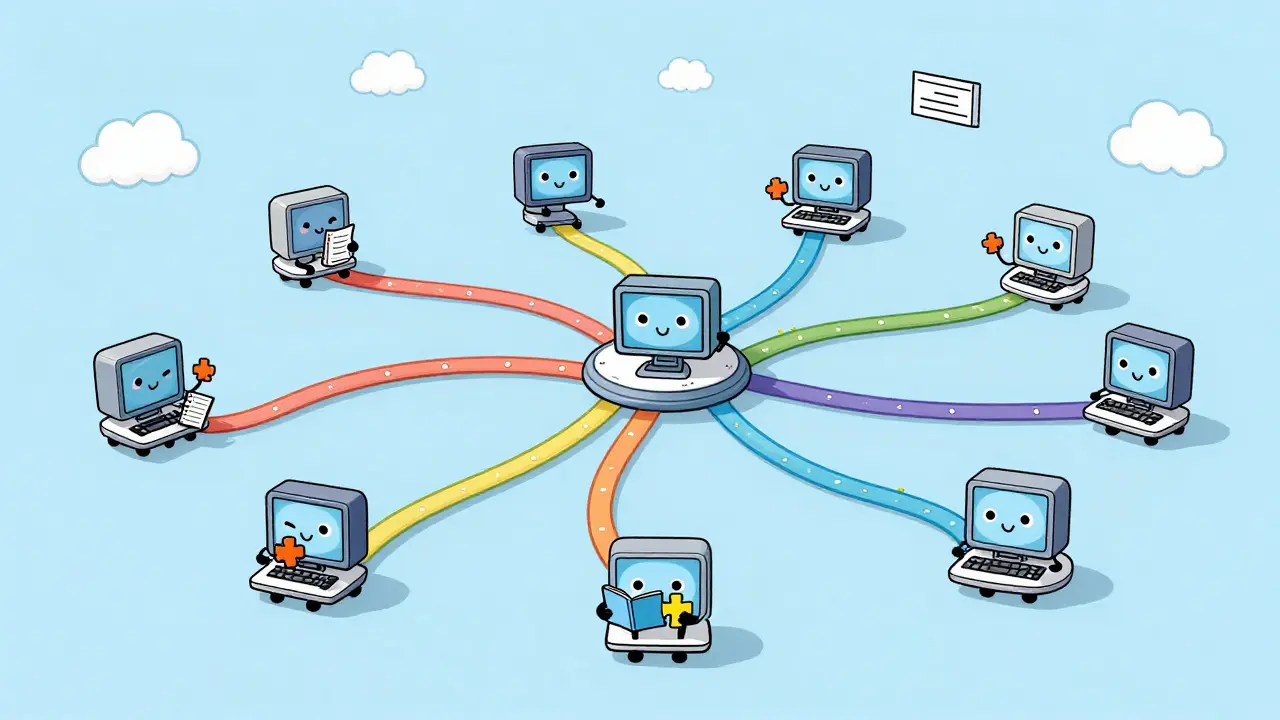
Peer-to-peer networking, on the other hand, flips this script. There is no central server. Instead, every participant in the network acts as both a client and a server simultaneously. These participants are called nodes. Each node stores a copy of the data and shares it directly with other nodes.
In a blockchain context, this means there is no single entity controlling the ledger. Whether you are looking at Bitcoin, Ethereum, or Solana, the transaction history isn’t stored in one building owned by one company. It is spread across thousands of computers worldwide. This distribution is what makes the system resilient. If one node goes offline, the rest keep working. The network doesn’t stop because one machine had a power outage.
How Nodes Communicate Directly
You might wonder how these independent computers agree on anything if there is no boss telling them what to do. The answer lies in direct communication protocols. In a P2P blockchain network, nodes identify each other using IP addresses. They establish connections via TCP (Transmission Control Protocol), which is the standard language computers use to talk over the internet.
Here is how the process typically unfolds when a new transaction occurs:
- Broadcasting: When Alice sends cryptocurrency to Bob, her node packages this transaction and broadcasts it to the nearest connected peers.
- Gossiping: Those peers don’t just store it; they pass it along to their own neighbors. This “gossip protocol” ensures the transaction spreads rapidly across the entire global network.
- Verification: As nodes receive the transaction, they check it against their local copy of the ledger. Does Alice have enough funds? Is the signature valid?
- Inclusion: Once verified, the transaction waits to be added to a new block by miners or validators, depending on the consensus mechanism.
This structure eliminates intermediaries. Traditional financial systems require banks to verify transactions because they hold the central record. In a P2P blockchain, the network itself verifies the truth. Every node has the same information, so no one can cheat without the others noticing.
Why Decentralization Equals Security
The biggest selling point of P2P networks in blockchain is security through redundancy. In centralized systems, hackers target one main server. If they breach it, they can steal data, shut down services, or alter records. Think of the massive data breaches we hear about involving large corporations. They happen because all the eggs are in one basket.
Blockchain security relies on the fact that altering data requires changing it on more than 51% of the nodes simultaneously. Since these nodes are spread across different countries, ISPs, and hardware setups, coordinating such an attack is practically impossible for most networks.
Let’s look at a comparison between traditional databases and P2P ledgers:
| Feature | Centralized System | P2P Blockchain Network |
|---|---|---|
| Data Storage | Single server or cluster | Distributed across all nodes |
| Failure Point | High risk (server crash = downtime) | Low risk (network continues) |
| Control | Admin/Company | Consensus among peers |
| Transparency | Opaque (users trust the admin) | Transparent (anyone can audit) |
This resilience is crucial for applications where trust is scarce. If you are sending value across borders without trusting a government or bank, you need a system that cannot be censored or shut down by a single authority. P2P networks provide that guarantee.
The Role of Consensus Mechanisms
A P2P network allows nodes to share data, but it doesn’t automatically decide which data is correct. What happens if two nodes report conflicting transactions? This is where consensus mechanisms come in. They are the rules that help the P2P network agree on the state of the ledger.
Proof of Work (PoW) and Proof of Stake (PoS) are the two most common methods.
In Proof of Work, used by Bitcoin, nodes (miners) compete to solve complex mathematical puzzles. The first one to solve it gets to add the next block of transactions. The rest of the P2P network checks the solution. If it’s valid, they accept the block and update their copies of the ledger. This process secures the network because attacking it would require more computing power than the rest of the world combined.
Proof of Stake, used by Ethereum and many newer chains, selects validators based on how much cryptocurrency they lock up as collateral. Instead of burning electricity, they stake assets. If they try to validate fraudulent transactions, they lose their stake. The P2P network still broadcasts these blocks, but the selection process is economic rather than computational.
Both mechanisms rely entirely on the P2P layer to propagate blocks and votes. Without the network spreading this information instantly, consensus would be slow and vulnerable to manipulation.
Real-World Examples Beyond Bitcoin
While Bitcoin is the most famous example of a P2P blockchain, it is not the only one. Different projects adapt P2P principles to suit specific needs.
Ethereum uses a P2P network to execute smart contracts. When you interact with a decentralized application (dApp), your request travels through the P2P network to reach the nodes that run the contract logic. The result is then broadcast back to the network.
IOTA takes a different approach with its Tangle, a directed acyclic graph (DAG). Instead of linear blocks, transactions reference previous ones directly. It is still a P2P system, but the structure looks less like a chain and more like a web. This allows for higher throughput and zero fees, though it sacrifices some decentralization compared to traditional blockchains.
Even file-sharing platforms like BitTorrent use P2P architecture, though they lack the cryptographic security and consensus layers of blockchain. Blockchain adds the critical element of trustless verification, ensuring that the data being shared hasn’t been tampered with.

Challenges and Limitations
P2P networks aren’t perfect. Their strength-decentralization-is also their weakness in terms of speed. Because every node must verify every transaction, scaling becomes difficult. This is known as the blockchain trilemma: balancing decentralization, security, and scalability.
Bitcoin processes about seven transactions per second. Visa handles thousands. To catch up, developers are building Layer 2 solutions like the Lightning Network. These sit on top of the base P2P layer, handling small payments off-chain while settling final balances on the main blockchain. This keeps the core P2P network secure while improving user experience.
Another issue is privacy. While wallets hide your identity behind public keys, the P2P network reveals your IP address to nearby nodes. Sophisticated observers could potentially link transactions to physical locations. Solutions like Tor integration and coin mixing aim to mitigate this, but true anonymity remains a challenge in open P2P systems.
Why This Matters for You
Understanding P2P networks changes how you view digital ownership. In centralized apps, you rent access to data controlled by a corporation. In P2P blockchains, you participate in a shared infrastructure that no one owns. You hold the keys, you verify the truth, and you contribute to the network’s resilience.
As Web3 technologies grow, more services will move onto P2P architectures. From decentralized social media to autonomous supply chains, the underlying principle remains the same: remove the middleman, distribute the power, and let the code enforce the rules. Knowing how this works helps you make better decisions about which platforms to trust and how to protect your digital assets.
Is peer-to-peer networking the same as blockchain?
No, they are related but distinct. Peer-to-peer (P2P) networking is the communication layer that allows computers to talk directly. Blockchain is the data structure and consensus system that runs on top of that network. You can have P2P without blockchain (like BitTorrent), but you cannot have a decentralized blockchain without a P2P network.
Can I run my own node?
Yes, anyone with sufficient storage and bandwidth can run a full node for major blockchains like Bitcoin or Ethereum. Running a node allows you to independently verify transactions and contributes to the network’s security. However, it requires technical knowledge and resources, as the blockchain data grows larger over time.
Are P2P networks anonymous?
Not inherently. While P2P networks hide your identity behind cryptographic keys, they often expose your IP address to neighboring nodes. For true anonymity, users typically combine P2P blockchains with privacy tools like Tor or use privacy-focused coins with built-in obfuscation features.
Why do P2P networks scale poorly?
Because every node must process and store every transaction, the network’s speed is limited by the weakest link. Adding more nodes improves security but doesn’t necessarily increase transaction throughput. This is why Layer 2 solutions are being developed to handle high-volume traffic off the main P2P layer.
What happens if half the nodes go offline?
The network continues to function as long as honest nodes remain active. However, if a significant portion goes offline, transaction confirmation times may increase due to reduced hashing power or staking participation. The system is designed to be resilient, but extreme node loss can impact performance.