
You’ve probably seen the ticker NIKITA flash across your screen or heard whispers in a Discord channel about an "AI-powered alpha generator." It sounds promising: a cryptocurrency that uses artificial intelligence to sniff out trends on Crypto Twitter before they go mainstream. But before you buy even a single satoshi, we need to look at what this project actually is-and more importantly, what it isn’t.
Nikita (NIKITA) is not a traditional utility token like Ethereum or a governance token like Compound. It is a speculative asset tied to an AI analytics agent built by a platform called Virtuals. The promise is simple: use the NIKITA token to access data insights generated by an AI that monitors over 10,000 key influencers on X (formerly Twitter). The reality, however, is far more complex and significantly riskier than the marketing suggests.
The Core Concept: AI Meets Crypto Sentiment
To understand NIKITA, you first have to understand its parent ecosystem. Virtuals Protocol is a platform designed to create and deploy autonomous AI agents within the Web3 space. Think of these agents as digital characters with specific jobs. In Nikita’s case, the job is market surveillance.
The technical claim is that Nikita ingests data hourly from major crypto influencers, tracking trending projects, popular cashtags (like $SOL or $BTC), and emerging narratives. By analyzing this chatter, the AI attempts to identify early-stage projects gaining traction. You pay for this service using NIKITA tokens.
This falls under the broader category of AI-driven crypto analytics, a niche that has exploded since 2023. Unlike general-purpose AI tokens, Nikita is hyper-specialized. It doesn’t try to solve global computing problems; it tries to solve one specific pain point for traders: information asymmetry. If you can find a gem before the crowd does, you make money. That is the theoretical value proposition.
Technical Specifications and Blockchain Foundation
Where does NIKITA live? According to technical documentation from exchanges like CoinSwitch, the token operates on the Solana blockchain. This is a critical detail because Solana is known for high-speed transactions and negligible fees. For a tool that promises real-time alerts, speed matters. If the network congested and delayed your alert by ten minutes, the "alpha" would be worthless.
Here are the hard numbers you need to know:
- Total Supply: 1,000,000,000 (1 billion) NIKITA tokens.
- Circulating Supply: Approximately 997 million NIKITA.
- Blockchain: Solana (via SPL token standard).
- Market Cap Status: Micro-cap (sub-$100,000 range based on recent data).
The fact that nearly the entire supply is already circulating means there is no "unlock schedule" or inflationary pressure from team vesting. However, it also means there is no future dilution to worry about-just pure market dynamics.
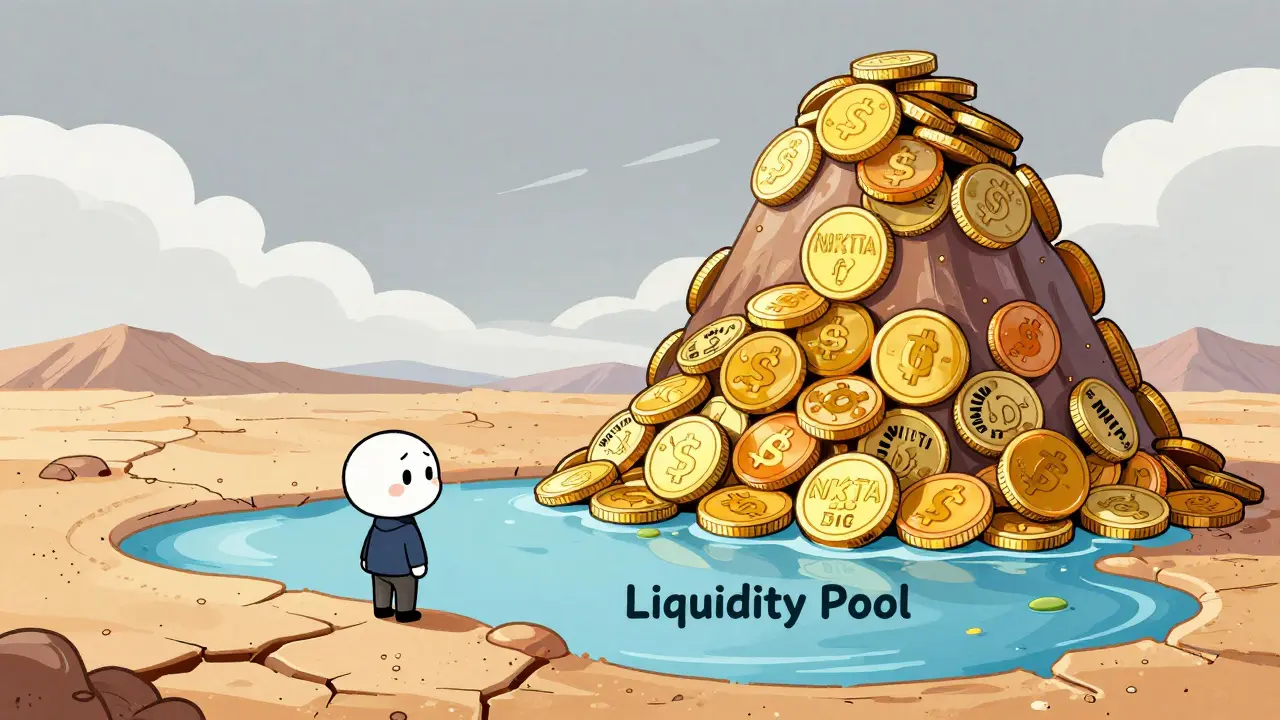
The Liquidity Trap: Why Price Doesn't Matter
If you look at the price of NIKITA, you might see numbers like $0.000050 or $0.000080 depending on the exchange. These prices mean almost nothing without context. The real story is in the liquidity.
Liquidity refers to how easily you can buy or sell an asset without moving its price. NIKITA suffers from extreme illiquidity. Recent data shows 24-hour trading volumes often dipping below $500. To put that in perspective, if you tried to sell $500 worth of NIKITA, you could crash the price by over 70%. This is a classic characteristic of micro-cap cryptocurrencies.
This creates a dangerous feedback loop. Because volume is low, large orders cause massive slippage. Because slippage is high, fewer people want to trade. Because fewer people trade, volume drops further. Analysts from firms like Messari have noted that projects with thousands of holders but sub-$100k market caps often consist of "dust wallets"-inactive accounts left over from initial launches rather than active community members.
Risk Assessment: Is It Safe?
We need to be blunt here. Investing in NIKITA carries extreme risk. Here is why experts categorize it as "Critical Risk":
- Volatility: The token has experienced drops of over 99% from its all-time highs. A 1-month decline of 34% while the broader market rose is a red flag indicating negative sentiment.
- Lack of Verification: There are no verified enterprise partnerships or public revenue streams disclosed. The value relies entirely on users believing the AI insights are valuable enough to keep buying tokens.
- Regulatory Uncertainty: The SEC has recently targeted AI tokens that lack functional utility beyond speculation. Since NIKITA’s primary driver appears to be speculative trading rather than essential infrastructure use, it sits in a regulatory gray zone.
- Platform Dependency: If Virtuals Protocol shuts down or fails to attract users, the NIKITA token loses its sole reason for existing.
User reviews on platforms like Reddit and CoinMarketCap reflect this anxiety. Common complaints include "impossible to sell due to no liquidity" and frustration that the cost of acquiring tokens for the service gets wiped out by price crashes faster than the insights can generate profit.
How to Actually Use NIKITA (If You Choose To)
If you decide to proceed despite the risks, you cannot simply buy NIKITA on Coinbase or Binance. It is primarily traded on decentralized exchanges (DEXs) on the Solana network, such as Raydium or Jupiter Aggregator.
Here is the step-by-step process:
- Set up a Wallet: You need a Solana-compatible wallet like Phantom or Solflare.
- Buy SOL: Purchase Solana (SOL) on a centralized exchange and transfer it to your wallet.
- Connect to DEX: Go to Raydium or Jupiter and connect your wallet.
- Swap for NIKITA: Paste the official contract address (verify this carefully, as fake tokens are common) and swap your SOL for NIKITA.
- Adjust Slippage: Due to low liquidity, you may need to set slippage tolerance higher than usual (e.g., 5-10%), which increases the risk of failing transactions or bad fills.
Note that this process requires technical knowledge. Beginners often lose funds due to failed transactions or interacting with scam contracts. Always verify the contract address from official Virtuals social channels.

Alternatives: Better Options for AI Crypto Analytics
If your goal is to leverage AI for crypto insights, NIKITA is likely not the best vehicle. Established players offer similar services with vastly superior liquidity and security.
| Project | Market Cap (Approx.) | Liquidity | Primary Focus | Risk Level |
|---|---|---|---|---|
| Fetch.ai (FET) | $1B+ | High | Autonomous AI Agents | Medium |
| SingularityNET (AGIX) | $600M+ | High | Decentralized AI Marketplace | Medium |
| The Graph (GRT) | $1.3B+ | Very High | Data Indexing | Low-Medium |
| Nikita (NIKITA) | <$100K | Extremely Low | Twitter Sentiment Analysis | Critical |
Projects like Fetch.ai and SingularityNET have deep liquidity, meaning you can enter and exit positions without destroying the price. They also have broader use cases beyond just social media monitoring, making them more resilient to market downturns.
Final Verdict: Speculation or Investment?
Nikita (NIKITA) is a textbook example of a micro-cap speculative asset. It offers a novel idea-AI-driven sentiment analysis on Solana-but lacks the fundamental strength to support sustainable growth. The extremely low liquidity makes it nearly impossible to treat as a serious investment rather than a lottery ticket.
If you are curious about AI in crypto, stick to the larger cap projects with proven track records. If you must experiment with NIKITA, treat the money as gone. Never invest more than you can afford to lose entirely, and be prepared for the possibility that you will not be able to sell your tokens when you want to.
Is Nikita (NIKITA) a good investment in 2026?
No, NIKITA is considered a critical-risk asset. With a market cap below $100,000 and extremely low trading volume, it lacks the stability and liquidity required for safe investing. It should only be approached as high-risk speculation, not a long-term hold.
What blockchain is the NIKITA token built on?
The NIKITA token is built on the Solana blockchain. This allows for fast transactions and low fees, which is necessary for its real-time data analysis features.
Can I buy NIKITA on Coinbase or Binance?
Generally, no. NIKITA is a micro-cap token that trades primarily on decentralized exchanges (DEXs) like Raydium or Jupiter. You typically need to buy Solana (SOL) first and then swap it for NIKITA.
What does the Nikita AI agent actually do?
The Nikita AI agent monitors over 10,000 key influencers on Crypto Twitter (X). It analyzes their posts to identify trending projects, emerging narratives, and potential "gems" before they become widely known.
Why is the liquidity for NIKITA so low?
Low liquidity is common for micro-cap tokens with niche use cases. Few people are actively trading NIKITA daily, meaning there aren't enough buyers and sellers to absorb large orders without drastically changing the price.
Who is behind the Virtuals Protocol?
Virtuals Protocol is the platform that hosts the Nikita AI agent. While specific founder details vary in public reports, the project focuses on creating autonomous AI entities within the Web3 ecosystem.