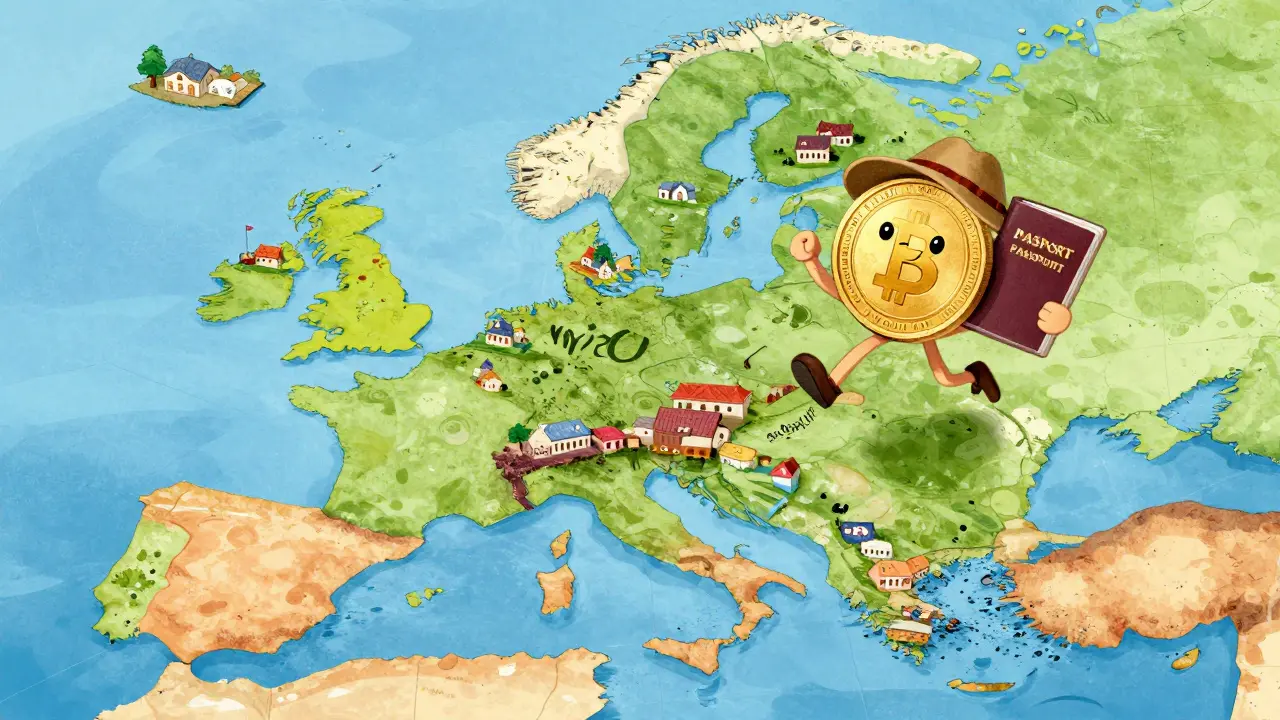
Imagine spending months getting a license to operate a crypto exchange in France, only to find out you have to start the entire process from scratch if you want to offer those same services in Germany or Spain. That was the fragmented reality for years. Now, the game has changed. The Markets in Crypto-Assets (MiCA) is the European Union's first comprehensive harmonized regulatory framework for crypto-asset services, designed to replace a patchwork of national laws with a single, unified rulebook. If you're running a crypto business in Europe, MiCA isn't just another layer of bureaucracy-it's your ticket to scaling across 27 different countries without losing your mind to red tape.
The Magic of the EU Passport System
The most significant shift under MiCA is the introduction of the passport system. In simple terms, if you are an authorized Crypto-Asset Service Provider (CASP) in one EU member state (your "home" state), you can essentially "passport" those services into any other member state. You don't need to apply for 27 different licenses; you get one, and it works everywhere.
To make this happen, a CASP just needs to notify their home supervisor about their intention to go cross-border. This removes the massive compliance costs that used to kill startups before they could even grow. Instead of hiring 27 different legal teams, you can focus on one set of rules that applies from Dublin to Athens. It turns the EU into a single market for crypto, which is a huge win for anyone looking for economies of scale.
What It Actually Takes to Get Authorized
Getting that golden ticket (the CASP authorization) isn't a walk in the park. The EU has set a high bar to ensure users don't wake up to find their exchange has vanished overnight. If you're applying, you'll need to prove you have a solid organizational structure and a clear set of conduct rules. You can't just "wing it" with your operations; you need documented procedures that ensure you're acting in the best interests of your clients.
There are also heavy-duty financial requirements. You'll need to maintain specific own funds-basically a capital cushion-and carry insurance policies to protect against operational failures. If you're handling client funds, the safekeeping obligations are strict. You can't commingle client assets with your own business funds, a lesson the industry learned the hard way with the collapse of several major platforms in recent years.
For those playing in the big leagues, there's a special category. If your service hits 15 million active users annually within the EU, you're labeled a "significant" CASP. This means you'll face extra scrutiny and have to report directly to the European Securities and Markets Authority (ESMA), which acts as the top-level watchdog for the entire bloc.
| Entity Type | Core Requirement | Key Compliance Focus |
|---|---|---|
| Custodial Wallet Provider | CASP Authorization | Private key security & asset segregation |
| Crypto Exchange | CASP Authorization | Market abuse detection & trading conduct |
| Token Issuer | White Paper Publication | Transparency, reserve management, & redemption rights |
| Significant CASP | Enhanced Supervision | Direct reporting to ESMA |
The "Reverse Solicitation" Trap for Non-EU Firms
If you're a company based in the US, UK, or Asia, you might be wondering if you can just keep serving EU clients from afar. The short answer is: it's very risky. Under MiCA, if you want to actively promote your services or solicit clients within the EU, you must establish a legal entity inside the Union and get full CASP authorization.
There is a tiny loophole called "reverse solicitation." This is when a client in the EU seeks out your service entirely on their own, without any nudge or advertisement from you. In the past, firms used this as a shield to avoid regulation. However, ESMA has clamped down on this. Their guidelines make it clear that if you have a website targeting Europeans or a marketing campaign running in the EU, you aren't "reverse solicited"-you're actively operating and need a license.
Many global exchanges have already reacted by setting up EU subsidiaries. It's simply easier to pay for a local office and follow the rules than to risk a massive fine or a total ban from the world's largest single market.
Beyond the License: AML and Market Integrity
A license doesn't mean you're off the hook. MiCA works hand-in-hand with the Anti-Money Laundering Directive (AMLD). Every CASP must implement rigorous customer due diligence (KYC). You can't just let people open accounts with an email address; you need to know exactly who they are and where their money is coming from.
Then there's the issue of market abuse. If you're facilitating trades, you're required to have monitoring systems that can spot insider dealing or market manipulation. The EU is treating crypto markets more like traditional stock markets now. This means the days of "wash trading" to pump up volume are officially over for any legitimate business operating under MiCA.
Dealing with Stablecoins and Asset-Referenced Tokens
Not all crypto is created equal under MiCA. Stablecoins are split into Asset-Referenced Tokens (ART) and E-Money Tokens (EMT). If you're issuing these, the rules are even tighter than for service providers. You need a reserve of assets to back the token, and users must have a guaranteed right of redemption.
If you're an issuer, your most important document is the white paper. It's not just a marketing brochure; it's a legal disclosure. If the white paper contains misleading information, the issuer can be held liable. This transparency is meant to stop the "trust me, bro" era of token launches and replace it with actual accountability.
Common Pitfalls to Avoid
One of the biggest mistakes companies make is assuming a one-size-fits-all timeline. While MiCA is a regulation (meaning it's directly applicable), some EU countries have chosen shorter transitional periods for their local firms. This has created a bit of a mess where some companies are already fully compliant while others are still transitioning. Always check the specific deadline of the member state where you're basing your primary operations.
Another pitfall is the "activity-based" scope. MiCA doesn't care if you call yourself a "tech company" or a "software provider." If you provide a service that looks like a crypto-asset service (like managing wallets or executing trades), you fall under the regulation. Even embedded finance platforms-apps that integrate crypto as a small feature-can find themselves needing a CASP license if they handle the assets.
Can a non-EU company provide crypto services to EU citizens without a license?
Only through "reverse solicitation," which occurs when the client initiates the request entirely on their own. However, ESMA guidelines have made this very narrow. If you advertise in the EU, you generally need a CASP authorization and a legal entity within the EU.
What is the main benefit of the MiCA passport system?
The passport system allows a Crypto-Asset Service Provider (CASP) authorized in one EU member state to offer its services across all 27 EU countries without having to seek separate authorizations in each jurisdiction.
Who is considered a "significant" CASP under MiCA?
A CASP is deemed "significant" if it serves at least 15 million active users annually within the EU. These providers face stricter supervisory requirements and must report directly to ESMA.
Do I need a license if I only issue a token but don't trade it?
Yes, token issuers have their own set of obligations. Depending on the token type (like ARTs or EMTs), you may need authorization and must publish a compliant white paper and maintain reserves.
When did MiCA fully come into effect?
MiCA was implemented in phases. Regulations for asset-referenced and e-money tokens began on June 30, 2024, and the full framework for CASPs became applicable on December 30, 2024.
Next Steps for Your Business
If you're currently operating without a license in the EU, your first move should be a gap analysis. Compare your current operational procedures against the MiCA conduct rules. Do you have a clear policy on client asset segregation? Is your KYC process up to the AMLD standard? If not, those are your priorities.
For those outside the EU, decide whether your EU user base is large enough to justify the cost of a subsidiary. If you're relying solely on reverse solicitation, be prepared for national authorities to challenge your status. The safest path is to find a "friendly" EU member state with a competent regulator and start your CASP application there to unlock the passport system for the rest of the continent.

Matthew Wright
April 7, 2026 AT 09:45This is a solid breakdown!! The passporting aspect is definitely the biggest game changer here... it's about time the EU stopped making every single country act like its own little island in terms of regulation!!
Suvoranjan Mukherjee
April 9, 2026 AT 01:33Absolutely spot on! The shift toward a unified framework will drastically reduce the operational overhead for FinTech startups. By eliminating the redundant licensing hurdles, we're seeing a massive catalyst for liquidity and innovation across the Eurozone. It's all about that scalability, baby! 🚀
vijendra pal
April 9, 2026 AT 01:54everyone knows MiCA is just a start lol 😜 the real money is in how you handle the white paper requirements without getting sued by ESMA 📈💸
Bruce Micciulla Agency
April 9, 2026 AT 22:49the notion that this reduces bureaucracy is purely academic because the actual implementation of the conduct rules will likely create a new layer of reporting that will choke mid sized firms who cant afford the compliance software needed to track every single movement in real time which effectively just helps the big players get bigger while the small guys get crushed under the weight of the paperwork
June Coleman
April 11, 2026 AT 06:55Oh sure, let's just trust a single 'unified rulebook' to fix everything. Because governments are just so famous for making things simple and efficient, right? 🙄
Lauren Gilbert
April 12, 2026 AT 13:29It is quite fascinating when you consider the broader philosophical implication of this shift, as we are essentially watching the transition of decentralized ideals into a structured, institutionalized reality where the very essence of crypto-which was originally about bypassing the gatekeepers-is now being embraced and managed by the ultimate gatekeepers in the form of the EU commission, creating a strange paradox where the freedom of the technology is curtailed to ensure the safety of the masses in a way that feels both necessary and tragic.
Siddharth Bhandari
April 14, 2026 AT 07:30For those looking at the technical side, the asset segregation requirements are the most critical. Implementing a truly segregated wallet architecture that satisfies MiCA's auditing standards requires a significant shift in how keys are managed.
david head
April 15, 2026 AT 14:21totally agree with the passporting point 💯 makes things way easier for us
Sonya Bowen
April 16, 2026 AT 07:06Focus on the gap analysis first. It is the most efficient way to identify risk.
Arwyn Keast
April 16, 2026 AT 09:22Typical EU over-regulation. This 'harmonization' is just a fancy word for bureaucratic bloat that will stifle any real alpha. The sheer amount of capital requirements for CASPs is a joke, designed to keep the incumbents safe while pricing out actual innovators. Purely protectionist rubbish.
Emily 2231
April 16, 2026 AT 21:25THE EU IS JUST TESTING THE WATERS FOR A GLOBAL DIGITAL PANOPTICON This is not about safety its about CONTROL and surveillance via the AMLD directives they want every single satoshi tracked from birth to death. wake up people!!
Alexandra Lance
April 18, 2026 AT 06:52Imagine thinking 'reverse solicitation' is a real loophole in 2024 💅 honestly some of you are so naive it's almost cute. ESMA is basically just waiting for you to post one tweet to shut you down 🙄😂
Krystal Moore
April 19, 2026 AT 20:18I honestly can't believe how some people are okay with this! My privacy is being stripped away just so some exchange can have a 'golden ticket' to operate in 27 countries? This is literally a nightmare for anyone who actually cares about the original point of crypto!
alex rodea
April 20, 2026 AT 00:05Keep going! You got this!
Sharhonda Walker
April 21, 2026 AT 08:46i think the white paper part is the trickiest bit because if you make a small typo or mistake in the disclosurs you could be liable for a lot of money. be carefull with the wording!
Manisha Sharma
April 23, 2026 AT 06:59European regulations are so quaint compared to the scale of what we are building in India. They try to cage the wind with these 'frameworks' while the real revolution happens in the east. such a simplistic approach to complex digital assets lol
Adriana Gurau
April 24, 2026 AT 12:53The 'significant CASP' threshold is just a way to create a two-tier system of corporate nobility. Typical. 🙄
JERRY ORTEGA
April 25, 2026 AT 12:53just take it one step at a time guys. if you're a small shop just focus on that kyc first and the rest will fall into place
Carmelita Gonzales
April 26, 2026 AT 22:32it is good to see more clarity for the users anyway
akash temgire
April 27, 2026 AT 23:40The direct reporting to ESMA for significant CASPs is an overreach. It removes national sovereignty over financial supervision.
Carol Prates
April 28, 2026 AT 06:25Omg the part about the 'trust me bro' era is literally so true! I've lost so much money to those kinds of launches, I'm just glad someone is finally putting some rules in place even if the process is a total mess! 😂
Nicholas Whooley
April 29, 2026 AT 07:45I believe this framework will ultimately foster a more inclusive environment for institutional investors who were previously too intimidated by the regulatory uncertainty to enter the space.
Patty Levino
April 29, 2026 AT 09:44Just a heads up for anyone struggling with the KYC transition, there are some great mid-ware tools that can help bridge the gap without needing to rebuild your entire backend.
gladys christine
May 1, 2026 AT 04:05YESSSS to no more red tape!!! Finally we can just breathe and grow across the whole EU without feeling like we are doing 27 different jobs at once!!!
Robert Coskrey
May 2, 2026 AT 18:40I concur with the assessment of the passport system's utility... it is indeed a most efficient mechanism for market expansion!!
Brooke Herold
May 4, 2026 AT 05:52It is interesting to see how different cultures in the EU react to this, but the goal of unity is clear.