
What Are Native Assets?
Native assets are the original cryptocurrencies that live on their own blockchains. Bitcoin (BTC) runs on the Bitcoin network. Ether (ETH) runs on Ethereum. Solana’s SOL runs on Solana. These assets aren’t copies or representations-they’re the real thing, built into the core protocol of their chain.
They follow the rules of their native network. Bitcoin uses proof-of-work with a 300+ exahash security network. Ethereum uses proof-of-stake and lets ETH pay for gas fees, vote in upgrades, and secure the network. There’s no middleman. No custodian. No bridge. Just the blockchain itself doing its job.
This makes native assets simple and secure. If you hold BTC, you’re directly interacting with the Bitcoin blockchain. No one else holds your coins. No third party can freeze them. That’s why Bitcoin purists prefer native assets-they match the original vision of decentralized money.
What Are Wrapped Assets?
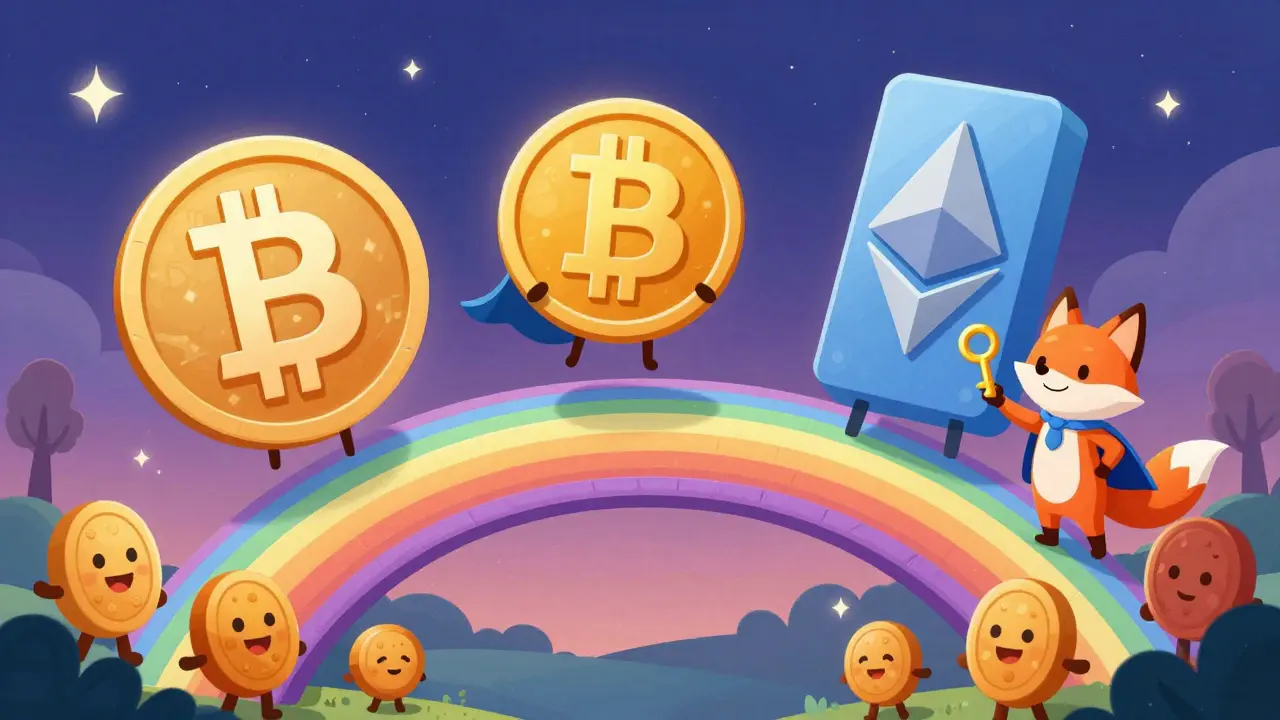
Wrapped assets are tokens that represent a native asset on a different blockchain. The most famous example is Wrapped Bitcoin (WBTC), which lets you use Bitcoin on Ethereum. Here’s how it works: you send your BTC to a trusted custodian, like BitGo. In return, you get an equal amount of WBTC on Ethereum-a token that acts like BTC but runs on Ethereum’s network.
Every WBTC is backed 1:1 by real BTC locked in a multisig wallet. When you want your BTC back, you burn the WBTC, and the custodian releases the original Bitcoin. The same process applies to Wrapped Ether (WETH), which is just ETH wrapped to fit ERC-20 standards, or wSOL on Solana.
These tokens aren’t new money. They’re digital receipts. But they’re powerful because they let assets move between chains. Without wrapped tokens, Bitcoin couldn’t be used in Ethereum DeFi apps like Aave or Compound. Now, over $12.5 billion in wrapped assets are locked in DeFi protocols as of late 2023.
Why Do Wrapped Assets Exist?
Blockchains are isolated. Bitcoin can’t talk to Ethereum. Ethereum can’t directly interact with Solana. That’s a problem when you want to earn interest on your BTC using Ethereum’s lending platforms.
Wrapped assets solve this. They bridge the gap. A Bitcoin holder can lock their BTC, mint WBTC, and then lend it on Aave to earn 4.2% APY-something impossible with native BTC. This brings billions in idle capital into DeFi ecosystems that need liquidity.
It’s not just about Bitcoin. Ethereum’s native ETH can’t be used on Solana. But wETH can. Polygon, Avalanche, and BSC all rely on wrapped versions of major assets to fuel their DeFi markets. Without them, cross-chain DeFi wouldn’t exist.
Big institutions are catching on too. JPMorgan uses a wrapped version of its JPM Coin across seven blockchains. Circle wraps USDC for 14 different chains. Even Fidelity is exploring wrapped Bitcoin for traditional finance clients.
Security: Native vs Wrapped
Native assets are secure because their security is baked into the blockchain. Bitcoin’s network has over 300 exahashes of computational power backing it. No single entity controls it. If you hold BTC, you’re protected by thousands of miners worldwide.
Wrapped assets rely on trust. WBTC, for example, depends on BitGo and 18 merchant partners to hold the real Bitcoin. If BitGo gets hacked, goes offline, or refuses to release funds, your WBTC becomes useless. During the FTX collapse in 2022, users with wrapped tokens tied to centralized exchanges faced 72-hour delays withdrawing funds.
Even decentralized wrapped tokens aren’t risk-free. In 2022, security researcher Samczsun found that 63% of wrapped token protocols had critical smart contract flaws. The Nomad bridge hack in August 2022 lost $600 million because of a flaw in its cross-chain message system.
Native assets win on security. Wrapped assets win on access. You trade some decentralization for functionality.
Performance and Cost: Speed, Fees, and Usability
Native Bitcoin transactions take about 10 minutes to confirm. Fees can spike to $25 during busy periods. Ethereum transactions? 15-30 seconds, with fees between $0.50 and $5.00-much faster and cheaper for DeFi.
That’s why people wrap BTC into WBTC. It’s not just about using Bitcoin in DeFi-it’s about using it efficiently. You can swap WBTC for DAI, lend it, and withdraw your earnings-all within minutes, with low fees.
But there’s a catch. Wrapping and unwrapping costs money. Coinbase charges a 0.875% fee to mint WBTC. Some platforms add network fees on top. And if you accidentally send WBTC to a Bitcoin address? Your tokens are gone. Etherscan recorded $2.1 million in stranded WBTC assets in 2023 because users didn’t understand the difference between networks.
Beginners often spend 3-5 hours learning how wrapped assets work. One common mistake? Using the wrong wallet network. MetaMask support tickets show that 37% of issues involve users sending wrapped tokens on the wrong chain.
Market Adoption and Trends
As of late 2023, WBTC controls 78% of the wrapped Bitcoin market. renBTC has 12%, and sBTC has 8%. There are 47 different wrapped Bitcoin implementations-but most are dead or unused.
Most wrapped assets are still centralized. But that’s changing. Chainlink’s CCIP protocol, in beta as of late 2023, aims to replace custodians with decentralized oracles. Instead of trusting BitGo, you’d trust a network of nodes verifying cross-chain transfers.
Zero-knowledge proofs are also emerging. Projects like zkBridge use cryptographic proofs to verify asset locks without relying on custodians. Experts predict these trust-minimized solutions will make up 65% of the market by 2025.
Meanwhile, native chains are improving. Ethereum’s Shanghai upgrade in 2023 let users withdraw staked ETH directly, reducing the need for stETH, a wrapped version of staked Ether. As native features grow, the need for wrapped tokens shrinks.
When to Use Each
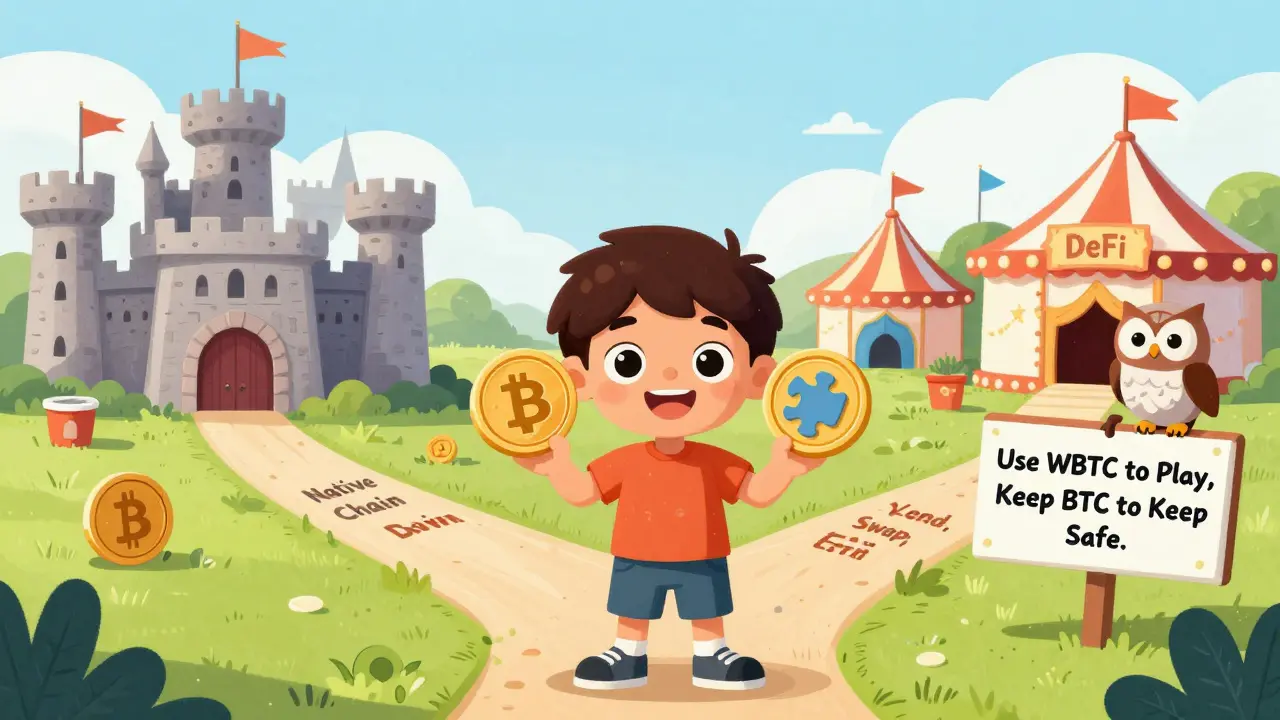
Use native assets when you care about security, decentralization, and direct control. Hold BTC if you want true censorship resistance. Use ETH to pay gas, vote on upgrades, or stake. Native is best for long-term holding and core protocol interaction.
Use wrapped assets when you want to participate in DeFi on another chain. Want to earn yield on your Bitcoin? Use WBTC on Ethereum. Need to trade SOL on Polygon? Use wSOL. Wrapped assets are tools for liquidity and access-not for holding.
Don’t use wrapped assets if you don’t understand custody. If you’re unsure who holds your original coins, don’t wrap them. Stick to native chains until you’re confident.
What’s Next?
The future of wrapped assets isn’t about more tokens-it’s about better infrastructure. The goal isn’t to wrap everything forever. It’s to make cross-chain communication seamless so wrapped tokens become unnecessary.
Vitalik Buterin believes native cross-chain messaging will eventually replace wrapping. Gavin Wood thinks we’ll need wrapped assets for 5-7 more years as blockchains mature.
For now, wrapped assets are the glue holding DeFi together. They’re not perfect. They’re not decentralized. But they’re working. Billions are moving through them. And until blockchains can talk natively, we’ll keep wrapping.
Are wrapped assets safe to hold long-term?
No, wrapped assets aren’t ideal for long-term holding. They rely on custodians or smart contracts, which can fail, get hacked, or be shut down. If you want to hold Bitcoin or Ethereum for years, keep them as native assets. Wrapped tokens are for active use in DeFi-lending, swapping, earning yield-not for storage.
Can I convert WBTC back to Bitcoin anytime?
Yes, you can always burn WBTC to get back Bitcoin-but only if the custodian is operational. WBTC is backed by BitGo and 18 merchant partners. If they go offline or refuse to process requests (like during the FTX collapse), your redemption could be delayed for days or even weeks. Decentralized alternatives like renBTC reduce this risk but are slower and less liquid.
Why is WBTC worth more than Bitcoin sometimes?
WBTC should always be pegged 1:1 to Bitcoin. If it trades above BTC, it’s usually because of high demand in DeFi-like when users rush to mint WBTC to earn yield on Ethereum. Arbitrageurs quickly fix the price by minting more WBTC or selling excess. Persistent premiums are rare and usually short-lived.
Do wrapped assets pay dividends or rewards?
Wrapped assets themselves don’t pay rewards. But you can use them in DeFi protocols that do. For example, you can deposit WBTC into Compound or Aave to earn interest. The yield comes from the protocol, not the wrapped token. WETH can be staked in liquidity pools on Uniswap to earn trading fees. The token is just the vehicle.
What happens if the custodian of WBTC goes bankrupt?
If BitGo or any WBTC custodian fails, the locked Bitcoin might be frozen or seized. Since WBTC relies on centralized custody, you’re exposed to their legal and financial risks. Unlike Bitcoin, where you control your keys, WBTC users don’t own the underlying asset directly. This is why many experts recommend using WBTC only for short-term DeFi activities, not as a long-term store of value.
Is WETH the same as ETH?
WETH is just ETH wrapped to fit the ERC-20 standard. On Ethereum, ETH isn’t natively ERC-20, so it can’t be used in many DeFi apps. WETH solves that by wrapping ETH into a token that works with smart contracts. You can swap WETH for ETH 1:1 at any time. Functionally, they’re identical-except WETH is required for lending, swapping, and staking in most Ethereum-based protocols.


orville matibag
February 5, 2026 AT 03:26Honestly, I just use WBTC to earn yield on Ethereum. Don't overthink it. It's not about holding-it's about using. Native assets are for storage, wrapped are for action. Simple as that.
Been doing this since 2021. No issues. Just don't leave it there for years.
Josh Flohre
February 5, 2026 AT 11:58This post is technically accurate but criminally naive. You say 'no custodian' for native assets-then you praise WBTC’s 1:1 backing? BitGo is a custodian. A centralized, corporate, KYC’d custodian. You're glorifying a middleman with a fancy name. This isn't decentralization. It's rebranding.
Jesse Pasichnyk
February 7, 2026 AT 02:08If you're not holding BTC on the Bitcoin chain, you're not holding BTC. You're holding a digital IOU. Period. America needs to stop pretending wrapped assets are crypto. They're fintech with blockchain branding. Wake up.
Jordan Axtell
February 7, 2026 AT 12:48I used to think wrapped assets were just a bridge. Then I lost $8K in renBTC because the multisig went MIA for 72 hours. That's not a bridge. That's a trust fall with your life savings. And now they're calling it 'DeFi innovation'? We're not building the future-we're building a house of cards held together by hope and gas fees.
James Harris
February 7, 2026 AT 17:39Hey everyone, just wanted to say if you're new to this-start with native. Learn how to self-custody. Use MetaMask right. Watch a few tutorials. Then dip into WBTC for yield. Don't jump in blind. I was there. Took me 3 months to not mess up transfers. You got this 💪
aryan danial
February 9, 2026 AT 09:42The fundamental flaw in this entire discourse lies in the ontological assumption that blockchain interoperability can be achieved through tokenized representations rather than protocol-level consensus layer unification. One cannot ‘wrap’ sovereignty; one can only simulate it through centralized oracles, which, by definition, reintroduce the very trust assumptions that blockchain was designed to eliminate. Thus, the entire wrapped asset paradigm is not merely suboptimal-it is epistemologically incoherent.
Michelle Anderson
February 11, 2026 AT 00:53So you’re telling me I should trust BitGo with my Bitcoin but not a centralized exchange? LOL. Same people. Same risk. Same ‘oops’ moments. Wrapped assets are crypto’s version of a ‘I’m not a regular customer, I’m a premium member’ scam.
Kyle Pearce-O'Brien
February 12, 2026 AT 14:19The wrapped asset economy is the ultimate crypto irony: we built decentralized systems to escape banks... then created digital banks that run on smart contracts. 🤡
WETH? Sure. But WBTC? That’s just BTC on a leash. And the leash? Held by a corporation with a legal department. We’re not pioneers. We’re rentiers.
Matthew Ryan
February 14, 2026 AT 05:58I've used both. Native for long-term. Wrapped for active DeFi. It's not an either/or. It's a toolkit. Just know what you're using and why. Don't let fear or hype drive your moves.
Molly Andrejko
February 15, 2026 AT 11:33For anyone just starting out: if you're not sure whether to wrap or not, don't. Stick to native. Learn the wallet. Learn the network. Then experiment. I've seen too many people lose funds because they sent WBTC to a Bitcoin address. It's heartbreaking.
Alisha Arora
February 17, 2026 AT 06:47Why are people still using WBTC? renBTC is way more decentralized. And wSOL? Why not just use SOL on Solana? This whole thing feels like a meme. Someone made a token, slapped a 1:1 on it, and now we’re all pretending it’s real.
Mrs. Miller
February 18, 2026 AT 08:41Ah yes, the classic 'trust the bridge, not the custodian' argument. The same people who screamed 'not your keys, not your coins' now hand their BTC to BitGo and say 'it's fine'. The cognitive dissonance here is beautiful. 🤭
Michael Sullivan
February 19, 2026 AT 05:23WBTC > BTC in DeFi? Nah. WBTC is just a placeholder. A temporary fix. Like using duct tape on a broken engine. It works... until it doesn't. And when it doesn't? You're stuck with a $2M token that can't be redeemed. 🤡
Reda Adaou
February 20, 2026 AT 09:36I use wSOL on Polygon for yield farming. It’s not perfect, but it’s better than letting my SOL sit idle. I know the risks. I accept them. That’s what crypto is: calculated risks. Not fear.
perry jody
February 22, 2026 AT 01:40If you’re still debating wrapped vs native, you’re not ready for DeFi. Just use native. Wait. Then come back. No rush. The market’s not going anywhere. 🙌
Paul Jardetzky
February 23, 2026 AT 18:42One thing everyone misses: wrapped assets aren’t just for Bitcoin. They’re for EVERYTHING. Want to use ETH on Solana? WETH. Want to use USDC on Avalanche? wUSDC. This isn’t a bug-it’s the feature. The chains aren’t talking. We’re building the translator.
Paul Gariepy
February 24, 2026 AT 11:38I lost 0.2 BTC once because I sent WBTC to a BTC address. Took me 3 weeks to get help. No one responded. No one cared. That’s the reality. Wrapped assets are convenient… until they’re not. Then you’re alone. Don’t be lazy. Learn the networks.
Jim Laurie
February 25, 2026 AT 08:17I used to be anti-wrapped. Then I started earning 8% APR on my BTC in Aave. That’s more than my savings account. So I wrapped. I still hold native BTC for long-term. But for yield? Wrapped is the only way. It’s not betrayal-it’s adaptation.
Sharon Lois
February 25, 2026 AT 13:45BitGo is a front for the Fed. WBTC is a backdoor into the banking system. They want you to think crypto is decentralized… so you’ll keep using it. Then they freeze it. Watch. 2025 is the year they pull the plug.
Oliver James Scarth
February 26, 2026 AT 11:38The notion that wrapped assets represent a legitimate form of cross-chain liquidity is, in my view, a profound misunderstanding of both cryptographic sovereignty and economic architecture. The tokenization of native assets introduces counterparty risk where none previously existed. One cannot claim decentralisation while relying upon custodial intermediaries. This is not innovation-it is regression dressed in Web3 clothing.
Kieren Hagan
February 27, 2026 AT 05:39Native assets = security. Wrapped assets = utility. Don't conflate the two. Use WBTC to earn yield. Hold BTC to store value. Different tools. Different goals. Simple.
sachin bunny
February 27, 2026 AT 07:10They say 'trust the code'... but the code doesn't hold your BTC. BitGo does. So who really controls your money? The blockchain? Or a guy in a suit with a server farm? 🤔
Olivette Petersen
February 27, 2026 AT 08:21I love that we’re having this conversation. It means we’re thinking. Not just buying. Not just FOMOing. Thinking. That’s the first step to real crypto literacy. Keep asking questions.
Danica Cheney
March 1, 2026 AT 05:39wrapped assets are just crypto fanfic
Shruti Sharma
March 2, 2026 AT 00:44i use wbtc because eth gas is cheaper than btc fees. duh. why overthink? i want to earn yield. not live in a philosophy lab.
Robin Ødis
March 2, 2026 AT 14:18The entire wrapped asset ecosystem is a psychological trap. You think you’re owning Bitcoin because you see ‘BTC’ on your wallet. But you’re not. You’re owning a promise. And promises? They’re only as good as the person who made them. And guess what? That person works for a corporation. With shareholders. With lawyers. With quarterly reports. You’re not a crypto degenerate. You’re a bondholder.
Jacque Istok
March 2, 2026 AT 19:37WETH exists because ETH isn’t ERC-20. That’s a design flaw in Ethereum, not a feature. If native assets are so perfect, why did they need to be wrapped just to work? The answer? They’re not perfect. And pretending they are is why we’re stuck with this mess.
Josh Flohre
March 4, 2026 AT 13:57Exactly. ETH was never meant to be non-ERC-20. It’s a hack on a hack. WBTC? Same story. We’re building a Rube Goldberg machine to solve problems that shouldn’t exist. The real innovation? Native cross-chain. Not wrapping.