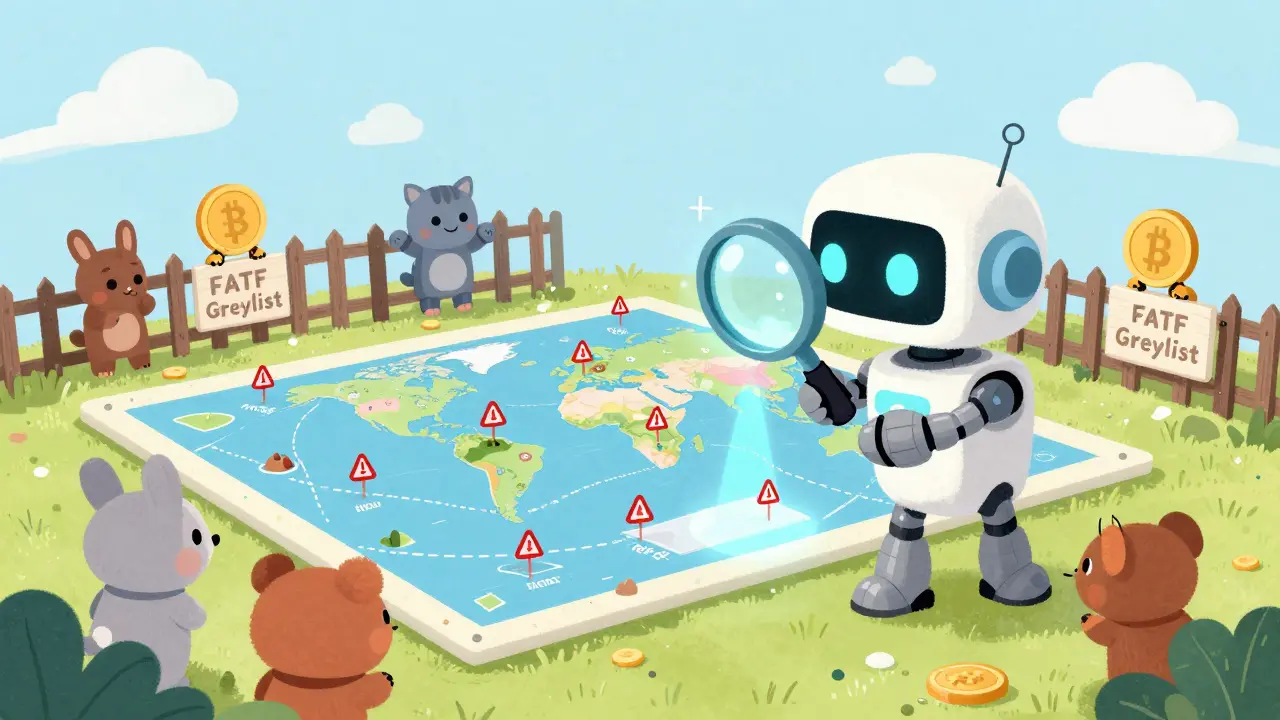
FATF Greylist Checker
Check if a country is on the FATF Greylist
As of June 2025, 24 countries are on the FATF greylist. Enter a country name to see if it's restricted for crypto transactions.
When you send crypto from one wallet to another, you might think it’s just a digital transfer. But behind the scenes, banks, exchanges, and regulators are watching closely - especially if money is moving to or from a country on the FATF greylist. As of June 2025, 24 countries are under increased monitoring by the Financial Action Task Force for weak anti-money laundering and counter-terrorism financing controls. That list isn’t just bureaucratic noise. It directly affects your ability to trade, transfer, or even hold crypto if you’re connected to any of these places.
What the FATF Greylist Actually Means
The FATF isn’t a law enforcement agency. It’s a global standard-setter. Founded in 1989, it creates rules that over 200 countries agree to follow. When a country lands on the greylist, it means FATF has found serious gaps in how it stops criminals from using its financial system - including crypto. The country isn’t banned. But banks and crypto firms treat it like a red flag. Countries on the greylist have agreed to fix these problems within a set timeframe. But until they do, every transaction involving them gets extra scrutiny. That means longer waits, more paperwork, and sometimes outright blocks. For crypto users, this isn’t theoretical. It’s daily reality.The 2025 FATF Greylist: Who’s On It
As of June 2025, the greylist includes:- Algeria
- Angola
- Bolivia
- Bulgaria
- Burkina Faso
- Cameroon
- Côte d’Ivoire
- Democratic Republic of the Congo
- Haiti
- Kenya
- Laos
- Lebanon
- Monaco
- Mozambique
- Namibia
- Nepal
- Nigeria
- South Africa
- South Sudan
- Syria
- Venezuela
- Vietnam
- Virgin Islands (UK)
- Yemen
Why Crypto Gets Hit Harder Than Banks
Traditional banks have decades of compliance systems. Crypto exchanges? Many are still building them from scratch. And here’s the problem: blockchain transactions are anonymous by design. A Bitcoin address doesn’t say “Nigeria” or “Syria.” But regulators don’t care about design - they care about risk. That’s why exchanges now use blockchain analytics tools like Chainalysis and Elliptic. These tools track where crypto moves. If a wallet has ever interacted with a known entity in a greylist country, the transaction gets flagged. You might get asked: “Where did this money come from?” If you can’t answer, your account gets frozen. And it’s not just about sending crypto to those countries. If you live in Nigeria and buy Bitcoin on a global exchange, your account might still be flagged. Why? Because the exchange doesn’t know if your funds came from a local peer-to-peer seller who’s connected to a greylisted network. So they play it safe - and restrict you.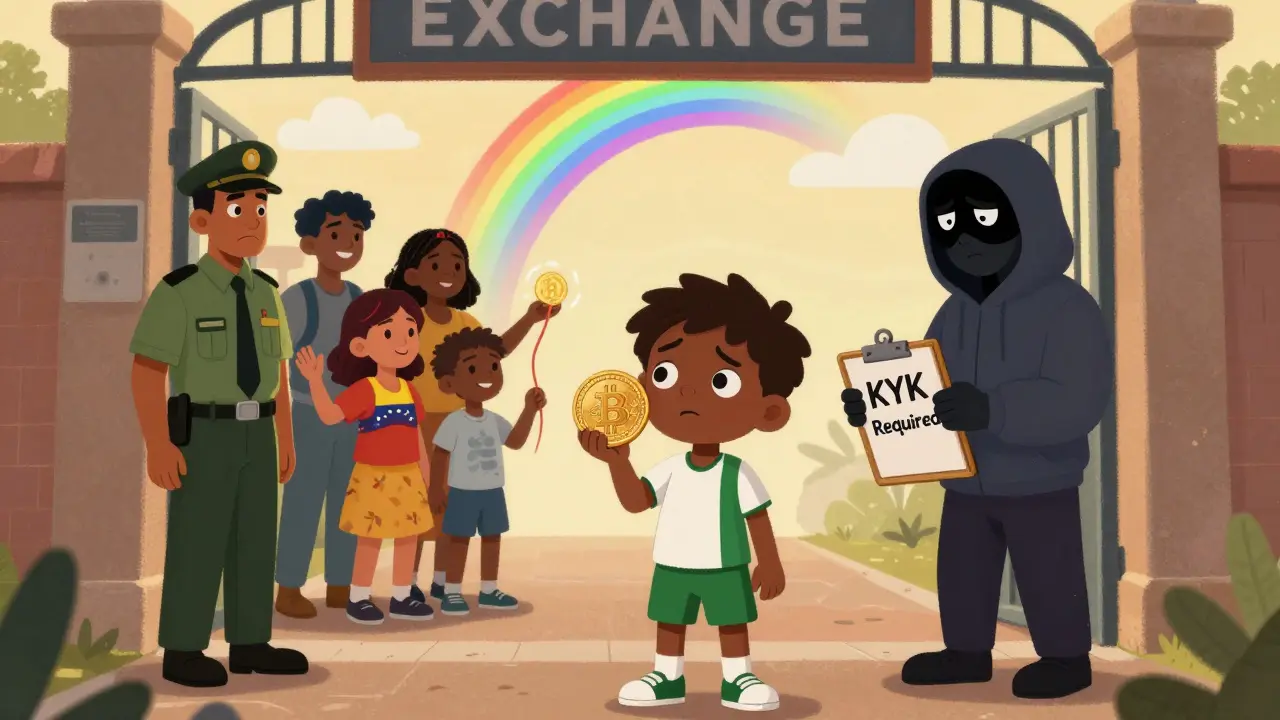
Real-World Impact: Stories From the Ground
In Nigeria, crypto adoption exploded after the naira’s collapse. But since Nigeria was greylisted in 2019, major exchanges like Binance and Kraken have restricted withdrawals and deposits. Many users turned to decentralized platforms or peer-to-peer apps. But even those aren’t safe. P2P sellers in Nigeria now face higher fees, longer settlement times, and increased risk of scams - because buyers are terrified of getting flagged. In Venezuela, people use crypto to survive hyperinflation. But when they try to cash out to USD via an exchange, their accounts get locked. Why? Because the exchange’s compliance system sees Venezuela as high-risk. Even if you’re just buying food, you’re treated like a money launderer. South Africa’s 2024 listing came after years of corruption scandals. The government knew it was coming. But instead of fixing the system, some local crypto firms just moved their servers offshore. That didn’t help users. It just made compliance harder and more expensive for everyone else.Blacklist vs. Greylist: The Crypto Difference
The FATF blacklist is worse. It includes North Korea, Iran, and Myanmar. These countries aren’t just monitored - they’re isolated. Crypto exchanges are legally required to block all transactions to and from these places. If you try to send Bitcoin to a North Korean wallet, the transaction won’t go through. Period. Some exchanges even freeze accounts if they detect any past interaction with a blacklisted address. But here’s the twist: criminals don’t care. North Korea’s Lazarus Group has stolen over $3 billion in crypto since 2017. Iran’s government is developing its own digital currency to bypass sanctions. In Myanmar, crypto is now the main way people send money after the military coup shut down banks. So while FATF rules make life harder for regular users, they don’t stop bad actors. They just push them into darker corners of the crypto world - where there’s no oversight, no recourse, and no protection.What Crypto Platforms Are Doing About It
Large exchanges like Coinbase, Kraken, and Binance have global compliance teams that update their systems every time FATF changes the list. When Bolivia was added in June 2025, their screening tools were updated within 48 hours. Smaller platforms? Many don’t have the resources. That’s why you’ll see some exchanges refuse to serve users from certain countries altogether. The cost of compliance is huge. One mid-sized exchange told me they spend over $2 million a year just on blockchain monitoring software and legal reviews. That’s why many now charge higher fees for users from greylist countries - or ban them outright. Some platforms try to be smart. They allow deposits from greylist countries but block withdrawals unless you prove your identity and source of funds. Others use geolocation and IP checks. But none of this is perfect. A VPN can bypass location checks. A fake ID can fool basic verification.
The Hidden Cost: How Greylisting Hurts Economies
Greylisting isn’t just a crypto problem. It’s an economic one. Pakistan was greylisted from 2008 to 2019. During that time, it lost an estimated $38 billion in foreign investment and trade. Banks refused to open accounts. Investors pulled out. Even legitimate businesses struggled to pay suppliers abroad. Albania tried to launch a voluntary tax program in 2020. FATF blocked it because the system didn’t meet their standards. The government had to scrap it - even though most citizens supported it. In South Africa, 82% of people believe corruption got worse in 2023. That’s why FATF added them. But punishing the whole country doesn’t fix the problem. It just hurts ordinary people trying to use crypto to save money or send remittances.What You Can Do If You’re Affected
If you live in a greylist country and use crypto:- Use regulated exchanges with strong KYC. Avoid unregulated P2P platforms if you want to avoid freezes.
- Keep records of every transaction - who sent it, why, and how you got the funds.
- Don’t use mixers or privacy coins to hide activity. That raises red flags faster than anything.
- Check if your exchange has a support channel for users from your country. Some offer special compliance paths.
- Be patient. If your account is flagged, respond quickly to verification requests. Delays make things worse.
The Future: More Rules, More Tech
FATF is working on new rules for DeFi and decentralized exchanges. The “Travel Rule” - which requires exchanges to share sender and receiver info - might soon apply to all crypto transfers over $1,000. That’s huge. Right now, only centralized platforms follow it. Soon, even decentralized apps might need to track users. Central Bank Digital Currencies (CBDCs) are also changing the game. Countries like Nigeria and Vietnam are launching their own digital money. FATF will soon require these to include built-in compliance - meaning your digital naira or dong might be traceable from day one. The goal isn’t to kill crypto. It’s to make it safer. But right now, the rules are blunt. They punish honest users because criminals exploit the system. Until FATF and countries work together to fix corruption and enforcement, the greylist will keep growing - and crypto users will keep paying the price.Which countries are currently on the FATF greylist in 2025?
As of June 2025, the FATF greylist includes 24 countries: Algeria, Angola, Bolivia, Bulgaria, Burkina Faso, Cameroon, Côte d’Ivoire, Democratic Republic of the Congo, Haiti, Kenya, Laos, Lebanon, Monaco, Mozambique, Namibia, Nepal, Nigeria, South Africa, South Sudan, Syria, Venezuela, Vietnam, Virgin Islands (UK), and Yemen. Bolivia and the UK Virgin Islands were added in June 2025, while Croatia, Mali, and Tanzania were removed after completing their reform plans.
Does being on the FATF greylist mean crypto is banned in those countries?
No, crypto isn’t banned in greylist countries. But international exchanges often restrict services to users from those regions. You might face withdrawal limits, longer verification times, or blocked transactions. Local crypto use still happens - especially in places like Nigeria and Venezuela where people rely on it to protect savings from inflation. The issue isn’t legality - it’s compliance risk for global platforms.
How do crypto exchanges know if a transaction involves a greylist country?
Exchanges use blockchain analytics tools like Chainalysis and Elliptic that track wallet histories. If a wallet has ever interacted with a known address linked to a greylist country - even indirectly - it gets flagged. Exchanges also check user IP addresses, KYC documents, and bank details. It’s not foolproof, but it’s enough to trigger manual reviews and possible account restrictions.
Can I avoid FATF restrictions by using a VPN or anonymous wallet?
Using a VPN or anonymous wallet might hide your location, but it increases your risk. Exchanges flag privacy tools and mixers as high-risk behavior. If you’re caught trying to bypass compliance, your account could be permanently banned. Worse, you might unknowingly interact with criminal wallets. FATF rules exist to protect users - not just governments. Avoiding them doesn’t make you safer; it makes you a target.
Why do some countries stay on the greylist for years, even if they fix their laws?
FATF doesn’t just look at laws - it checks if they’re enforced. Syria and Yemen technically met their reform goals by 2024, but FATF can’t send inspectors there due to war. South Africa passed new laws, but corruption in government agencies still blocks enforcement. Without real action on the ground, FATF won’t remove a country - no matter how good the paperwork looks.
What happens if I accidentally send crypto to a greylist country?
If you accidentally send crypto to a greylist country, your exchange will likely freeze your account and ask for details about the transaction. You’ll need to prove the transaction was legitimate - like sending money to a family member or paying for a service. If you can provide proof (invoices, messages, IDs), your account may be restored. If not, you could face a longer investigation or even permanent restriction. Always double-check addresses before sending.


Tara Marshall
December 8, 2025 AT 10:02This is why I only use regulated exchanges. No drama, no surprises.
Joe West
December 10, 2025 AT 09:33I live in Nigeria and this hits hard. We use crypto to feed our families, not launder money. But every time I try to cash out, I get ghosted by the exchange. It's not fair.
Jon Visotzky
December 10, 2025 AT 12:32So if I use a VPN to access Binance from Kenya, does that make me a criminal or just someone trying not to get locked out of their own money?
Scott Sơn
December 10, 2025 AT 12:37FATF is basically treating entire nations like sketchy ATM machines. Meanwhile, the real bad actors? They're laughing in Swiss vaults with private jets. The system's broken.
Lore Vanvliet
December 11, 2025 AT 08:01Oh here we go again. Another ‘crypto is dangerous’ panic because some corrupt government didn’t fix paperwork. Meanwhile, my uncle in South Africa sends crypto to his kids in the UK every week. He’s not laundering-he’s surviving. But sure, let’s punish him.
ronald dayrit
December 12, 2025 AT 16:03The fundamental irony here is that the very technology designed to decentralize trust is being strangled by centralized bureaucratic fear. Blockchain offers immutable, transparent ledgers-yet we rely on opaque, human-driven compliance systems that misfire 80% of the time. The solution isn’t more rules, it’s better data. But power doesn’t like transparency-it likes control.
Martin Hansen
December 12, 2025 AT 22:03If your country can’t stop money laundering, maybe you shouldn’t be allowed to touch crypto at all. This isn’t discrimination-it’s common sense. You don’t let a drunk driver near a car, and you don’t let corrupt regimes near global finance.
Elizabeth Miranda
December 14, 2025 AT 20:50I get why exchanges do this. But it’s heartbreaking to see people in Venezuela or Nigeria get treated like criminals just because their government is corrupt. The tech didn’t fail them. The system did.
Regina Jestrow
December 16, 2025 AT 14:15I’ve seen people in Lagos use crypto to pay for insulin. Not for speculation. Not for crime. For life. And now they’re being blocked because FATF says their banking system is ‘weak.’ What’s weak is the assumption that one size fits all.
Mairead Stiùbhart
December 18, 2025 AT 10:33Oh please. You think Nigeria’s on the list because they’re bad at fighting crime? No, they’re on it because Western banks don’t want to process their transactions. The real crime is economic colonialism dressed up as compliance.
Neal Schechter
December 18, 2025 AT 22:00I work in compliance for a mid-sized exchange. We spend more on blockchain analytics than on engineering. It’s insane. And 95% of the flags are false positives. People just trying to send rent money get flagged because their wallet once interacted with a mixer 3 years ago.
Nicole Parker
December 19, 2025 AT 17:11It’s not just about rules-it’s about dignity. When you live in a country that’s been exploited for decades, crypto is one of the few tools left to reclaim agency. But instead of helping, the system punishes the vulnerable. That’s not safety. That’s silence dressed as security.
Cristal Consulting
December 19, 2025 AT 21:41If you’re in a greylist country, use KYC-compliant platforms. Keep receipts. Don’t use mixers. Be patient. It’s annoying, but it works. I’ve helped 12 people get their accounts restored just by submitting proof of income and transaction history.
Chloe Hayslett
December 21, 2025 AT 01:39So let me get this straight-people in Nigeria can’t use crypto because their government is corrupt, but Americans can buy Bitcoin with credit cards earned from selling surveillance tech to said governments? What a joke.
Glenn Jones
December 22, 2025 AT 04:11FATF is a paper tiger. They’re terrified of crypto because it exposes their own corruption. They don’t want transparency-they want control. And they’re using ‘compliance’ as a weapon to crush innovation in the Global South. This isn’t about crime. It’s about power.
Frank Cronin
December 23, 2025 AT 20:28If you’re using crypto in a greylist country, you’re either a criminal or a naive fool. Either way, you’re a liability. Stop pretending this is about human rights-it’s about risk management. And guess what? Your risk is my cost.
miriam gionfriddo
December 25, 2025 AT 01:38I work for a blockchain analytics firm and I can tell you-half the flagged wallets are just people who bought ETH from a P2P seller who once got scammed. The system is so broken it flags grandmas sending birthday money. We’re not protecting anyone-we’re just making everyone paranoid.
Noriko Robinson
December 26, 2025 AT 14:40I’m from Nepal. We don’t have banks. We don’t have credit cards. But we have crypto. It’s how my sister pays for her medical treatment. FATF doesn’t care about that. They care about paperwork. I wish they’d come here and see what real financial exclusion looks like.
Isha Kaur
December 26, 2025 AT 19:57In India, we’re watching this closely. We’re building our own CBDC. But we’re also pushing for interoperability with global crypto networks. If FATF keeps treating entire countries as threats, we’ll end up with two separate crypto worlds-one for the rich, one for the rest. And that’s not innovation. That’s apartheid.
Roseline Stephen
December 28, 2025 AT 10:37I don’t have a strong opinion. Just wanted to say thanks for the detailed post. Helpful.