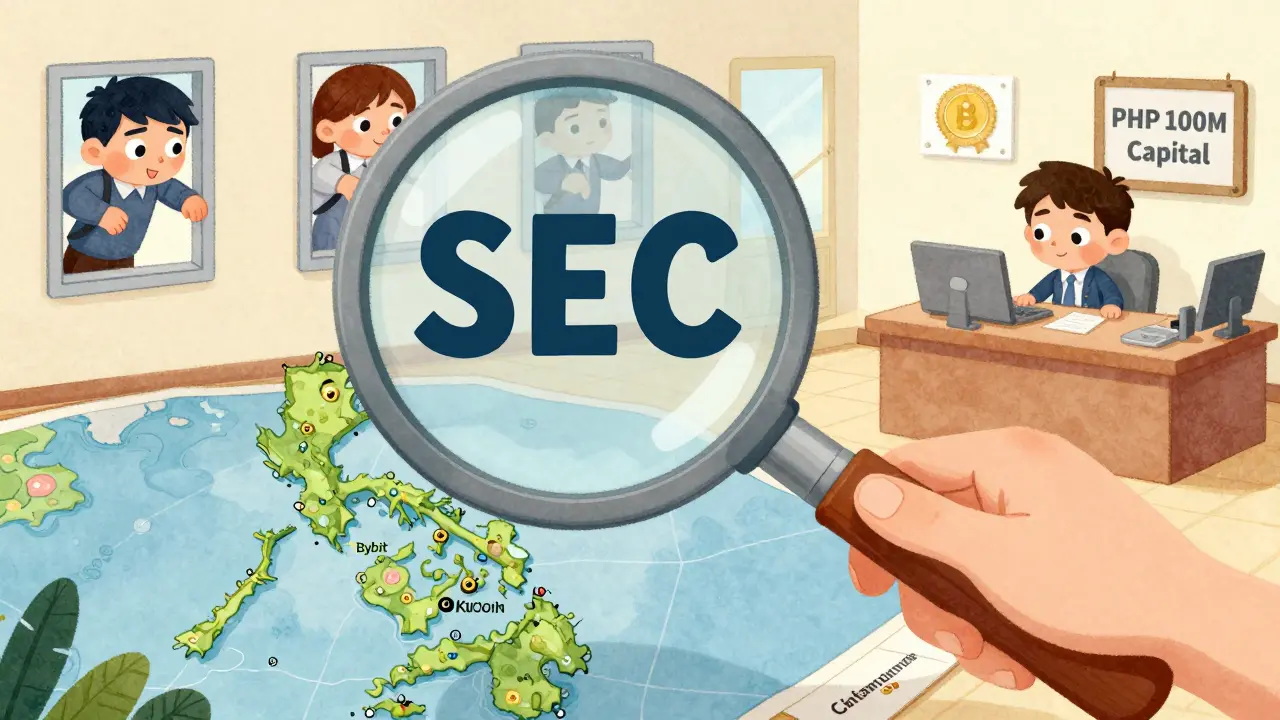
Before July 5, 2025, anyone could run a crypto exchange in the Philippines without permission. That changed overnight. The Securities and Exchange Commission (SEC) didn’t just tighten rules - it rewrote the entire game. Now, every platform serving Filipino users must be licensed. No exceptions. No loopholes. If you’re trading Bitcoin, Ethereum, or any other crypto in the Philippines, you’re now under the SEC’s watch.
Who Needs a License?
The SEC calls them Crypto Asset Service Providers, or CASPs. That’s any company offering services like trading, custody, staking, or even marketing crypto assets to people in the Philippines. It doesn’t matter if you’re based in Singapore, the U.S., or Estonia. If your website accepts Filipino users, you need a license. This rule targets big names like OKX, Bybit, KuCoin, and Kraken - all of which were publicly warned in August 2025 for operating illegally. The same fate befell Binance in 2024, when it was blocked from the local market after failing to register.
The Minimum Requirements
Getting licensed isn’t easy. The SEC set hard numbers that most international exchanges can’t meet without major changes. First, you must be a registered domestic corporation in the Philippines. That means setting up a legal entity here, not just a PO box or a virtual office. Second, you need at least PHP 100 million in paid-up capital - roughly $1.8 million USD - and this money must be in Philippine pesos or fiat currency. Crypto assets don’t count. You can’t use Bitcoin to prove you’re solvent.
You also need a physical office in the Philippines. No remote teams. No outsourcing. The SEC wants someone on the ground who can show up for audits, answer questions, and handle emergencies. This alone blocks many small exchanges that can’t afford to open a local branch.
What You Must Submit
When you apply, you’re not just filling out a form. You’re handing over a full compliance package. The SEC requires:
- Business rules detailing how you operate
- Full AML (Anti-Money Laundering) and KYC (Know Your Customer) systems
- Clear risk control plans for market volatility and cyberattacks
- A disclosure plan for all crypto offerings
- Proof that customer funds are kept separate from company funds
All of this must be submitted at least 30 days before you start marketing or accepting users. No exceptions. Even if you’re just planning to launch a new token, you can’t promote it until the SEC has reviewed and approved your disclosure documents.
Marketing Rules: No False Promises
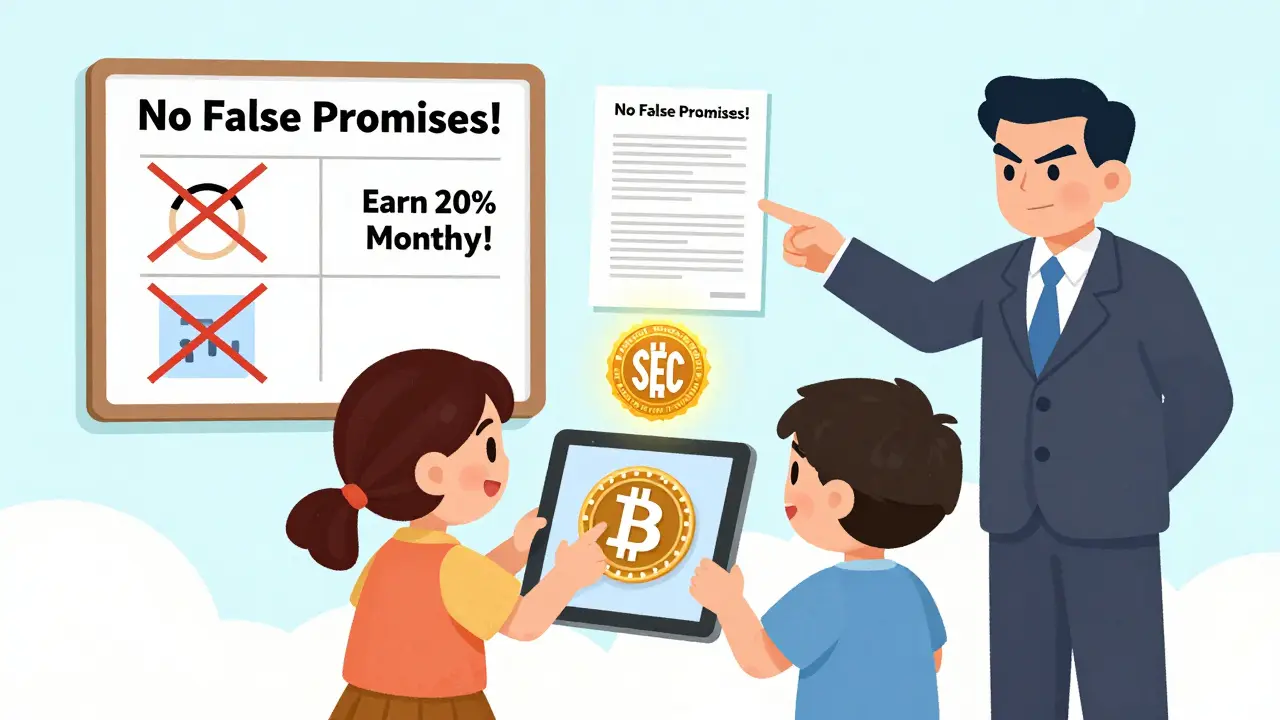
The SEC doesn’t allow crypto ads that say things like “Earn 20% monthly returns” or “Bitcoin will hit $100K next year.” Those are banned. You can mention historical performance, but you can’t predict future prices. Every marketing campaign - whether it’s on Facebook, TikTok, or YouTube - must include a disclosure document filed with the SEC. That document must be published on your website, app, and all social media channels. You can’t hide it behind a login page. It has to be public, clear, and easy to find.
Financial Reporting and Oversight
Licensing isn’t a one-time event. Once approved, you’re under constant supervision. You must submit detailed monthly financial reports to the SEC. These include revenue, user numbers, transaction volumes, and asset holdings. The SEC also requires regular audits by independent firms to check your AML controls. If you fail an audit, your license can be suspended or revoked.
Another key rule: customer funds must be held in segregated accounts. This means your users’ Bitcoin or Ethereum can’t be mixed with your company’s money. If your exchange goes bankrupt, users still get their assets back. This rule was added after the collapse of several global exchanges in 2022 and 2023, where users lost millions because companies used their funds to cover losses.
Fines and Penalties
Breaking the rules isn’t a slap on the wrist. The SEC can fine you anywhere from PHP 50,000 to PHP 10 million per violation. That’s $900 to $180,000 USD. If you keep operating illegally, you’ll pay an extra PHP 10,000 per day - roughly $180 - until you comply. In practice, this means a non-compliant exchange could rack up millions in fines within weeks.
The SEC has already started enforcing this. After issuing public advisories against ten major exchanges in August 2025, the next step could be website blocking. If a platform refuses to register, the government may order internet providers to cut off access. This already happened with Binance. Filipino users couldn’t load the site unless they used a VPN.
Who’s Winning Under the New Rules?
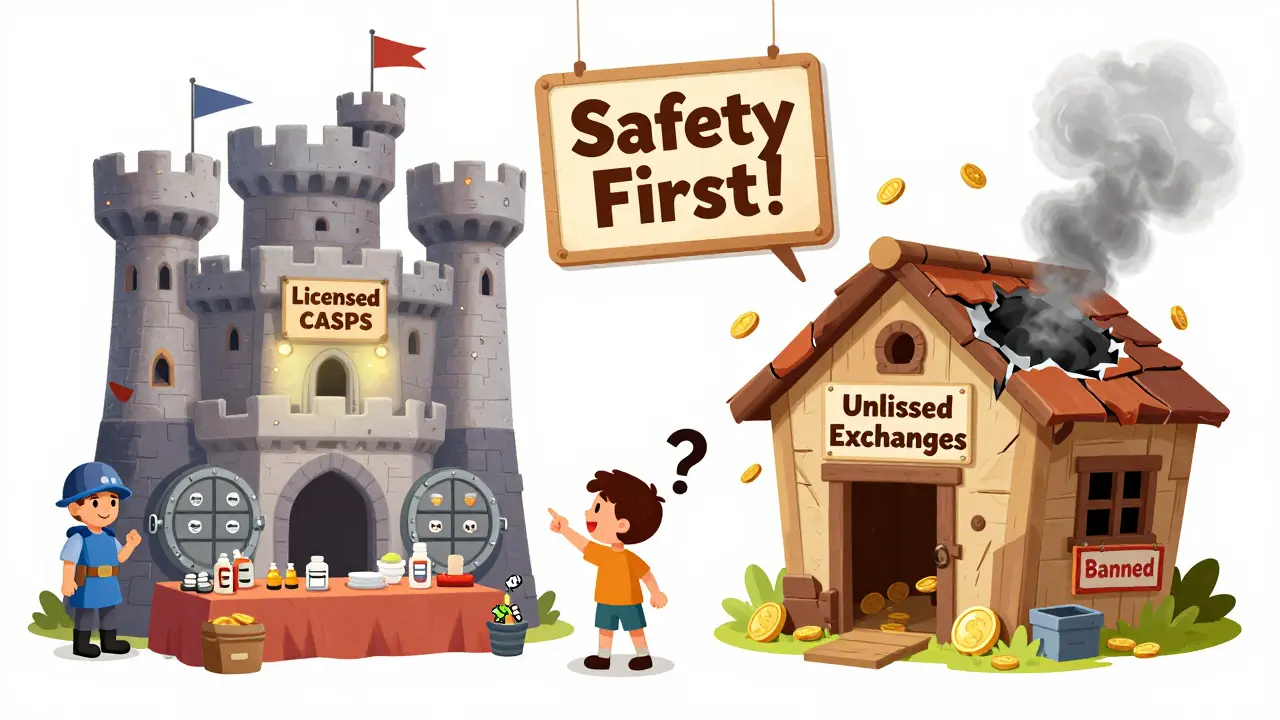
The regulations have created a two-tier market. On one side, you have global giants like Bybit, Cex.io, Bitget, and Bigone - all of which have moved quickly to comply. They’ve opened local offices, hired compliance teams, and updated their systems. They’re now marketing themselves as the “safe” choices for Filipinos.
On the other side, smaller exchanges and startups are struggling. The PHP 100 million capital requirement is too high for most. Many simply can’t afford to set up a physical office. As a result, the market is becoming less diverse. The SEC says this protects investors. Critics say it protects big players and kills innovation.
What About Everyday Users?
Here’s the good news: you can still trade crypto. The SEC didn’t ban Bitcoin or Ethereum. You can still buy, sell, and hold crypto. But now, you’re safer. Licensed platforms must follow strict rules. Your funds are segregated. Your identity is verified. Your ads are honest. If something goes wrong, there’s a regulator holding the platform accountable.
That’s why the SEC says this isn’t about stopping crypto - it’s about making it safer. The Philippines has one of the highest crypto adoption rates in Southeast Asia. Over 12 million people already use crypto. Revenue from crypto activities hit ₱1.1 billion in 2025. The goal isn’t to kill this growth. It’s to make sure it lasts.
The Bigger Picture
The Philippines didn’t just copy rules from Europe or the U.S. It built something new. A system that balances consumer protection with market access. Other countries in Southeast Asia - Indonesia, Thailand, Vietnam - are watching closely. If this model works, it could become the blueprint for the whole region.
For now, the message is clear: if you want to serve Filipino crypto users, you need to play by SEC rules. No shortcuts. No exceptions. The era of unregulated crypto is over.
Do I need a license if I’m just buying crypto as a personal user?
No. The SEC rules apply only to businesses that offer crypto services - like exchanges, wallets, or staking platforms. If you’re buying Bitcoin or Ethereum for yourself, you don’t need a license. But you should only use platforms that are licensed by the SEC to protect your funds.
Can foreign companies apply for a CASP license?
Yes, but they must first register as a domestic corporation in the Philippines. That means setting up a legal entity with a local office, local directors, and a physical presence. You can’t apply as a foreign branch. The SEC requires full integration into the local business system.
What happens if I use an unlicensed exchange?
You won’t be fined, but you’re at high risk. Unlicensed platforms have no legal obligation to protect your funds. If they get hacked, go bankrupt, or disappear, you have no recourse. The SEC warns users to avoid these platforms entirely. Only use services listed on the SEC’s official registry.
How do I check if a crypto platform is licensed?
Visit the SEC’s PhiliFintech Innovation Office website and look for the official list of registered CASPs. Only platforms on that list have passed the full licensing process. If a platform claims to be licensed but isn’t on the list, it’s a lie.
Are staking and yield farming allowed under the new rules?
Yes, but only if the platform offering them is licensed. Staking and yield farming are considered crypto asset services, so they fall under the CASP rules. Any platform promising fixed returns must disclose risks and comply with marketing rules. If a platform offers staking without a license, it’s operating illegally.

George Suggs
March 1, 2026 AT 20:38Honestly? This is how crypto should be. No more shady platforms disappearing with people's money. Finally, someone's protecting the little guy.
Dianna Bethea
March 3, 2026 AT 15:54I've been using a licensed exchange since last year and honestly it's a night and day difference. No more sleepless nights wondering if my funds are safe. The SEC's rules are annoying but necessary.
Jan Czuchaj
March 5, 2026 AT 03:41The capital requirement of PHP 100 million is brutal for startups. I get the intent-protect users-but this isn't regulation, it's a gatekeeping maneuver. You're not preventing fraud, you're just making it harder for new players to enter. The market will become a monopoly of a few well-funded entities, and that's not innovation, that's stagnation dressed up as safety.
McKenna Becker
March 6, 2026 AT 18:06The fact that they require a physical office and local entity is smart. Crypto isn't magic. It needs real-world accountability.
Tracy Peterson
March 7, 2026 AT 23:11I love how this isn't just copying EU or US rules. The Philippines is building its own model. That's bold. And honestly? It might work.
Felicia Eriksson
March 8, 2026 AT 07:01I'm just a user but I feel safer now. I used to trade on random apps and now I only use the ones on the SEC list. It's a small change but it means a lot.
Cathy Sunshine
March 10, 2026 AT 02:31They're not protecting investors. They're protecting the big exchanges. This is corporate capture disguised as consumer protection. The real victims are the small traders who can't afford $1.8M to play.
Amita Pandey
March 10, 2026 AT 16:32The requirement for segregated accounts is the most crucial element. After Mt. Gox, Binance.US, and FTX, no jurisdiction can afford to ignore asset segregation. This is not overregulation-it is basic fiduciary responsibility.
Tracy Whetsel
March 11, 2026 AT 02:00This is just the beginning. Wait until they start requiring blockchain audits on-chain. Next thing you know, they'll be forcing every wallet to have a government ID attached. Welcome to the surveillance state.
Samantha Stultz
March 12, 2026 AT 15:04The AML/KYC requirements are reasonable. But the disclosure mandates? That's where it gets Kafkaesque. You have to publish a document on your site that explains how you're not promising returns... but you can't say anything that sounds like a return. So you say nothing. And users get confused. This isn't transparency. It's performative compliance.
Michelle Mitchell
March 14, 2026 AT 12:21i mean like... why do they even care? if i wanna buy btc on some random site, its my problem right? theyre just making life harder for everyone
Danny Kim
March 15, 2026 AT 20:18So let me get this straight. You can't say 'earn 20% monthly' but you can say 'historical returns have been high'? That's not regulation. That's linguistic gymnastics.
KingDesigners &Co
March 17, 2026 AT 06:01I've seen the lists. The only ones on there are the ones with deep pockets. The rest? Gone. This isn't about safety. It's about control. And control means profit for the insiders.
Kaitlyn Clark
March 18, 2026 AT 19:17I'm so proud of the Philippines for doing this 💪✨ It’s not perfect but it’s a STEP in the right direction. Real protection for real people. No more ghost platforms. No more scams. I’m crying happy tears 😭❤️
precious Ncube
March 20, 2026 AT 07:03If you're still using unlicensed platforms, you're not a crypto enthusiast-you're a liability. You're the reason regulators have to step in. Get with the program.
Curtis Dunnett-Jones
March 21, 2026 AT 01:14The structural integrity of this regulatory framework is remarkable. By mandating physical presence, segregated custody, and transparent disclosures, the SEC has constructed a compliance architecture that aligns with fiduciary best practices globally. This is not overreach. It is foundational.
Richard Cooper
March 21, 2026 AT 08:20So now you gotta pay a million bucks just to let people trade crypto? That's not regulation. That's a tax on dreams.
Shannon Black
March 22, 2026 AT 18:28As someone from a developing economy, I find this model inspiring. The Philippines isn't waiting for permission from the West. They're writing their own rules. That's sovereignty.
Tracy Whetsel
March 23, 2026 AT 01:16Wait till they start requiring every crypto transaction to be logged in a national database. This is how they track you. This is how they control you.