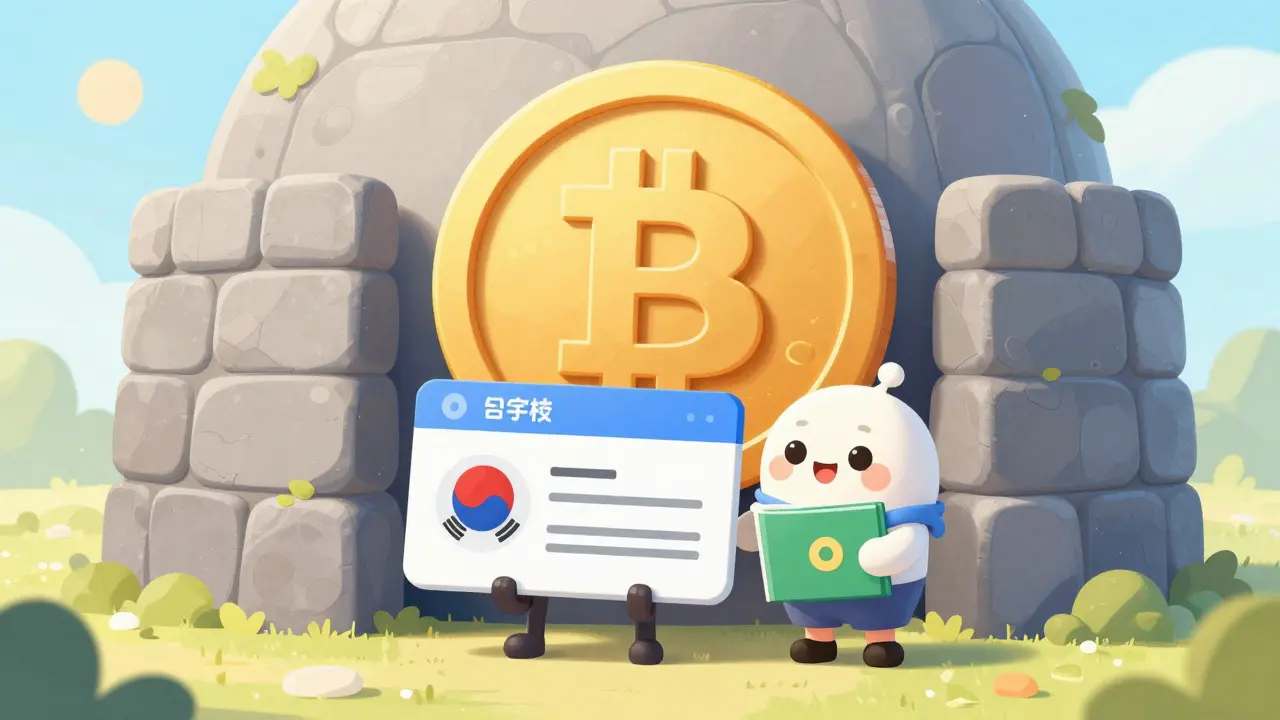
If you're thinking about trading digital assets in South Korea, you'll quickly realize it isn't like the "wild west" of some other markets. South Korea has built one of the most rigid and comprehensive regulatory walls in the world. For a regular trader, this means you can't just download an app and start buying coins with a credit card. You're entering a system where your identity is tied to your bank account, and every single transaction is tracked by the government. But while it sounds restrictive, this setup is exactly why Korean exchanges are some of the most secure places to keep your funds.
The Core Rules of the Game
The entire landscape is governed by the Special Financial Information Act is a legal framework that came into effect in March 2021 to regulate virtual asset transactions and prevent money laundering. If you want to trade legally, you have to go through a Virtual Asset Service Provider (or VASP), which is basically a licensed exchange. To get this license, an exchange doesn't just need a business permit; they need a rigorous Information Security Management System (ISMS) certification and, most importantly, a partnership with a domestic bank.
This brings us to the most famous hurdle: Real-Name Verification is a mandatory process where a crypto exchange account must be linked to a verified bank account bearing the same name. You cannot trade anonymously. If your exchange account is in your name, your bank account must be too. This system, managed by the Korea Financial Intelligence Unit (or KoFIU), has effectively killed off hundreds of unlicensed platforms, leaving only a few giants that dominate the market.
Who Actually Controls the Market?
While there are thousands of global platforms, the Korean market is essentially a "Big Four" club. Only a handful of exchanges have managed to jump through all the regulatory hoops to get full approval. These players handle over 95% of all domestic trading volume.
| Exchange | Operator | Key Feature | Typical Bank Partners |
|---|---|---|---|
| Upbit | Dunamu | Highest Volume / Global Top 5 | K-Bank |
| Bithumb | Bithumb Korea | Aggressive Marketing / Wide Reach | NH Nonghyup Bank |
| Coinone | Coinone Co. | Focus on Professional Traders | Nonghyup Bank |
| Korbit | Korbit Inc. | First Exchange in Korea | Shinhan Bank |
How to Get Started (And Where You'll Get Stuck)
For an individual, the onboarding process is a bit like applying for a high-security mortgage. You can't just sign up with an email. You'll need to complete a three-level identity verification process. First, you provide your government-issued ID. Second, you link your verified domestic bank account. Third, you often have to do a video call with a representative to prove you're a real person. This usually takes a few weeks to fully settle.
Once you're in, you'll notice a few strict limits. You cannot use credit cards to buy crypto-that's a hard no. International wire transfers for the purpose of buying coins are also generally blocked. Everything flows through domestic bank transfers. If you're trying to move money from a foreign account into a Korean exchange, you're going to hit a wall of IP blocks and bank restrictions designed to stop capital flight and money laundering.
The Trade-Off: Safety vs. Selection
Is all this red tape worth it? If you value your sleep, probably. Because the Financial Services Commission (or FSC) requires these exchanges to keep at least 70% of customer assets in cold storage (offline wallets) and carry massive cyber insurance policies, the risk of a "FTX-style" collapse is much lower here. In fact, the licensed platforms have a nearly spotless record compared to the billions lost in global hacks.
The downside is the "Coin Desert" effect. Because the government vets which assets are listed, you'll find far fewer altcoins. While a global giant like Binance might list 600+ tokens, a Korean exchange might only have 200 to 300. If you're a DeFi degenerate hunting for the next micro-cap gem, you'll likely find the Korean ecosystem frustratingly limited. Many traders end up using these platforms as a "safe harbor" for Bitcoin and Ethereum, while moving riskier plays to international wallets.
Taxes and Future Hurdles
The era of "free money" is ending. Starting from the 2025 tax year, South Korea has implemented a capital gains tax on crypto. If your profits exceed 2.5 million KRW in a year, you're looking at a 20% tax hit. This has caused a bit of a stir in the community, as it marks the transition of crypto from a speculative hobby to a taxable financial asset.
Looking ahead, the government is experimenting with a Central Bank Digital Currency (or CBDC), which could change how we perceive private coins. There's also a massive push for stablecoin transparency. If an exchange lists Tether or USD Coin, they now have to follow strict reserve backing rules and undergo monthly audits. The goal is clear: eliminate the systemic risk that comes with "unbacked" assets.
Common Pitfalls to Avoid
- Avoid Unlicensed "Exchanges": If a platform doesn't require a real-name bank account, it's likely illegal in Korea. Your funds are not protected, and the FSC can shut them down overnight.
- Don't Use VPNs for Deposits: Trying to bypass IP restrictions to move money into a Korean bank account often triggers an automatic AML (Anti-Money Laundering) freeze on your funds.
- Watch the 2.5 Million KRW Limit: Keep a tight log of your trades. Once you cross that threshold, the tax man wants his 20%.
- Verify Your ID Early: Don't wait for a market pump to verify your account. The Level 3 verification can be slow, and you don't want to be stuck in a queue while Bitcoin is mooning.
Can foreigners trade on Korean exchanges?
It is extremely difficult. To trade on licensed exchanges like Upbit or Bithumb, you need a Korean Alien Registration Number (ARC) and a verified account at a participating domestic bank. Without these, you cannot pass the real-name verification process.
Is crypto legal in South Korea?
Yes, it is legal, but heavily regulated. You can own and trade cryptocurrency, but you must use platforms that are licensed by the KoFIU to ensure your funds are secure and the exchange is compliant with AML laws.
Why are there so few coins on Korean exchanges?
Korean regulators apply strict listing standards to protect investors from "scam coins." This means the exchanges perform more due diligence before listing a token, resulting in a curated list that is smaller than global counterparts.
What happens if I use an unlicensed exchange?
You lose all legal protection. If the platform is hacked or the owners disappear, the FSC will not help you recover your funds. Additionally, the government actively blocks the IPs of unlicensed platforms.
How does the 20% crypto tax work?
It is a capital gains tax. You subtract your initial investment from your total profit. If that amount is over 2.5 million KRW per year, you owe 20% of the excess to the government.

JERRY ORTEGA
April 4, 2026 AT 21:24this kind of oversight is actually pretty decent if you just want to avoid the usual exchange rugs
Deepak Prusty
April 5, 2026 AT 13:43The real-name verification system is simply a mechanism for state control and capital flight prevention. It is not about security as much as it is about surveillance. Most people fail to realize that once you link your bank account, you have effectively surrendered your financial privacy to the KoFIU.
Suvoranjan Mukherjee
April 6, 2026 AT 05:26For anyone looking at the DeFi angle, the slippage on these domestic exchanges can be brutal during high volatility!
You've got to watch the order books closely because the liquidity is heavily concentrated in the Big Four. If you're pivoting from a DEX environment to a CEX like Upbit, the KYC friction is a huge shock but the security protocols for cold storage are top-tier. Just keep your API keys safe!
david head
April 7, 2026 AT 14:50wow that tax hit is steep 😱 20% is crazyyy but at least the platforms are safe 🙌
Alexandra Lance
April 9, 2026 AT 08:03Oh honey, imagine actually believing that "government vetting" is for your protection 🙄 It's just a way to ensure only the tokens they can manipulate stay on the board. The "Coin Desert" isn't a side effect, it's the whole point 🤡💅
Hugo Lopez
April 9, 2026 AT 08:09It is certainly a disciplined approach to market stability. I appreciate the transparency regarding the cold storage requirements! 😊
shubhu patel
April 10, 2026 AT 04:27I feel like the trade-off between selection and safety is something a lot of us struggle with because while having a curated list of coins makes the experience feel a bit more sterile, there is a certain peace of mind that comes from knowing the regulators are actually doing some due diligence before a token hits the market, which is honestly a breath of fresh air compared to the absolute chaos of some of the international platforms where literally any project with a website can get listed.
Erica Mahmood
April 12, 2026 AT 00:37the isms cert is the real bottleneck here and most smaller shops just can't afford the compliance overhead to get that bank partnership
Joshua Aldrich
April 12, 2026 AT 23:28Man, the irony is that we wanted crypto for decentralization but here we are with a 3-level KYC process including a video call lol. Its wild how far the dream has drifted. But yeah, if you're just holding BTC, the cold storage mandate is a huge W for the average Joe who doesnt know how to use a ledger properly.
Emma Pease-Byron
April 14, 2026 AT 06:20The notion that a "spotless record" justifies the eradication of anonymity is quaint. One does not simply trade a free asset within a panopticon and call it "investing." It's a managed petting zoo for the financial elite.
Lauren Gilbert
April 15, 2026 AT 09:26It makes me wonder if the essence of cryptocurrency is lost when it becomes just another regulated bank product, as the original philosophy was to remove the middleman entirely, yet here the middleman is the only way in. Perhaps the stability provided by these rigid rules is a necessary evolution for the mass adoption of digital assets, even if it means sacrificing the adventurous spirit of the early blockchain era.
Sonya Bowen
April 16, 2026 AT 04:05Compliance is a tool for longevity.
Carol Prates
April 17, 2026 AT 07:52Omg a 20% tax?! That is literally robbery! I can't even deal with this right now, imagine working for your gains just for the government to swoop in and take a fifth of it. Absolute tragedy! 😭
Carmelita Gonzales
April 18, 2026 AT 14:06it is so hard for expats to get these accounts i know a few people who spent months trying to get their arc sorted just to trade
Nicholas Whooley
April 19, 2026 AT 14:57It is advisable for all newcomers to maintain a meticulous ledger of their transactions to avoid any discrepancies during the tax season.
alex rodea
April 20, 2026 AT 03:13just stick to the big ones and you'll be fine
Susan Wright
April 20, 2026 AT 17:32Pro tip: if you're moving funds from a global exchange to a Korean one, use a stablecoin pair to minimize volatility during the transfer process since the bank side of things can take forever.
Earnest Mudzengi
April 21, 2026 AT 09:44This is all just a front for the CBDC rollout! They're choking the private market to force everyone into the government's digital ledger so they can freeze your funds if you say something wrong. It's a total power grab by the FSC and the globalists to kill the sovereign individual!
sekhar reddy
April 23, 2026 AT 03:50LMAOOO the video call verification is the funniest part!! Imagine having to stare at a stranger and prove you aren't a bot just to buy some Dogecoin. Absolute circus!! 🎪
Brooke Herold
April 24, 2026 AT 16:53The strictness is quite reflective of the broader societal approach to rule-following in Korea.
Krystal Moore
April 25, 2026 AT 14:04Honestly, the fact that people are okay with this level of surveillance is just depressing. We're literally paying for the privilege of being tracked. Where is the outrage? This is basically a financial prison with a fancy app interface!
Sharhonda Walker
April 25, 2026 AT 22:06make sure you double check the bank names becouse if you use the wrong partner bank for a specific exchage your transfer migth get bounced back and it takes ages to resolve
Bruce Micciulla Agency
April 26, 2026 AT 12:19the volatility in the kimchi premium is what actually drives the volume and these regulations are just a way to keep the retail crowd from getting totally wiped out by the whales who already have offshore accounts and don't even care about the 2.5m krw limit because they're playing a completely different game with different rules
Adriana Gurau
April 28, 2026 AT 00:37Imagine thinking 200 coins is "limited" 🙄 some of you are just addicted to gambling on shitcoins that have zero utility 💅✨
June Coleman
April 29, 2026 AT 06:58Oh, look at us, praising the government for giving us a "safe harbor" while they take 20% of our money. Truly a win-win situation for the bureaucrats! 🙄
Emily 2231
April 29, 2026 AT 09:21The implementation of the Special Financial Information Act is a direct assault on personal liberty and a precursor to a total state-controlled economy. This is why we must protect the integrity of national borders and financial sovereignty against these creeping globalist standards. THE END IS NIGH.