
China’s stance on cryptocurrency is clear: it is banned. But how do you stop millions of people from trading Bitcoin when the internet is everywhere? The answer lies not just in laws, but in the apps everyone uses to buy lunch or pay rent. Alipay is a dominant digital payment platform operated by Ant Group that serves as a critical enforcement mechanism for China's cryptocurrency ban. Alongside its rival, WeChat Pay, these two platforms process the vast majority of digital transactions in mainland China. They are no longer just payment tools; they are the frontline defense for financial regulators trying to keep crypto out of the country.
If you try to send money to a known crypto exchange using Alipay or WeChat Pay in 2026, the transaction will likely fail instantly. This isn’t a glitch. It is a sophisticated, government-mandated system designed to block crypto-linked financial flows before they happen. Understanding how this works reveals why China’s ban is so effective compared to other nations, and where the cracks still exist.
The Regulatory Web Behind the Apps
You might think Tencent or Ant Group made these rules up, but they didn’t. These companies are following orders from a massive coalition of Chinese regulatory bodies. The People's Bank of China (PBOC) is the central bank that oversees monetary policy and mandates strict anti-crypto measures on payment platforms. They work alongside the National Administration of Financial Regulation (NAFR), the China Securities Regulatory Commission (CSRC), and the Cyberspace Administration of China (CAC).
In 2025, regulations were tightened further. Both Alipay and WeChat Pay are explicitly required to conduct enhanced Know Your Customer (KYC) and Anti-Money Laundering (AML) procedures. This means they don’t just look at who you are; they monitor your behavior patterns. If your spending habits look like someone trying to move capital into cryptocurrency, the system flags you. The goal is to cut off banking and payment service channels for crypto-related activities completely. State-owned banks coordinate with these platforms, creating multiple layers of enforcement that make it nearly impossible for residents to use traditional finance for crypto trades.
How the Technology Blocks Crypto Transactions
The magic happens behind the scenes with advanced transaction monitoring systems. These aren’t simple keyword filters. They use machine learning to identify payments associated with cryptocurrency exchanges, over-the-counter (OTC) trading, and mining operations. When you scan a QR code or initiate a transfer, the system checks the recipient against a constantly updated blacklist of prohibited entities.
- Automatic Blocking: Payments to known crypto exchanges are rejected instantly.
- Behavioral Analysis: Unusual transaction volumes or frequencies trigger manual reviews.
- Cross-Border Scrutiny: Transfers involving foreign entities face heightened AML checks.
This technical enforcement turns Alipay and WeChat Pay into primary choke points. Because almost every merchant in China accepts these apps, there is little room to maneuver. You can’t easily switch to a different payment method without stepping outside the formal economy. This ubiquity is what makes the ban so powerful. It forces users to stay within a monitored ecosystem.
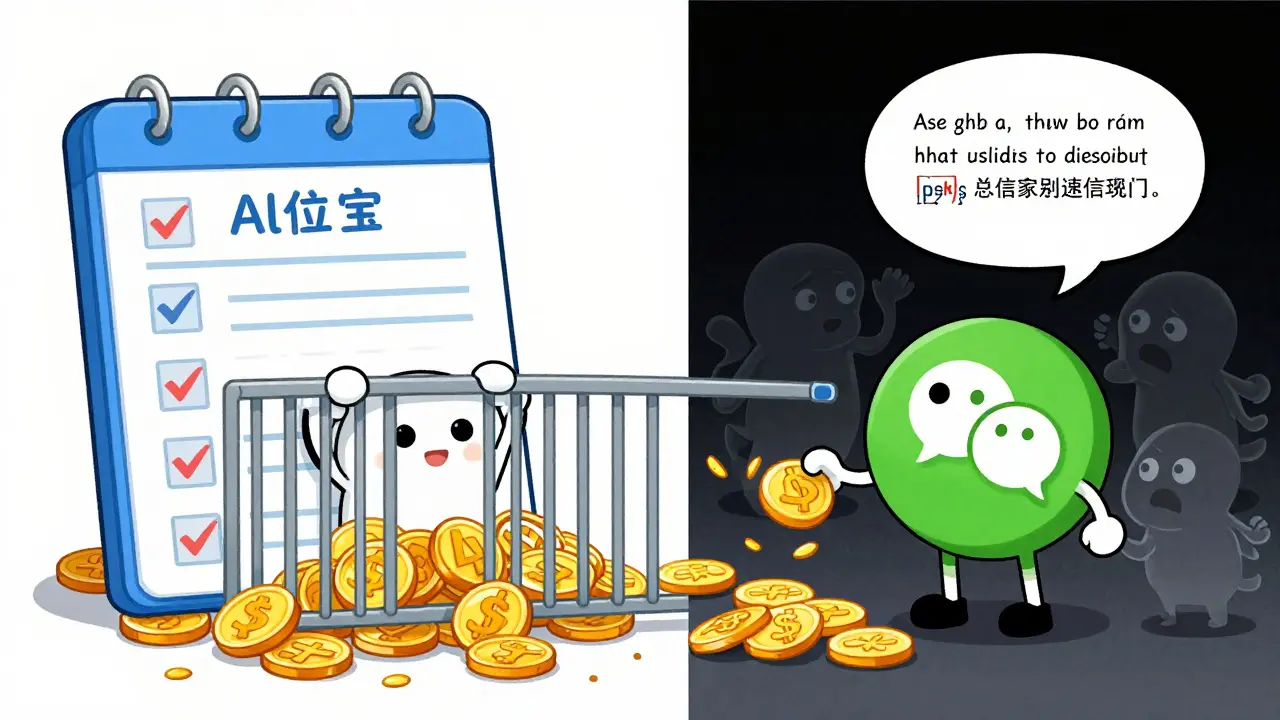
WeChat Pay’s Unique Challenge: The Messaging Loophole
While Alipay is primarily a financial tool, WeChat Pay is a payment service integrated into Tencent's super-app WeChat, which also functions as an encrypted messaging platform. This dual nature creates a unique problem for enforcers. Criminal organizations have adapted by using WeChat’s messaging capabilities to coordinate trades while keeping the actual money movement separate from the platform’s monitoring systems.
Here is how it works: Users chat via WeChat to agree on a price for Bitcoin. They share wallet addresses through text messages. Then, one party sends fiat currency via WeChat Pay to the other’s personal account, not an exchange. Because the payment goes to a person, not a blacklisted entity, the automated system often misses it. The encrypted nature of WeChat’s communications makes it difficult for law enforcement to track these coordination activities. WeChat does not share user data with international authorities, and its encryption hides the planning phase of these illicit deals.
Experts point out that Know Your Transaction (KYT) tools can trace blockchain activity once the crypto moves, but they miss the off-chain planning that happens inside WeChat. This has led to calls for smarter KYT systems and increased pressure on Tencent to cooperate more extensively with domestic police. However, balancing privacy features with surveillance remains a delicate political issue.
| Feature | Alipay | WeChat Pay |
|---|---|---|
| Primary Function | Digital Wallet / Finance App | Social Super-App / Payment Integration |
| Operator | Ant Group | Tencent |
| Crypto Blocking Method | Direct transaction interception & entity blacklisting | Transaction monitoring + behavioral analysis |
| Vulnerability | Lower (focused financial interface) | Higher (encrypted messaging allows off-chain coordination) |
| Regulatory Focus | AML/KYC compliance on financial flows | Content moderation + financial flow monitoring |
The Reality of Circumvention and Risks
Despite the tight net, some users still find ways to trade. Over-the-counter (OTC) methods remain popular. People meet in person or use trusted intermediaries to swap cash for crypto keys. Others use offshore platforms that accept foreign bank transfers. However, these approaches carry significant legal risks. In July 2025, the Shanghai State-owned Assets Supervision and Administration Commission hinted that rapid evolution in digital assets might soften China’s position, but no concrete changes occurred. For now, engaging in illegal fundraising or unauthorized capital movement can lead to criminal penalties.
The effectiveness of the ban varies by user type. Legitimate consumers report zero issues. Their accounts function normally because their behavior matches typical retail spending. But anyone attempting to circumvent restrictions faces immediate flagging. Accounts can be frozen, and users may be summoned for questioning. The threat of losing access to daily financial life is a strong deterrent.

Contrast with Regional Neighbors
China’s approach stands in stark contrast to its neighbors. Singapore allows fully regulated cryptocurrency activities under the Monetary Authority of Singapore (MAS). Hong Kong operates sandbox-supported programs under the Securities and Futures Commission (SFC). Mainland China maintains its prohibition through Alipay and WeChat Pay enforcement mechanisms. These platforms are prohibited from supporting domestic cryptocurrency legality, stablecoin usage (except in restricted government sandboxes), or any form of retail crypto payments.
Interestingly, cross-border blockchain transactions are being tested under strict state-controlled frameworks. The mBridge project involves China, Hong Kong, Thailand, and the UAE. This shows that China isn’t against blockchain technology itself; it is against private, decentralized control of money. The distinction is crucial. The government wants to harness the efficiency of distributed ledger technology without surrendering monetary sovereignty.
The Future: e-CNY and Tighter Control
Looking ahead, the enforcement landscape will evolve around the e-CNY is China's Central Bank Digital Currency (CBDC) that serves as a government-controlled alternative to private cryptocurrencies. The e-CNY is expanding for retail and selective business-to-business uses. Unlike Bitcoin, it operates on a centralized ledger controlled by the PBOC. Alipay and WeChat Pay are expected to serve as distribution channels for the e-CNY while maintaining their enforcement role against private cryptocurrencies.
Industry experts anticipate that the platforms' enforcement capabilities will become more sophisticated as regulatory technology advances. The fundamental prohibition on private cryptocurrency activities is expected to remain in place. The focus will continue to be on financial risk prevention, investor protection, and capital control. As the e-CNY gains traction, the need for citizens to seek out risky crypto alternatives may diminish, naturally reducing the burden on enforcement agencies.
Can I use Alipay to buy Bitcoin in China?
No. Alipay actively blocks transactions to known cryptocurrency exchanges and services. Attempting to do so will result in failed payments and potential account flagging for suspicious activity.
Why is WeChat Pay harder to regulate than Alipay?
WeChat combines payments with encrypted messaging. Users can coordinate crypto trades via chat and then send fiat payments to personal accounts, bypassing direct exchange blocking mechanisms. This off-chain coordination is difficult for automated systems to detect.
What happens if my account is flagged for crypto activity?
Your account may be frozen pending investigation. You could face questions from authorities regarding the source and destination of funds. Repeated violations can lead to permanent bans from the platform and potential legal consequences under anti-money laundering laws.
Is the e-CNY allowed on Alipay and WeChat Pay?
Yes. The e-CNY is a government-backed digital currency. Alipay and WeChat Pay are integrating support for e-CNY wallets as part of China's push for a state-controlled digital payment system, distinct from private cryptocurrencies.
Are there any exceptions to the crypto ban in China?
Retail trading and ICOs are strictly banned. However, institutional blockchain research and specific cross-border pilot projects like mBridge are permitted under tight state supervision. Private citizens cannot legally hold or trade cryptocurrencies.


Jay Sharma
June 29, 2026 AT 17:59it is not about the crypto at all, it is about control. they want to see every single penny you spend so they can predict your behavior before you even think it. the ban is just a cover for total surveillance capitalism on a state level.
Jon Milton
July 1, 2026 AT 08:35The integration of financial tools into social messaging platforms like WeChat creates a unique paradox where privacy and transaction monitoring collide in real-time. While the article highlights the technical blocking mechanisms, one must consider the broader cultural implication of having one's entire social graph linked to their financial behavior. This level of interconnectedness means that dissent or unconventional economic activity is not just financially penalized but socially isolated as well.
Rebecca Shoniker
July 1, 2026 AT 16:24It is absolutely fascinating how the regulatory bodies have managed to enforce such strict KYC and AML procedures without causing widespread civil unrest. The sophistication of the machine learning algorithms used to flag behavioral patterns is truly impressive; it shows a high level of technological maturity that many Western nations are still struggling to achieve in their own financial sectors. One has to admire the efficiency with which Ant Group and Tencent comply with these mandates, ensuring that no loopholes remain for illicit activities.
Abby Martin
July 3, 2026 AT 07:18People need to stop romanticizing the idea of decentralized finance when it comes to authoritarian regimes. The reality is that if you cannot pay for your lunch without the state knowing, you do not have freedom. It is simple as that. The e-CNY is not a step forward for innovation; it is a step backward for individual liberty. They are building a cage and calling it a digital wallet.
Mélanie Boulay
July 4, 2026 AT 16:45I find it quite interesting to observe the distinction made between Alipay’s direct interception methods and WeChat Pay’s more nuanced approach involving behavioral analysis and content moderation, especially considering that the latter operates within a super-app environment where social interactions and financial transactions are deeply intertwined, thereby creating a complex matrix of data points that regulators can exploit to identify potential anomalies in user behavior that might otherwise go unnoticed in a purely financial context.
Maurice Flynn
July 6, 2026 AT 12:26Just watching this unfold from the outside. It is wild how much power two apps hold over an entire nation's economy. I guess when you control the pipes, you control the water. Makes me appreciate my ability to use cash here, even if it is becoming rare.
nancy jarecki
July 7, 2026 AT 22:28The notion that 'behavioral analysis' is merely a tool for anti-money laundering is a naive oversimplification of the sophisticated surveillance infrastructure being deployed. These platforms are essentially harvesting granular data on consumer psychology and social networks under the guise of compliance, creating a panopticon effect that serves both corporate profit motives and state security interests simultaneously.
Robert Hundley
July 8, 2026 AT 10:40This is huge news for anyone thinking about moving money around! 🚀 The tech behind blocking these transactions is seriously advanced. It is crazy to think that scanning a QR code triggers a whole AI review process. Stay safe out there everyone!
Melissa L
July 9, 2026 AT 11:30i dont get why people try so hard to break the rules. its just gonna get ur account frozen anyway. seems pointless to me honestly.
ELNORA JEFFERSON
July 10, 2026 AT 01:05Another day, another way they tighten the screws. Honestly, it is exhausting reading about how every move is tracked. I just want to buy something without filling out a form for the government. The drama of living under constant scrutiny is enough to make anyone lose their mind.
Carol @minaszilda
July 10, 2026 AT 11:13It is important to remember that regulations often aim to protect users from fraud. However, balance is key. Let us hope for systems that secure assets without sacrificing privacy.
John Curry
July 11, 2026 AT 19:11The philosophical implications of a state-controlled digital currency replacing private crypto are profound. We are witnessing the end of anonymous commerce as we knew it. The mBridge project suggests a future where cross-border transactions are efficient yet entirely transparent to the state. It is a brave new world, indeed.
Trent Erman1
July 12, 2026 AT 05:57Great breakdown of the technical side! The use of ML for blacklisting entities is smart. It is amazing how fast these systems adapt to new evasion tactics. Keep an eye on the e-CNY rollout, it will change everything.
Fiona Ellis
July 13, 2026 AT 12:56I actually wonder if you have considered the impact on small business owners who rely on informal credit networks? 😊 The encryption loophole in WeChat is really the only lifeline left for some communities. It is a bit sad that they have to hide to survive economically.
Nicole Woessner
July 13, 2026 AT 22:55Living abroad i see how different our banking feels. here we have checks and balances there it is just top down control. makes me value my local bank branch even if it is slow
Sajjad Ghorbani Moghaddam
July 15, 2026 AT 04:15Hey folks, just wanted to add that while the tech is impressive, the human element is what really drives these changes. People adapt. If you look at history, every time a payment system gets restricted, new underground economies pop up. It is a cat and mouse game that never really ends.