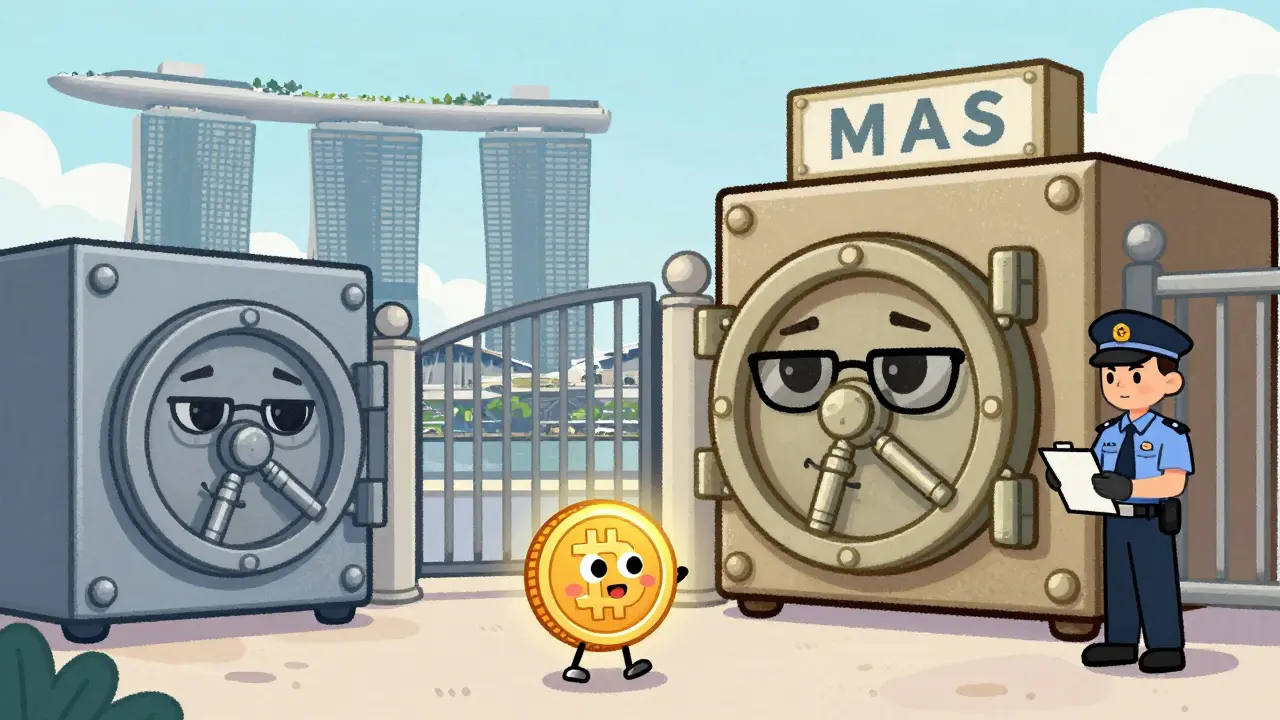
For years, Singapore was the golden ticket for crypto startups. You moved your servers there, hired a local team, and suddenly you had the stamp of approval from one of Asia’s most respected financial hubs. But if you are looking to launch a new digital token service in Singapore today, you might want to stop right there. The Monetary Authority of Singapore (MAS) is the central bank and regulatory authority that has effectively halted new crypto licenses due to strict anti-money laundering concerns has pulled the rug out from under the industry.
In June 2025, MAS announced it would issue Digital Token Service Provider (DTSP) licenses only in "extremely limited circumstances." With a hard deadline of June 30, 2025, for full compliance with the Financial Services and Markets Act (FSMA), the message was clear: if you aren't already licensed and compliant, you’re likely out. This isn’t just a tightening of screws; it is a strategic pivot that has turned Singapore into one of the most restrictive jurisdictions for crypto on the planet.
The End of the "Crypto-Friendly" Era
You might remember when Singapore actively courted blockchain firms. They offered tax incentives, fast-track visas, and a reputation for stability. That era ended abruptly with the enforcement of the FSMA 2022. The core issue? Regulatory arbitrage.
MAS officials were concerned that companies were using Singapore as a brand name while doing business elsewhere. A firm could register in Singapore, gain trust from global investors, but serve clients in countries with weaker oversight. This created a reputational risk for Singapore itself. If a scam happened, the blame fell on Singapore’s regulators, even if the actual operations were offshore.
To fix this, Section 137 of the FSMA introduced extraterritorial reach. What does that mean for you? It means if you are a Singapore corporation or individual operating from Singapore, you need a DTSP license-even if your customers are all in Europe or North America. Your servers don’t matter. Your user base doesn’t matter. If you operate from Singapore, you play by MAS rules.
| Jurisdiction | Licensing Status (2026) | Key Focus | New Entrant Friendly? |
|---|---|---|---|
| Singapore (MAS) | De facto ban on new licenses | AML/CFT integrity, Reputation protection | No |
| Switzerland (Zug) | Active licensing | Innovation hub, Clear guidelines | Yes |
| UAE (Dubai VARA) | Active licensing | Rapid growth, Comprehensive framework | Yes |
What Does Compliance Actually Cost?
If you are one of the lucky few existing license holders trying to survive the transition, here is what you are facing. The requirements are not just paperwork; they require structural changes to your business.
- Singapore-Based Compliance Officer: You must hire a qualified professional who lives and works in Singapore. According to 2025 salary surveys, these roles command between SGD 150,000 and SGD 250,000 annually. This is non-negotiable.
- Capital Thresholds: You need significant minimum capital to prove solvency and operational stability.
- Annual Independent Audits: Every year, an external auditor must verify your processes. This adds recurring costs and scrutiny.
- Cybersecurity Standards: Your infrastructure must meet rigorous security benchmarks to protect customer assets and data.
Then there is the Travel Rule. Implemented through Notice PSN02, this requires platforms to collect and share sender and receiver details for transactions over SGD 1,500 (about USD 1,100). Integrating software to handle this data exchange securely can cost between SGD 50,000 and SGD 200,000, depending on your transaction volume. Add in the consumer protection updates from September 2024-which banned high-risk practices like buying crypto with credit cards-and your operational costs jump by 25-40%, according to Deloitte’s May 2025 analysis.

The Human Cost: Jobs and Exodus
Regulations affect more than just balance sheets; they affect people. The abrupt timeline-only four weeks between the announcement and the enforcement deadline-left many firms scrambling. Some chose to exit entirely rather than invest hundreds of thousands of dollars in compliance infrastructure for a market they couldn’t fully access.
The impact on employment was immediate. LinkedIn workforce analytics showed a 37% decline in crypto-related job postings in Singapore during Q1 2025 compared to the previous quarter. Startups that relied on Singapore’s talent pool began moving their teams to Dubai, Zurich, or London. For professionals working in Web3, the signal was loud: Singapore wants quality, not quantity. And right now, they define quality as extreme caution.

Who Can Still Get a License?
MAS stated they will generally not issue licenses. However, "generally" leaves a tiny crack open. Reed Smith’s legal analysis suggests that approvals are restricted to firms with "elite compliance infrastructure and a strong operational justification."
Think about what that looks like in practice. It’s not a startup with a great idea. It’s a established financial institution or a massive tech giant that already has robust AML systems, deep pockets, and a clear reason to be in Singapore beyond just branding. If you are a small-to-medium enterprise, the door is essentially closed. Blockdata’s June 2025 market analysis predicted that only 15-20 existing license holders would maintain full compliance, down from roughly 200 firms that had previously applied or held provisional status.
Looking Ahead: Stablecoins and DeFi
The story isn’t completely over. MAS is still refining its approach, particularly around stablecoins and Decentralized Finance (DeFi). In November 2023, they published a framework for stablecoins to ensure value stability, and in May 2025, parliamentary replies hinted at further guidance for DeFi protocols later in 2025.
This suggests that while the wild west of general crypto trading is gone, specific, regulated niches might still have room. But expect those rules to be just as strict. The goal remains protecting Singapore’s standing as a trusted financial hub. As Dr. Jane Lim of the Asian Fintech Institute warned, overly restrictive regulation could permanently diminish Singapore’s role in the global crypto ecosystem. Conversely, MAS officials argue that a smaller, higher-quality industry serves Singapore’s long-term interests better.
For now, the landscape is clear. If you want to build in crypto, look elsewhere. If you are already in Singapore, buckle up and prepare for intense scrutiny. The party is over, and the bill has arrived.
Can I still get a crypto license in Singapore in 2026?
It is extremely difficult. MAS has declared it will issue DTSP licenses only in 'extremely limited circumstances.' Unless you are a large, established entity with elite compliance infrastructure and a compelling operational reason to be in Singapore, you should assume the answer is no.
Why did MAS tighten crypto regulations so much?
MAS is concerned about 'regulatory arbitrage,' where companies use Singapore's reputable name to gain trust while serving overseas clients under weaker laws. This poses a reputational risk to Singapore as a financial hub. The new rules aim to prevent money laundering and terrorism financing (AML/CFT) risks associated with cross-border crypto activities.
What happens if I operate a crypto business in Singapore without a license?
The penalties are severe. You face fines of up to SGD 200,000 (approx. USD 147,000), potential imprisonment, and a mandatory cessation of operations. There are no grace periods or transitional phases beyond the initial deadlines.
Does the FSMA apply to me if my customers are outside Singapore?
Yes. Under Section 137 of the FSMA, the law has extraterritorial reach. If you are a Singapore corporation or individual operating from Singapore, you need a DTSP license regardless of where your users, servers, or funds are located.
How much does it cost to comply with MAS crypto rules?
Compliance is expensive. You need to hire a Singapore-based compliance officer (SGD 150k-250k/year), implement Travel Rule software (SGD 50k-200k), and undergo annual audits. Overall operational costs for firms have increased by 25-40% due to these requirements.

Terry Hyland
June 18, 2026 AT 20:32They are just trying to stop the bad guys from washing their dirty money. It is good for society. The government knows best.
Monica Pathammavong
June 19, 2026 AT 06:43i mean its obvious they are scared of decentralization but lets be real the compliance costs are insane like who can afford a 250k salary for one guy?? its basically a ban on small players and only the big banks will survive this mess
Tim Lefebvre
June 20, 2026 AT 01:11hey everyone i work in fintech compliance and yeah the travel rule integration is no joke it takes months to get right with all the api handshakes you need between exchanges so dont sleep on that cost
Kenneth Riley
June 21, 2026 AT 23:12this is absolute garbage regulation designed to crush innovation while protecting the status quo of traditional finance who do they think they are telling us where we can operate?? its a total disaster for the industry and frankly pathetic
ravi mahla
June 22, 2026 AT 18:21Wow, Singapore really said 'not today' to crypto bros. I guess if you want to party hard you gotta go to Dubai now lol. At least the air is cleaner there without all these scammy startups.
Mark Brunschwiler
June 24, 2026 AT 11:59I feel such sadness reading this. People lose jobs because of rules. Why does money have to be so complicated? We just want to trade freely without the government watching every move. It hurts my soul to see talent leave.
Sonya O'Brien
June 26, 2026 AT 09:01I completely understand why MAS did this though because when you look at the broader picture of financial integrity and the reputation of the nation as a whole, it makes sense that they would want to avoid being associated with illicit activities even if it means hurting some businesses in the short term which is unfortunate but necessary for long term stability.
Filbert Reeves
June 27, 2026 AT 16:42you think this is about money laundering?? nah its about control they want to track every single satoshi you own so they can tax you into oblivion and then when the dollar collapses they will blame the crypto people again its a setup man wake up sheeple
Nick Rice
June 28, 2026 AT 14:14Listen up folks. If you are serious about Web3 you need to pivot to jurisdictions that actually welcome you. Dubai is booming right now and they have clear frameworks. Stop complaining and start adapting or get left behind.
Amit Thakur
June 29, 2026 AT 23:15The regulatory arbitrage angle is key here. You cannot just park a shell company in SG and serve global clients without facing the consequences. This is standard KYC/AML protocol enforcement globally and anyone saying otherwise is ignorant of basic compliance frameworks.
Eric Scheinberg
June 30, 2026 AT 09:10It is important to note that the Financial Services and Markets Act was enacted to ensure robust oversight. While the immediate impact appears negative for startups, the long-term viability of the sector depends on trust which requires strict adherence to anti-money laundering standards.
pankaj chawla
July 1, 2026 AT 01:06I agree with the assessment that this will filter out low quality projects. Only those with real utility and strong governance will remain. It is painful but perhaps necessary for maturation of the ecosystem.
Jessica Lane
July 2, 2026 AT 23:37Could someone explain how the extraterritorial reach works exactly? If I am in the US but my server is in Singapore do I still need a license? This seems incredibly broad and confusing for international teams.
Charles Pawlikowski
July 4, 2026 AT 18:36Good riddance to bad rubbish :D These crypto scammers were ruining our reputation anyway. Keep the streets clean and keep the criminals out. America first and Singapore safe :)
Andrea Burd
July 5, 2026 AT 22:35ugh another article about boring regulations nobody cares about the details just tell me if i can still buy bitcoin with my credit card or not waste of space
Akeem Whittaker
July 7, 2026 AT 04:09If you are a startup founder reading this drop everything and look at the UAE VARA framework. They are actively recruiting talent right now. Do not let Singapore’s door closing discourage you from building. The world is big.
Manish Prajapat
July 7, 2026 AT 12:26There is a philosophical shift happening here from quantity to quality. Perhaps the wild west era was never meant to last. True value emerges from structure and discipline not chaos.
John Doe
July 7, 2026 AT 17:48I am devastated by the news regarding job losses. Thirty seven percent decline is huge. These are real families losing income. The human cost is often ignored in these policy debates and it breaks my heart.
Mekz Wheoki
July 9, 2026 AT 07:27You people are so naive thinking Dubai is any better. It is just a different flavor of corruption. Singapore at least has rule of law. Enjoy your sandcastles.
Skm Shubham
July 11, 2026 AT 01:38This analysis is superficial. You fail to mention the specific technical requirements for the Travel Rule implementation which vary significantly by provider. Most firms underestimate the engineering lift required for PSI data exchange.
Rob Aronson
July 12, 2026 AT 14:35As a legal tech specialist 🧐 I can confirm that the Section 137 extraterritorial clause is a game changer. It effectively kills the 'Singapore flag' strategy for offshore entities. You need substance not just a mailbox.
Kwon Bill
July 13, 2026 AT 15:10In Asian markets relationship based trust is paramount. MAS is leveraging its brand equity to enforce higher standards. This aligns with broader regional trends towards stricter AML/CFT protocols seen in Japan and Korea recently.
Danna Charris
July 14, 2026 AT 23:21Obviously only the elite deserve to play. The rest of you amateurs should stick to stocks.
Fede Faith
July 15, 2026 AT 00:35Hey don't lose hope! There are still niches like stablecoins that might open up. Focus on building compliant infrastructure now and you will be ready when the next window opens. Stay positive!
Josh Dodson
July 16, 2026 AT 08:58yeah its tough but hey thats life in business u gotta adapt or die im sure lots of cool stuff will come out of this pressure cooker soon enough keep grinding fam
Suman Patil
July 17, 2026 AT 13:05Let's stay united friends. Whether we are in India or Singapore we are all part of the same decentralized movement. Regulations change but the technology remains. Let's support each other through this transition period.
Kumaran sowkarpet
July 18, 2026 AT 21:45From an Indian perspective we see similar moves in RBI guidelines. Global coordination is increasing. It is good to have clear rules even if they are strict. Clarity is better than ambiguity for investors. :)
Mauricio Contreras Loredo
July 19, 2026 AT 11:15Haha well that went well. Guess we all know where the party is moving next. Better pack your bags early before the visa lines get too long. See you in Zurich!