
| Feature | Traditional Cross-Border | Blockchain (L2/High-Speed Networks) |
|---|---|---|
| Average Cost | 2% to 7% | Sub-cent to 2% (depending on provider) |
| Settlement Time | 3 to 5 Business Days | Under 3 Minutes |
| Intermediaries | Multiple Correspondent Banks | Minimal (Smart Contracts/Validators) |
The Great Collapse of Layer-2 Costs
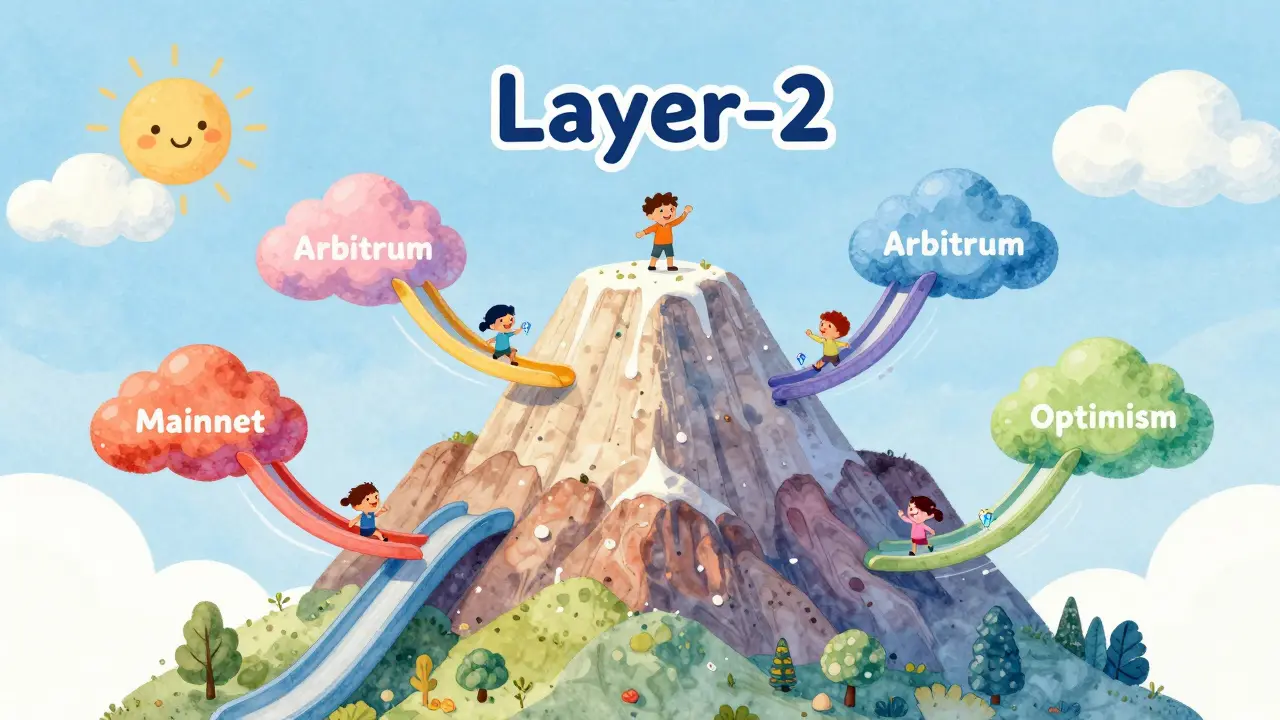
If you used Ethereum back in 2021, you probably remember the horror of paying $24 just to move some funds. Fast forward to 2026, and the landscape is unrecognizable. Thanks to the rollout of EIP-4844 (also known as proto-danksharding), the cost of data availability has plummeted. This upgrade essentially created a new way for rollups to store data, meaning they don't have to pay the exorbitant fees of the mainnet.
The result? Average transaction costs on Layer-2 solutions like Arbitrum, Base, and Optimism have dropped to less than one cent. We've moved from a world where only "whales" could afford to interact with DeFi to one where a teenager can buy a digital collectible without the fee costing more than the item itself. This abundance of cheap blockspace is the engine driving the next wave of consumer apps.
The Speed and Cost Edge of Monolithic Chains
While Ethereum scales via layers, Solana took a different path. By focusing on a high-performance single layer, it has maintained consistently low fees as a core competitive advantage. For developers building consumer-facing apps-think social media or high-frequency gaming-the predictability of Solana's fee structure is a massive draw.
We are also seeing a rise in permissioned blockchain networks. In these setups, there are fewer validators, which naturally optimizes energy consumption and speeds up the process. For enterprises, this means a more predictable cost model and controlled visibility, where auditors can see everything but clients only see what's necessary. It turns the "wild west" of public fees into a streamlined corporate utility.
Stablecoins: The Trojan Horse for Global Payments
The real story isn't just about the tech; it's about the volume. By September 2025, monthly adjusted stablecoin transaction volume hit a staggering $1.25 trillion. Why? Because stablecoins remove the volatility of the asset while keeping the low cost of the network. When you combine a stable asset with a low-fee network, you get a product that can actually compete with Visa or SWIFT.
Looking ahead to 2030, projections suggest stablecoins could capture 20% of the global cross-border payments market. With the total cross-border market expected to reach $290 trillion, the shift toward blockchain transaction fees will save businesses and individuals trillions in lost intermediary charges and FX spreads. We're seeing the transition of blockchain from a speculative asset class to a fundamental layer of global finance.
The Role of Zero-Knowledge Tech and Privacy
Efficiency isn't just about speed; it's about how we handle data. Zero-Knowledge (ZK) Proofs are changing the game. Instead of uploading massive amounts of data to a chain (which costs money), ZK technology allows a user to prove something is true without revealing the underlying data. This drastically reduces the amount of "on-chain" work required, further lowering fees.
This trend is extending into privacy. Tools like Railgun and Zcash are enabling more efficient private transactions. When privacy is handled via clever math (like ZK-proofs) rather than bulky encryption, the network load drops, and the cost to the user stays low. Even tech giants are getting in on this, with Google introducing its own ZK identity system, signaling that the efficiency of blockchain-style verification is moving into the mainstream web.

Regulatory Guardrails and Fee Caps
It's not all a downhill slide toward zero cost. Regulation is starting to catch up. In late 2025, the SEC and CFTC began coordinating a more unified approach to digital asset regulation. We're seeing a shift where transparency in fee disclosure is becoming mandatory. Some jurisdictions are even exploring fee caps-for instance, some regulations have suggested capping transaction fees at 18% with daily limits for new customers to prevent predatory pricing.
While these rules might seem like a hurdle, they actually provide the "institutional certainty" that big banks need to fully migrate their systems. When the rules of the road are clear, the big players move in. This institutional influx will likely drive further optimization, as banks will demand fee structures that fit their existing accounting and compliance frameworks.
How to Optimize Your Own Transaction Costs
If you're managing assets or running a business, you can't just set it and forget it. Navigating these fees requires a bit of strategy. Here is a simple rule of thumb for choosing your path:
- For micro-transactions: Use a Layer-2 (like Base) or a high-throughput chain (like Solana). If the fee is more than 1% of the transaction value, you're using the wrong network.
- For high-value institutional transfers: Use the mainnet for maximum security, but time your transactions. Watch the "gas" prices-sending a transfer during a massive NFT mint is like trying to take an Uber during a rainstorm in New York City; you'll pay a premium for nothing.
- For cross-border B2B: Prioritize stablecoins over volatile assets to avoid losing 3-5% on conversion spreads at the off-ramp.
Why do blockchain fees spike during busy periods?
Blockchain networks have limited space in each block. When thousands of people try to send transactions at once (like during a popular token launch), they compete for that limited space by offering higher fees to validators. It's essentially a real-time auction for priority.
Will transaction fees eventually hit zero?
Probably not entirely. Fees serve as a defense against spam. If transactions were completely free, a malicious actor could flood the network with billions of useless entries, crashing the system. However, for the average user, fees will likely feel negligible, similar to how we don't think about the cost of a single Google search today.
What is the difference between a gas fee and a processing fee?
A gas fee is the raw cost paid to the network's validators to compute the transaction. A processing fee is typically charged by a third-party service provider or payment gateway that simplifies the process for the user, often including a markup for their convenience and tools.
Are Layer-2 solutions safe for large amounts of money?
Most modern Layer-2s use optimistic or ZK-rollups that eventually settle their data back to the main Ethereum chain. While they are generally very secure, they do introduce a different risk profile than the mainnet. For multi-million dollar transfers, the mainnet is still the gold standard for security, despite the higher fees.
How do stablecoins lower the overall cost of payments?
Stablecoins reduce costs by eliminating the need for multiple intermediary banks and expensive currency exchange (FX) spreads. Instead of a chain of 3-4 banks each taking a cut, a stablecoin transfer is a direct peer-to-peer move on a low-fee network.


Prachi Bhadarge
April 15, 2026 AT 07:10Oh sure, just wait until the "low fees" are replaced by a subscription model because someone decided they needed a new yacht. Classic crypto.
Andrew Southgate
April 15, 2026 AT 09:46It is honestly so inspiring to see how far we have come since those brutal 2021 gas wars where everything felt impossible for the average person. I remember helping a few friends set up their first wallets and the look of sheer panic when they saw a $50 fee just to swap some tokens was something I'll never forget. Now, the transition to Layer-2 solutions is making the ecosystem so much more welcoming for everyone, regardless of their budget, and it really opens the door for global adoption in a way that actually helps people in underdeveloped regions get access to financial tools. This shift toward utility over speculation is exactly what the space needed to grow maturely and sustainably for the next decade!
Trudy Morse
April 16, 2026 AT 01:48Money is just a shared hallucination anyway. This is just shifting the hallucination to a different ledger. Cute.
Kevin Lư
April 17, 2026 AT 08:53I mean, it's cool and all, but imagine the moral decay of a world where we just trust code over humans. Still, cheaper than my bank, I guess!
Michelle Stanish
April 19, 2026 AT 05:29L2s aren't a real fix.
Jeff Barlett
April 21, 2026 AT 03:28Wait, so we're just supposed to trust that these "rollups" aren't just centralized honeypots for some dev to rug us? Absolute madness! The sheer audacity of calling this a "utility" when it's basically a house of cards waiting for a breeze to hit it. I can't believe people are actually eating this up as "progress" while ignoring the systemic fragility!
Kim Smith
April 22, 2026 AT 12:16the way we think about value is so tied to these old systems but maybe the real shift isnt the cost of the transction but the cost of the trust we put in it... like if i send a coin to someone in another country it isnt just about the cent it's about the connecton across borders that used to be gated by these huge banks who didnt care about the little guy and now we're seein this l2 stuff just makin the world feel a bit smaller and more accessible for everyone who ever felt left out of the loop by a suit in a high rise building in nyc or london
Abhinav Chaubey
April 22, 2026 AT 15:39Typical Western perspective. India is already leading the way in digital payments with UPI, making these blockchain "predictions" look like they are lagging behind our current reality. We don't need your slow L2s when we have systems that actually work for billions of people right now!
siddharth narula
April 24, 2026 AT 12:48One must contemplate the ethical implications of removing the intermediary entirely. Does the absence of a moral arbiter in financial transactions lead to a vacuum of accountability? 🧐
Yuhan Mo
April 26, 2026 AT 10:56The throughput optimization via ZK-rollups is definitely mitigating the latency issues we saw in early iterations of the EVM. It's a solid architectural pivot.
Michael Harms
April 27, 2026 AT 06:02Love seeing the tech become more accessible! Anyone who feels overwhelmed by the L2 stuff just remember that it's all about making things easier for the end user in the long run.
Anna Grealis
April 28, 2026 AT 21:13Who is funding these "fee caps" though? probably the same people who want to monitor every single cent we spend. it's all a trap to bring us into a social credit system
Karen Mogollon Gutierrez
April 30, 2026 AT 14:24The sheer audacity of suggesting that a 18% fee cap is a "guardrail" is an absolute travesty of regulatory failure! This is an insult to the very concept of decentralized finance!
Tracy Sperandio
April 30, 2026 AT 20:46Let's go! This is the kind of disruption that actually empowers the global south and breaks the chains of legacy banking. Absolutely electric to see the numbers on stablecoin volume!
nathan jones
May 1, 2026 AT 20:18Interesting stuff. Keep it simple.
Robert Preston
May 2, 2026 AT 18:24If you are moving six figures, just stick to the mainnet. The "savings" on an L2 are negligible compared to the risk of a sequencer failure for that kind of capital.
Alex Long
May 3, 2026 AT 16:27Boring. Another "future of" post that ignores the fact that most people can't even set up a seed phrase without losing it.
Evan Iacoboni
May 4, 2026 AT 18:16The mention of Google's ZK identity system is the most interesting part. That's where the real scale happens.
Nishant Goyal
May 5, 2026 AT 21:36Great outlook. Very promising.
Gaurav Undirwade
May 6, 2026 AT 09:17It is highly regrettable that the common user continues to seek shortcuts via Layer-2 solutions rather than mastering the fundamental discipline of on-chain management. One must possess the fortitude to endure higher fees to ensure absolute sovereignty over one's assets.
Ian Chait
May 7, 2026 AT 06:40all this talk bout l2s but the real plot is the central banks usin' this to track evrysingle penny with their cbdcs... total surveillance state coming right up, mate
Sean Douglas
May 7, 2026 AT 20:32The sheer, unadulterated agony of remembering the 2021 gas fees is practically a visceral experience! My soul wept as I watched my funds evaporate into the ether, all for the "privilege" of a transaction that took an eternity to confirm. It was a Shakespearean tragedy played out in a digital wallet, and quite frankly, I am still recovering from the trauma of that financial carnage!
Vicky Duffala
May 8, 2026 AT 22:49Think about the liberation here! We're not just talking about cents, we're talking about the democratization of value. Every time a fee drops, a barrier falls. 🚀
Kaitlyn Wu
May 8, 2026 AT 23:34We need to ensure that these lower fees don't lead to a surge in spam that degrades the network for everyone. Accessibility is great, but not at the cost of stability.
nikki krinkin
May 10, 2026 AT 20:25Just listening and observing. It's a lot of noise, but the trend seems clear.
Shantal Sanjur
May 12, 2026 AT 20:24Oh, absolutely! Let's just trust the SEC to "coordinate" our fees. I'm sure that'll go wonderfully. I can't wait for the government to tell me how much a peer-to-peer transaction should cost. Truly a peak moment for decentralization, haha.
Chintu Parikh
May 13, 2026 AT 23:17I believe it is absolutely imperative that we embrace these technological advancements with an open mind and a spirit of cooperation to ensure the betterment of the global financial ecosystem for all stakeholders involved!
Mike Kempenich
May 14, 2026 AT 03:12The numbers for stablecoins are pretty undeniable. Even if you don't like the tech, the volume speaks for itself. It's happening whether the banks like it or not.
Adam Mann
May 15, 2026 AT 14:48It is just so wonderful to see how this all comes together for people who have never had a bank account in their lives! I mean, just think about a small business owner in a rural village who can now receive payments from across the ocean without some big bank taking a huge chunk of their hard-earned money just for the sake of it. It really is like a bridge being built where there used to be a giant wall, and I think we should all be really excited about how this helps everyone get a fair shot at the global economy, no matter where they were born or what language they speak, because at the end of the day, we're all just trying to take care of our families and build a better future together!