
Imagine you want to prove to a friend that you know the combination to their safe, but you don't want to tell them the numbers. Or picture trying to convince a bouncer you’re over 21 without handing over your ID and revealing your home address. This sounds impossible, right? Yet, in the world of cryptography, this is exactly what Zero-Knowledge Proofs (ZKPs) are cryptographic protocols that allow one party to prove a statement is true without revealing any information beyond the validity of the statement itself. They are the mathematical backbone of privacy-preserving technologies, from anonymous cryptocurrencies like Zcash to scalable blockchain solutions like Ethereum’s Layer 2 networks.
If you’ve ever felt intimidated by terms like "elliptic curves" or "polynomial commitments," you aren’t alone. The math behind ZKPs looks dense on paper. But at its core, it’s about turning logic into algebra so a computer can verify truth without seeing the data. Let’s break down how this magic works, starting with the basic building blocks.
The Three Rules of Zero-Knowledge
Before diving into equations, we need to understand what makes a proof "zero-knowledge." In 1985, cryptographers Shafi Goldwasser, Silvio Micali, and Charles Rackoff defined three strict criteria that every ZKP must meet. If a protocol fails even one of these, it isn’t a true zero-knowledge proof.
- Completeness: If the statement is actually true, an honest prover can always convince an honest verifier. There are no false negatives for truthful claims.
- Soundness: If the statement is false, no cheating prover can convince the verifier it’s true, except with negligible probability. For example, the chance of fooling the system should be less than 1 in 2128-a number so small it’s effectively zero.
- Zero-Knowledge: The verifier learns nothing other than the fact that the statement is true. They gain no insight into the underlying secret (like the safe combination or your birthdate).
Think of it like a maze. You want to prove you know the exit path without showing the map. You enter the maze, and a friend asks you to come out from a specific entrance. If you can do this repeatedly from random entrances, they become convinced you know the full layout, even though they never saw the path itself.
Turning Logic into Algebra: Arithmetization
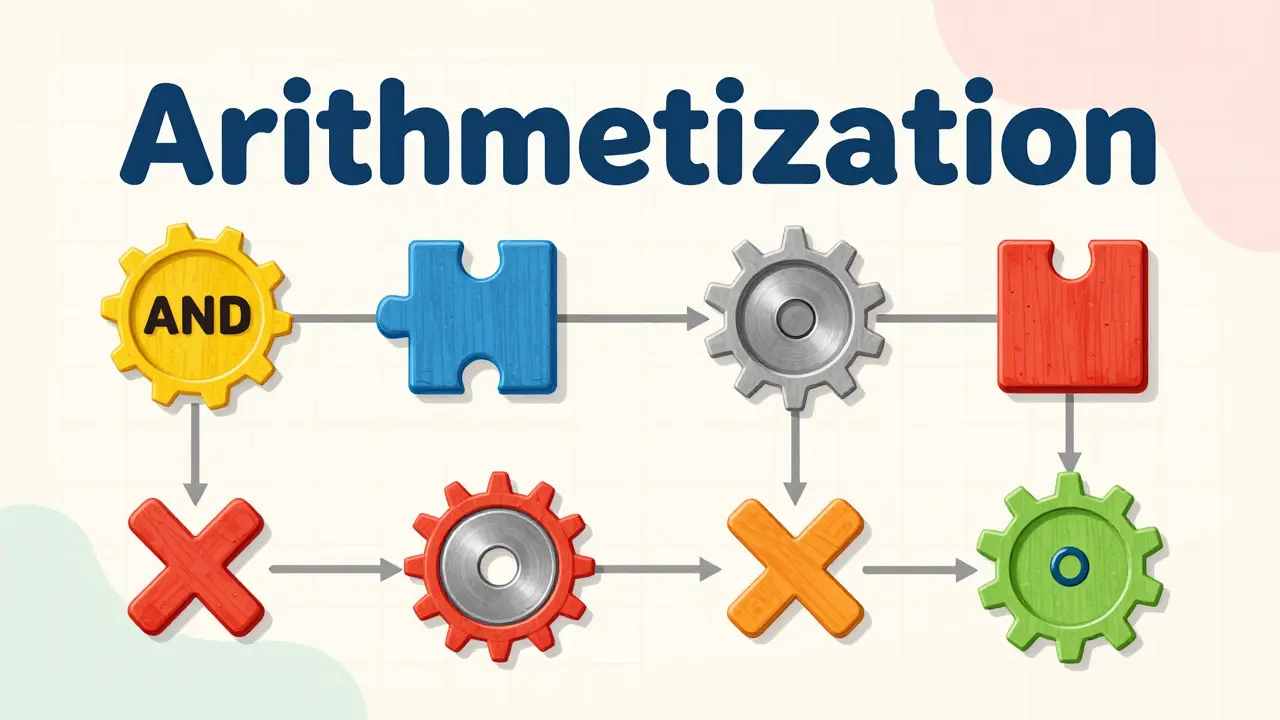
Computers don’t think in "truth" or "lies." They process bits and bytes. To create a ZKP, we first have to translate the computation we want to verify into a format the math can handle. This process is called arithmetization.
Any complex calculation-whether it’s checking a password hash or validating a financial transaction-can be broken down into simple logical gates: AND, OR, and XOR. Mathematicians use a concept called functional completeness, which proves that you only need two operations (XOR and AND) to build any computational problem.
In ZKP systems, these logic gates are converted into arithmetic circuits. Instead of binary 0s and 1s, we work with numbers in a finite field. For instance, an AND gate becomes multiplication, and an XOR gate becomes addition. If you multiply two boolean values (0 or 1), the result mimics the AND operation perfectly. This allows us to represent an entire program as a massive system of polynomial equations.
Here’s where it gets heavy: verifying a single SHA-256 hash requires about 25,000 constraints. Verifying an entire Ethereum block? That jumps to over 100 million constraints. The goal of ZKP engineering is to minimize these constraints while keeping the proof secure.
The Role of Polynomials and Randomness
Once we have our arithmetic circuit, we need a way to prove we solved it correctly without revealing the inputs. This is where polynomials and randomness come in. Modern ZKPs rely heavily on the Schwartz-Zippel Lemma, a fundamental theorem in algebra.
The lemma states that if you have a non-zero polynomial of degree d over a large field, the probability that it equals zero at a randomly chosen point is very low-specifically, less than d/|F|, where |F| is the size of the field. In simpler terms: if two different polynomials agree on a few random points, they are almost certainly the same polynomial everywhere.
This allows the verifier to check just a handful of points instead of evaluating the entire massive equation. It’s like checking the temperature at three spots in a room to confirm the whole house is heated evenly. By using cryptographic hash functions (like SHA-256) to generate random challenges, the prover cannot predict which points will be checked, forcing them to provide a valid proof for the entire computation.
zk-SNARKs vs. zk-STARKs: Choosing Your Protocol
Not all zero-knowledge proofs are created equal. Depending on your needs-speed, security, or transparency-you’ll choose between different protocols. The two most prominent families are zk-SNARKs and zk-STARKs.
| Feature | zk-SNARKs | zk-STARKs | Bulletproofs |
|---|---|---|---|
| Proof Size | Small (188-288 bytes) | Large (45-150 KB) | Medium (1-2 KB) |
| Verification Time | Fast (~10ms) | Moderate (100-500ms) | Linear (depends on circuit) |
| Trusted Setup? | Yes (required) | No (transparent) | No |
| Quantum Resistance | No | Yes | Partial |
| Best Use Case | On-chain verification (e.g., Ethereum L2s) | High-security, off-chain verification | Range proofs (e.g., Monero) |
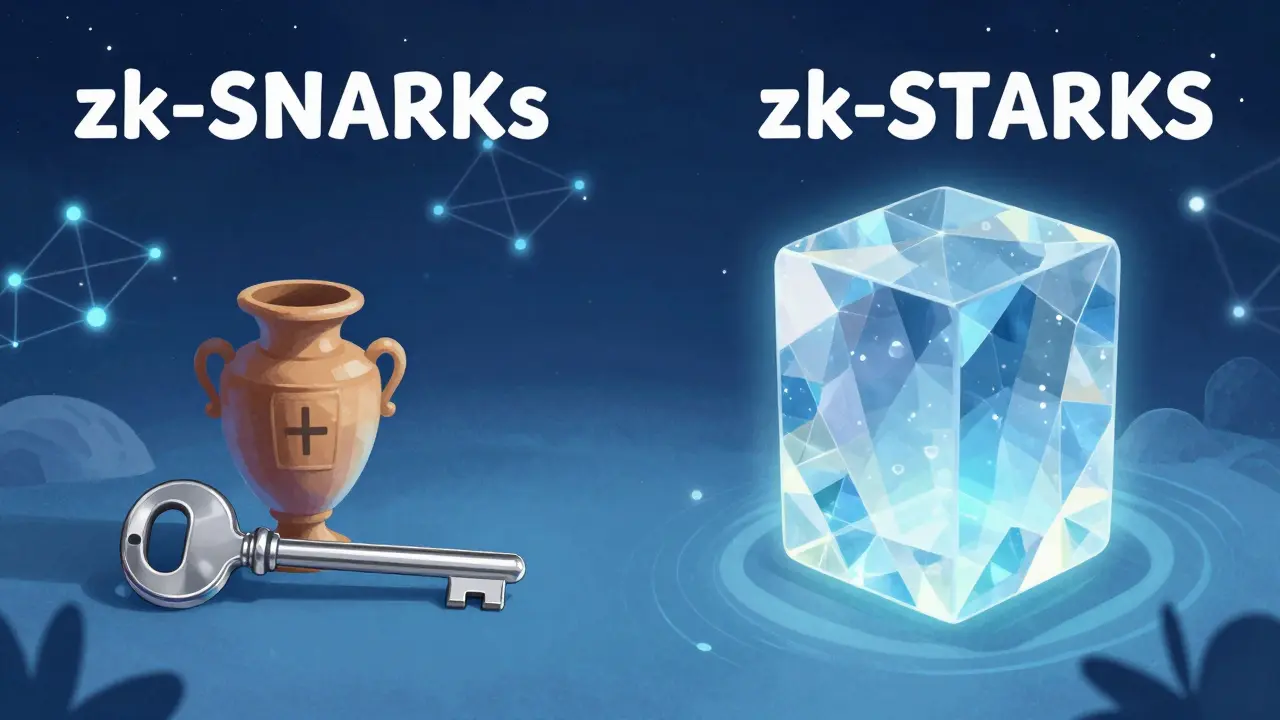
zk-SNARKs (Succinct Non-Interactive Arguments of Knowledge) are the industry standard for blockchain scaling. Projects like zkSync and Polygon zkEVM use them because the proofs are tiny and fast to verify on-chain. However, they require a "trusted setup"-a ceremony where secret parameters are generated and then destroyed. If those secrets are leaked, the system can be forged.
zk-STARKs (Scalable Transparent Arguments of Knowledge) eliminate the trusted setup entirely, making them more transparent and quantum-resistant. The trade-off is larger proof sizes and slower verification, which makes them less ideal for direct on-chain use but perfect for off-chain validation or recursive proving.
Real-World Applications and Challenges
You might wonder why all this math matters. The answer lies in scalability and privacy. Today, ZKPs power some of the most critical infrastructure in crypto:
- Privacy Coins: Zcash uses zk-SNARKs to hide sender, receiver, and amount details in transactions.
- Layer 2 Scaling: zk-Rollups bundle thousands of transactions off-chain, generate a single ZKP of validity, and submit it to Ethereum. This reduces costs by up to 100x thanks to upgrades like EIP-4844 (proto-danksharding).
- Identity Verification: Startups are using ZKPs to let users prove they are human, over 18, or creditworthy without exposing personal data to centralized databases.
However, the technology isn’t flawless. Generating proofs is computationally expensive. Current state-of-the-art provers take about one second to process one million constraints on consumer hardware. For real-time applications, this latency is a bottleneck. Additionally, debugging failed proofs is notoriously difficult; developers often spend 40% of their time optimizing circuit design rather than writing application code.
How to Learn ZKP Mathematics
If you’re a developer looking to dive in, expect a steep learning curve. Mastering the necessary algebraic geometry and number theory typically takes 3-6 months of dedicated study. Here’s a practical roadmap:
- Start with Modular Arithmetic: Understand "clock math" and prime fields (like Fp where p is a large prime). This is the foundation of finite field operations.
- Study Elliptic Curve Cryptography: Familiarize yourself with curves like BN254 or BLS12-381, which underpin many pairing-based SNARKs.
- Practice Circuit Design: Use tools like Halo2 or Circom to write simple circuits. Try converting a basic function (like `x + y = z`) into a constraint system.
- Engage with Community Resources: Check out the "ZK Whiteboard Sessions" on YouTube or enroll in the ZK MOOC by 0xPARC. These resources bridge the gap between theory and implementation.
Remember, the goal isn’t to memorize every formula. It’s to understand how logic transforms into algebra, and how algebra enables trustless verification. As Professor Amit Sahai notes, ZKPs fundamentally change what we thought possible in secure computation. With the market projected to reach $5.23 billion by 2028, understanding this math is no longer just academic-it’s essential for the future of digital privacy.
What is the simplest example of a zero-knowledge proof?
The classic example is the "Ali Baba’s Cave" scenario. A prover enters a circular cave with a magic door that only opens with a secret word. The verifier waits outside. The prover goes in, and the verifier calls out a direction (left or right). If the prover comes out from the correct side, they likely know the secret. Repeating this many times reduces the probability of guessing to near zero, proving knowledge of the secret without revealing it.
Why do zk-SNARKs need a trusted setup?
zk-SNARKs rely on elliptic curve pairings that require pre-generated cryptographic parameters. If anyone retains the "toxic waste" (secret keys) from this setup, they can forge fake proofs. Trusted setups involve multi-party ceremonies where no single participant knows the full secret, mitigating this risk.
Are zero-knowledge proofs quantum-resistant?
It depends on the type. zk-SNARKs generally rely on elliptic curve cryptography, which is vulnerable to quantum attacks. zk-STARKs, however, are based on hash functions and are considered quantum-resistant, making them a safer long-term choice for high-security applications.
What is arithmetization in ZKPs?
Arithmetization is the process of converting a computational problem (like a software program) into a system of arithmetic equations. This allows the proof system to verify the computation using algebraic methods rather than re-running the program.
How long does it take to learn ZKP development?
For a developer with strong math skills, reaching proficiency typically takes 3-6 months and around 200-300 hours of study. The biggest hurdles are understanding finite fields, polynomial commitments, and circuit optimization techniques.