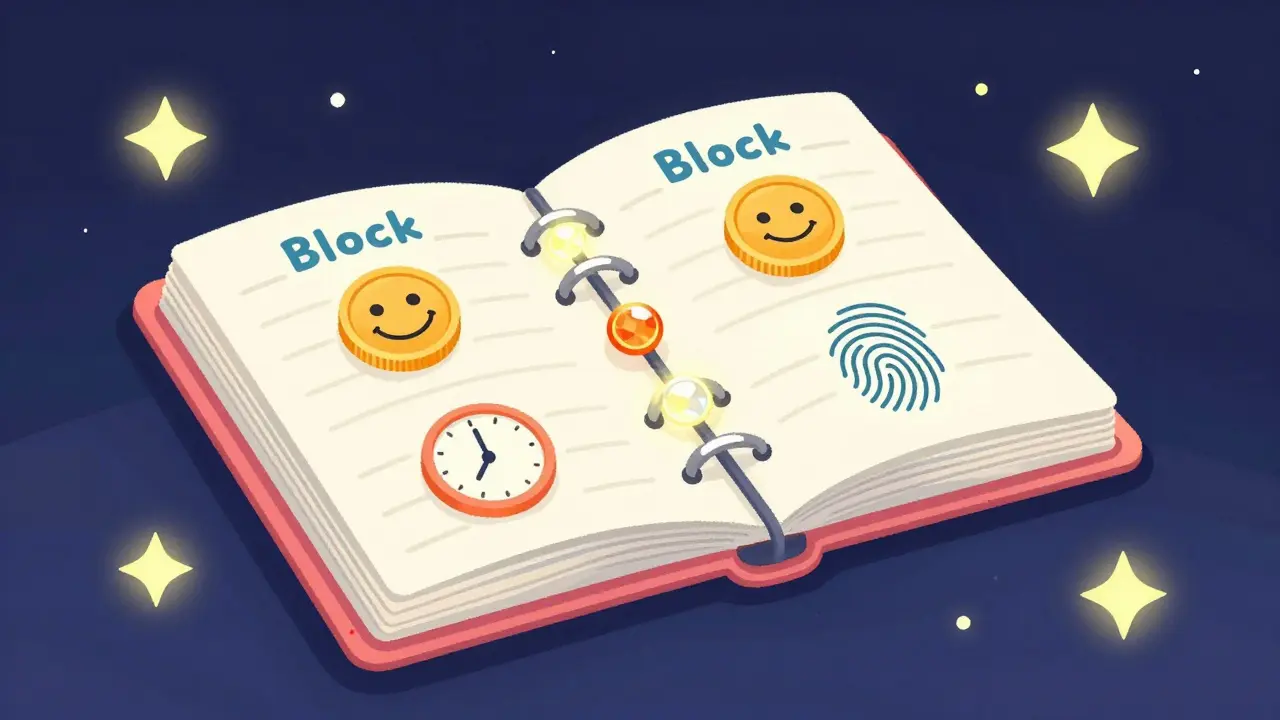
Think of blockchain like a digital notebook that everyone can see but no one can erase. Every page in that notebook is a block. And each page doesn’t just record what happened-it locks it in place forever using math. That’s the core idea behind a block in blockchain technology.
What Exactly Is a Block?
A block is a digital container that holds a group of verified transactions. It’s not just a list of transfers-it’s a sealed unit of data that includes a timestamp, a unique fingerprint (called a hash), and the fingerprint of the block before it. That last part is what makes it a blockchain. Each block links to the one before it, like links in a chain. Change one block? You break the chain. That’s why it’s so hard to tamper with.
The first block ever created, known as the genesis block, was added to Bitcoin’s network in January 2009. It had no predecessor. Since then, every new block has been built on top of the last, forming an unbroken line of data stretching back to that very first one. Today, Bitcoin alone has over 800,000 blocks. Ethereum has over 20 million. And it keeps growing.
What’s Inside a Block?
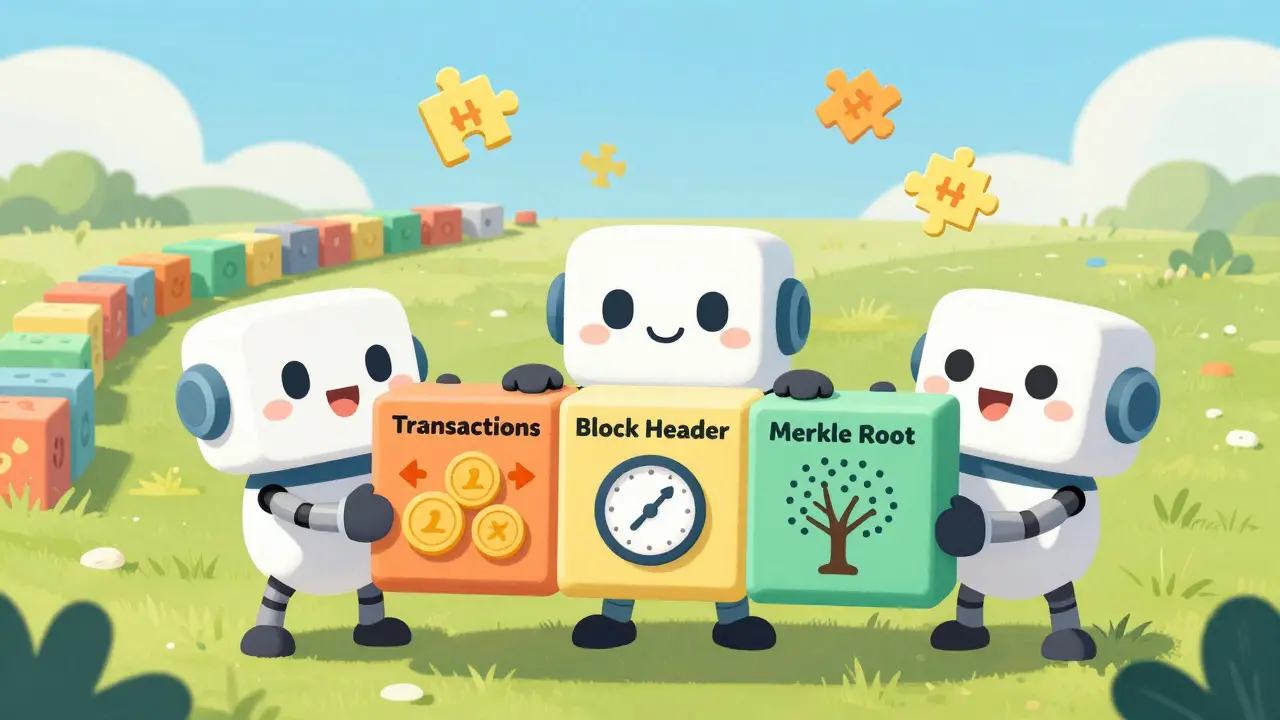
Every block has three main parts:
- Transaction data-This is the actual record of what happened. For Bitcoin, that’s who sent how many bitcoins to whom. But it can be anything: a contract, a land title, a medicine shipment, a vote. The data isn’t personal names-it’s digital addresses and amounts.
- Block header-This contains the cryptographic hash of the previous block, a timestamp, and a number called a nonce. The hash of the previous block is what links everything together. Without it, the chain falls apart.
- Merkle root-This is a single hash that represents all the transactions in the block. Instead of storing every transaction’s hash individually, the system combines them into a tree-like structure. This makes checking transactions faster and more efficient.
For example, if you sent 0.5 BTC to your friend, that transaction gets bundled with dozens or hundreds of others into one block. Once the block is confirmed, your transaction becomes part of the permanent public record.
How Are Blocks Created and Added?
Blocks don’t just appear. They’re created through a process called consensus. Different blockchains use different rules to decide who gets to add the next block.
In Bitcoin, it’s called proof-of-work. Miners compete to solve a complex math puzzle. The first one to solve it gets to bundle the next set of transactions into a block and add it to the chain. As a reward, they get newly minted bitcoins and transaction fees. This process takes about 10 minutes per block on average.
Other blockchains, like Ethereum since 2022, use proof-of-stake. Instead of solving puzzles, validators are chosen based on how much cryptocurrency they “stake” as collateral. The more you lock up, the higher your chance of being selected. This method uses far less energy and is faster.
Either way, the network doesn’t trust one person. Thousands of computers check that the block’s transactions are valid. No double-spending. No fake signatures. Once consensus is reached, the block is added-and it’s nearly impossible to undo.
Why Is a Block Immutable?
Here’s the magic: every block’s hash depends on the data inside it-and the hash of the block before it. If someone tries to change a transaction in Block 5, the hash of Block 5 changes. But Block 6 contains the old hash of Block 5. So now Block 6 doesn’t match. That breaks the chain.
To fix it, the attacker would have to redo Block 5, then recalculate the hash for Block 6, then Block 7, then Block 8… all the way to the most recent block. And they’d have to do it faster than the entire network adds new blocks. On Bitcoin, that’s over 800,000 blocks. The computing power needed? More than the entire planet’s current electricity output.
That’s why blockchain is called immutable. It’s not that it’s impossible to change-it’s that it’s practically impossible. The cost and effort outweigh any possible gain.
Blockchains vs. Traditional Databases
Most companies use databases where a single administrator can edit, delete, or hide records. Your bank can reverse a transaction. A hospital can update your medical record. That’s fine in controlled environments.
But blockchain is different. No one controls it. No central authority can delete your transaction. Once it’s in a block and confirmed, it’s there forever. That’s powerful for things like:
- Proving ownership of digital art (NFTs)
- Tracking food from farm to store
- Recording land titles in countries with corrupt registries
- Verifying voting results without trusting a central election body
But it’s not perfect. If you send crypto to the wrong address? You can’t undo it. If you make a mistake in a smart contract? You can’t edit it. You have to add another transaction to fix it-and both the error and the fix stay on the chain forever.

What Are the Downsides?
Blocks aren’t magic. They come with trade-offs.
First, speed. Bitcoin can handle about 7 transactions per second. Visa handles 24,000. That’s why Bitcoin transactions can take minutes-or hours-during busy times.
Second, size. Every full node on the network stores a copy of every block ever created. Bitcoin’s blockchain is over 600 gigabytes. That’s a lot of storage. It makes running a node harder for everyday users.
Third, energy. Proof-of-work blockchains like Bitcoin use massive amounts of electricity. Critics say it’s unsustainable. Supporters argue that much of it comes from renewable sources, and newer blockchains have moved away from it.
Finally, privacy. Everything is public. You can’t hide who sent what to whom. Some blockchains add privacy layers, but the core design is transparent by default.
What’s Next for Blocks?
Developers are working hard to make blocks faster, smaller, and greener.
Layer-2 solutions like the Lightning Network for Bitcoin let users make thousands of off-chain transactions and only record the final result on the main chain. That reduces load and cost.
New block structures, like Ethereum’s “blobs,” are being tested to store more data efficiently without bloating the main chain.
And consensus mechanisms keep evolving. Proof-of-stake is now the standard for most new blockchains. Some are experimenting with proof-of-space, proof-of-history, and even consensus based on real-world events.
The goal? Keep the security and trust of blocks-without the slowdowns and waste.
Why Should You Care?
You don’t need to be a coder to understand blocks. They’re the reason you can trust digital money without a bank. They’re why you can prove you own something online without a middleman. They’re the foundation of a new kind of internet-one where trust is built into the system, not handed out by corporations.
Blocks aren’t just for crypto. They’re being used in supply chains, healthcare records, digital IDs, and even carbon credit tracking. The technology is still young, but the idea is simple: if you can’t change it, you can’t lie about it.
That’s the power of a block in blockchain technology.
Can a block be deleted from a blockchain?
No, blocks cannot be deleted from a blockchain. Once a block is added and confirmed by the network, it becomes part of the permanent, immutable record. Even if you wanted to remove it, you’d need to change every single block after it-which requires more computing power than exists on Earth. Some blockchains allow for forks (new versions of the chain), but the original block still exists on the old chain. Nothing is ever truly erased.
How big is a typical blockchain block?
Bitcoin blocks are limited to 1 MB in size, which allows about 2,000-3,000 transactions per block. Ethereum blocks don’t have a fixed size-they’re limited by gas, which measures computational effort. On average, an Ethereum block holds around 100-200 transactions. Some newer blockchains, like Solana or Polygon, can fit thousands of transactions per block by using more efficient data structures.
Do all blockchains use the same block structure?
Most blockchains follow the same basic structure: transactions, header with previous hash, timestamp, and Merkle root. But details vary. Bitcoin uses SHA-256 hashing. Ethereum uses Keccak-256. Some blockchains include smart contract code inside blocks. Others use different consensus rules that affect how blocks are validated. The core idea is the same, but the implementation adapts to the network’s goals.
What happens if two blocks are created at the same time?
This is called a fork. It happens occasionally, especially in fast networks. When two miners find a valid block at nearly the same time, the network temporarily has two competing chains. Miners then keep building on whichever block they see first. The chain with the most subsequent blocks becomes the accepted one. The other block becomes an orphan and is discarded. Transactions in the orphaned block are usually re-added to the next batch. This is normal and built into the system.
Are blocks the same as cryptocurrency coins?
No. A block is a container for transactions. Cryptocurrency coins (like Bitcoin or Ethereum) are the units of value being transferred within those transactions. A single block can contain hundreds of transactions involving thousands of coins. The block doesn’t hold coins-it records who sent what to whom. The coins themselves exist as entries in the ledger, tracked across blocks.
How long does it take to create a new block?
It depends on the blockchain. Bitcoin targets one block every 10 minutes. Ethereum targets one every 12 seconds. Cardano creates blocks every 20 seconds. Some private blockchains can create blocks in under a second. The speed is set by the network’s rules and adjusted based on how many miners or validators are active. The goal is to balance security, speed, and decentralization.



Mike Pontillo
December 27, 2025 AT 21:42So let me get this straight-you’re telling me we’re trusting math instead of banks? Cool. I’ll believe it when my IRS forms can’t be edited by some guy in a basement with a laptop.
Joydeep Malati Das
December 29, 2025 AT 16:39The structural integrity of blockchain as a decentralized ledger is indeed a remarkable advancement in distributed consensus systems. The immutability property ensures data integrity without reliance on central authorities.
rachael deal
December 30, 2025 AT 01:46This is SO cool!! I just learned something new today and I’m hyped 😍 Blockchain isn’t just for crypto-it’s like a digital fingerprint for truth. Can’t wait to see how this changes the world!
Elisabeth Rigo Andrews
December 30, 2025 AT 18:45The Merkle root optimization is a non-trivial innovation in cryptographic commitment schemes, enabling logarithmic verification complexity while maintaining O(n) space efficiency. Without it, scalability would be fundamentally compromised at the protocol layer.
Adam Hull
December 30, 2025 AT 20:07Let’s be honest. This whole thing is just a glorified Excel sheet run by people who think ‘decentralized’ means ‘no one’s in charge so I can do whatever I want.’ The energy waste alone makes this a tech bro fantasy.
Mandy McDonald Hodge
January 1, 2026 AT 08:59i just read this and i’m like wowwwww i never thought about how blocks link together like legos 😅 so cool that even if you mess up u cant delete it… kinda scary but also kinda beautiful??
Bruce Morrison
January 2, 2026 AT 19:19Blocks are the foundation of trust without middlemen. Simple. Effective. No fluff. Just code and consensus.
Andrew Prince
January 2, 2026 AT 23:49It is worth noting, with a degree of scholarly rigor, that the proof-of-work mechanism employed by Bitcoin, while ostensibly decentralized, exhibits a concerning concentration of mining hashpower among a handful of industrial-scale operations, thereby undermining the very principle of egalitarian participation that underpins its theoretical architecture.
Jordan Fowles
January 3, 2026 AT 08:06There’s something poetic about a chain that can’t be broken. We spend so much time trying to erase our mistakes, but here, the system says: remember. Maybe that’s the real innovation-not the tech, but the philosophy.
Steve Williams
January 4, 2026 AT 11:56This is a groundbreaking development for transparent governance and secure record-keeping. In developing nations, blockchain can empower citizens by providing immutable proof of ownership and identity, reducing corruption at its roots.
prashant choudhari
January 6, 2026 AT 10:48Great breakdown. The Merkle tree is the unsung hero here. Efficient verification without storing every single transaction is genius
Willis Shane
January 6, 2026 AT 20:05You say it’s immutable, but what about the 51% attack? You’re ignoring the elephant in the room. This isn’t secure-it’s just slow enough that most people won’t bother trying to break it.
Jake West
January 8, 2026 AT 05:48So you’re telling me I can’t undo sending crypto to the wrong address? Lmao. This isn’t tech, it’s a trap for people who can’t copy-paste right.
Shawn Roberts
January 8, 2026 AT 05:51this is wild!!! blocks are like digital time capsules 😎 i love that once its in its forever. no going back. no excuses. just truth. lets goooo
Abhisekh Chakraborty
January 10, 2026 AT 03:19I’ve been reading this for 20 minutes and I still don’t get it. Why can’t we just use Google Sheets? It’s easier. And you can delete stuff. Why is this better?
dina amanda
January 10, 2026 AT 21:42This is just a government backdoor. They want everyone’s transactions tracked. They’re using ‘blockchain’ to hide the fact they’re building a surveillance state. Wake up people.
Emily L
January 12, 2026 AT 20:09So you’re saying I can’t delete my embarrassing crypto transaction? That’s literally the worst thing I’ve ever heard. I hate this.
SUMIT RAI
January 13, 2026 AT 22:19Blockchains are overrated 🤡 Proof-of-stake is just rich people voting for themselves. Also, why is everyone acting like this is new? Databases have had hashes since the 80s.
Josh Seeto
January 15, 2026 AT 18:39You think the 1MB block limit is the problem? Nah. It’s the people who think ‘decentralized’ means ‘no rules.’ The real bottleneck isn’t the block size-it’s the users who treat it like a casino.