
Most crypto exchanges force you to choose between safety and freedom. You either trust a centralized company with your funds or navigate the messy, unregulated wild west of decentralized finance. Figure Markets claims to bridge this gap. Launched in 2024 by Mike Cagney, former CEO of SoFi, this platform sits on the Provenance Blockchain, a public proof-of-stake blockchain designed specifically for financial services. It promises zero trading fees, institutional-grade compliance, and real-world asset yields that actually pay out.
But does it deliver? With reports of $191 million in revenue for the first half of 2025, Figure Markets is growing fast. Yet, questions remain about its limited coin selection and slower customer support. If you are looking for a place to park stablecoins for yield or borrow against Bitcoin without selling, this review breaks down whether Figure Markets fits your portfolio in 2026.
What Exactly Is Figure Markets?
Figure Markets is not your typical spot exchange like Coinbase or Binance. It is a hybrid platform. Think of it as a self-custody wallet that has been wrapped in regulatory compliance. The core technology relies on multi-party computation (MPC) wallets. Unlike traditional custodial exchanges where the company holds your private keys, MPC splits your key into parts. You hold some, Figure holds some, but neither can move your funds alone without cooperation. This gives you control while allowing the platform to verify your identity for legal purposes.
The platform was founded in 2024, though its parent company, Figure Technologies, dates back to 2018. This distinction matters because Figure brings years of experience in lending and fintech to the crypto space. Headquartered in San Francisco, it operates as a registered entity in the United States. This registration allows it to offer products that most decentralized exchanges (DEXs) cannot touch, such as the YLDS stablecoin, the first SEC-registered yielding stablecoin offering approximately 3.85% APY.
The main value proposition here is integration. You do not need to move money between five different apps to trade, earn interest, and take out a loan. Everything happens on one interface. For users tired of fragmentation, this is a significant convenience factor.
Core Features: Trading, Yield, and Lending
Let's look at what you can actually do on the platform. The features are streamlined rather than exhaustive.
- Zero-Fee Trading: Figure Markets charges no fees on major cryptocurrency pairs. This is a bold move compared to competitors who charge between 0.05% and 0.60%. However, this applies primarily to major assets, not obscure altcoins.
- Crypto-Backed Loans: You can borrow USDC against your Bitcoin or Ethereum holdings. The loan-to-value (LTV) ratios are conservative at 50% and 75%. There are no credit checks. In Q2 2025, the platform processed over $2 billion in loan volume, showing strong demand for liquidity without liquidation anxiety.
- Real-World Asset (RWA) Yields: This is the standout feature. By holding YLDS or participating in their yield pools, you earn returns backed by real-world loans, primarily home equity and auto loans. Targeted returns hit around 8.5% APY for certain RWA products, significantly higher than traditional savings accounts.
The catch? Selection. If you want to trade hundreds of meme coins or niche DeFi tokens, Figure Markets will disappoint you. It focuses on high-quality, regulated assets. For a trader seeking alpha in small-cap gems, this is a dead end. For an investor seeking stability and yield, it is a goldmine.
Security and Regulatory Compliance
In crypto, security is not just about code; it is about law. Figure Markets leans heavily into its regulatory moat. Being SEC-registered for its yield products means it undergoes scrutiny that platforms like Uniswap or Aave do not. This protects you from rug pulls and fraudulent yield schemes, which have wiped out billions in the past.
Technically, the platform uses the Provenance Blockchain. This chain is built for speed and low cost, handling financial transactions efficiently. Security firm CertiK audited the platform in August 2025, praising the MPC architecture for providing enterprise-grade security while maintaining user sovereignty. They noted that this setup is a significant step up from traditional custodial models where a hack of the exchange's cold storage could mean total loss for users.
However, regulation comes with friction. The Know Your Customer (KYC) process is mandatory. Users report verification times averaging 2.3 business days. While this is slightly slower than Coinbase's 1.5-day average, it is a necessary evil for accessing these compliant yield products. You cannot hide behind anonymity here, and that is by design.

Fees, Deposits, and Withdrawals
Cost efficiency is a major draw for Figure Markets. Since there are no trading fees, your entry and exit costs are minimal. But how do you get money in and out?
| Method | Region | Speed | Limits/Fees |
|---|---|---|---|
| ACH Bank Transfer | US Only | Instant (after linking) | Up to $25,000 per transfer; No fee |
| USDC Deposit (ERC-20) | International | Dependent on Ethereum network | Network gas fees apply; No platform fee |
| SEPA/SWIFT | Planned for Q1 2026 | N/A | Not yet available |
For US residents, the instant ACH link is a game-changer. You connect your bank account, and funds are available immediately for trading or lending. International users face more hurdles. Currently, you must deposit USDC via Ethereum addresses. This means paying Ethereum gas fees, which can be steep during network congestion. The promised expansion to SEPA and SWIFT in early 2026 should alleviate this, but until then, non-US users need to budget for transaction costs.
User Experience and Support
The interface is clean and modern, reflecting its fintech roots. If you have used SoFi or Robinhood, the layout will feel familiar. Navigation is intuitive, separating trading, earning, and borrowing into clear tabs. Mobile apps for iOS and Android perform well, with no reported lag or crashes in recent reviews.
Where the platform stumbles is community size and support responsiveness. With only 37 reviews on Trustpilot as of late 2025, the sample size is small. The average rating is 3.8/5. Positive reviews highlight the ease of earning yield and the peace of mind from self-custody. Negative reviews often cite slow customer support, with an average response time of 18.5 hours. Compare this to industry leaders who aim for under 2 hours, and you see a gap. For urgent issues, this delay can be frustrating.
Educational resources are decent. Video tutorials explain the MPC wallet concept clearly, which helps onboard users unfamiliar with blockchain mechanics. However, the Discord community of 12,500 members is tiny compared to Binance's millions. You won't find massive hype or rapid peer-to-peer troubleshooting here.
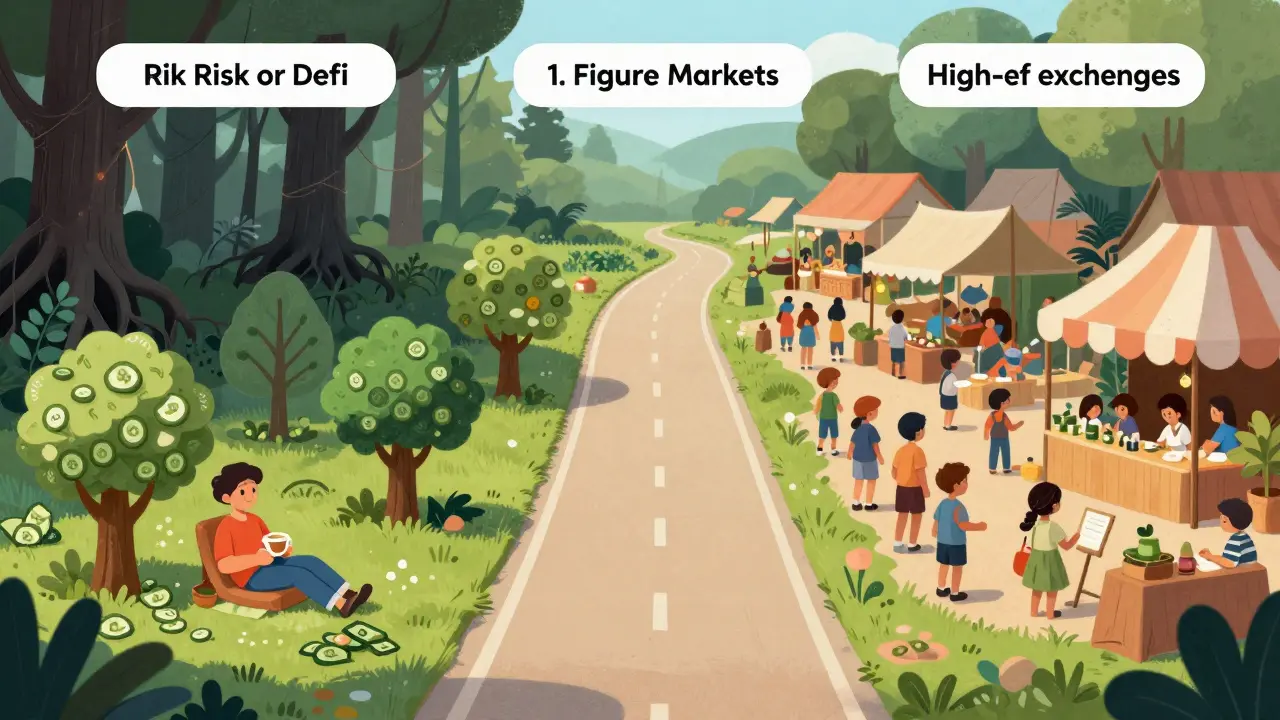
Figure Markets vs. The Competition
To understand where Figure Markets fits, we need to compare it to established players. It does not try to beat them at their own game; it plays a different one.
| Feature | Figure Markets | Coinbase | Uniswap (DEX) |
|---|---|---|---|
| Custody Model | Self-Custody (MPC) | Custodial (Insured) | Non-Custodial |
| Trading Fees | 0% | 0.05% - 0.60% | 0.30% (Standard) |
| Regulatory Status | SEC Registered (Yield Products) | Publicly Traded, Regulated | Unregulated |
| Yield Source | Real-World Assets (Loans) | Money Market Funds | Protocol Fees/Liquidity |
| Asset Variety | Low (Major Coins + RWAs) | High (200+) | Very High (Thousands) |
Coinbase offers better support and a wider range of coins, but you pay for it in fees and surrender custody. Uniswap offers total freedom and thousands of tokens, but you bear all the risk of smart contract bugs and have no recourse if things go wrong. Figure Markets sits in the middle: regulated, safe, and fee-free, but limited in scope. It is best for users who prioritize capital preservation and steady yield over speculative trading.
Risks and Considerations
No investment is risk-free, and Figure Markets has specific vulnerabilities you must understand.
- Concentration Risk: As of September 2025, 87% of the yield products are backed by home equity loans. If the US housing market crashes and defaults spike, your yield could vanish. This is a macroeconomic risk tied directly to the underlying assets.
- Limited Liquidity for Altcoins: Because the platform focuses on majors and RWAs, you cannot easily diversify into smaller projects. If your strategy relies on finding the next 100x gem, this platform is not for you.
- Regulatory Shifts: While current SEC registration is a strength, crypto regulations change rapidly. Any shift in how tokenized assets are treated could impact the availability of YLDS or other yield products.
Despite these risks, the platform's profitability ($29 million profit in H1 2025) suggests a sustainable business model. Unlike many crypto startups burning cash, Figure Markets is generating real revenue from loan interest and spread capture.
Who Should Use Figure Markets?
This platform is ideal for:
- Conservative Crypto Holders: You own Bitcoin or Ethereum and want to earn passive income without selling or taking on high leverage.
- US-Based Investors: Access to instant ACH transfers and SEC-compliant products makes this seamless for American users.
- DeFi Skeptics: You want exposure to blockchain yields but distrust the lack of oversight in pure DeFi protocols.
Avoid Figure Markets if:
- You are an active day trader needing deep order books for volatile altcoins.
- You require anonymous transactions.
- You live outside the US and want easy fiat on-ramps (until SEPA launches).
Is Figure Markets safe for my crypto?
Yes, it employs a high-security model using Multi-Party Computation (MPC) wallets on the Provenance Blockchain. Unlike centralized exchanges that hold your private keys, MPC ensures that neither you nor Figure can move funds unilaterally. Additionally, its SEC registration for yield products adds a layer of regulatory oversight rare in the crypto industry.
What is the YLDS stablecoin?
YLDS is the first SEC-registered yielding stablecoin launched by Figure Markets. It pays an approximate annual percentage yield (APY) of 3.85%, distributed directly to holders. The yield is generated from interest earned on real-world assets, primarily secured loans like home equity lines of credit.
Can I use Figure Markets outside the US?
Yes, but with limitations. International users can deposit USDC via Ethereum addresses. However, they currently lack direct fiat on-ramps like ACH, SEPA, or SWIFT, which are planned for launch in Q1 2026. You must also complete KYC verification, which takes an average of 2.3 business days.
Are there any trading fees on Figure Markets?
No, Figure Markets offers zero trading fees on major cryptocurrency pairs. This distinguishes it from competitors like Coinbase or Binance, which charge between 0.05% and 0.60% per trade. Note that this benefit applies mainly to supported major assets and may not extend to all tokenized real-world assets.
How do I get a crypto-backed loan on Figure Markets?
You can borrow USDC against collateral like Bitcoin or Ethereum. The platform offers Loan-to-Value (LTV) ratios of 50% and 75%. There are no credit checks required. For example, with 1 BTC, you might borrow up to 50% of its value instantly. Interest rates are fixed and competitive, making it a useful tool for leveraging positions without selling assets.
Why is the asset selection limited compared to Binance?
Figure Markets prioritizes regulatory compliance and security over variety. It focuses on major cryptocurrencies and tokenized real-world assets (RWAs). Listing hundreds of unvetted altcoins would introduce significant compliance risks and potential security vulnerabilities, contradicting the platform's core mission of providing institutional-grade, safe digital asset management.