Imagine trying to join a massive global conversation where no one has a phone book. You don't know who is talking, you don't have a central directory to call, and yet, somehow, you need to find someone to listen and respond. This is the exact problem Peer Discovery is the fundamental process by which nodes in decentralized blockchain networks locate and connect to other participating nodes. Without it, cryptocurrencies like Bitcoin and Ethereum would simply cease to exist. The network relies on this invisible web of connections to validate transactions, share blocks, and maintain consensus.
If you are running a node or just curious about how decentralization actually works under the hood, understanding peer discovery is crucial. It is not just a technical detail; it is the immune system and the nervous system of the blockchain combined. Let's break down how these networks find each other, why the methods differ between major chains, and what happens when things go wrong.
The Core Problem: Finding Friends in a Decentralized World
In traditional client-server architectures, finding a server is easy. You type a URL, your browser looks up an IP address via DNS, and you connect. Simple. But in a peer-to-peer (P2P) network, there is no central server. Every participant is both a client and a server. When a new node boots up for the first time, it has zero knowledge of the network. It needs to find at least one active peer to begin syncing the blockchain and validating transactions.
This initial connection is the most vulnerable moment for a node. If it connects to malicious peers, it could be isolated from the rest of the network-a scenario known as an eclipse attack. Therefore, the mechanisms used to discover the first few peers are critical for security. Most networks use a hybrid approach: starting with some trusted, hardcoded sources and then rapidly transitioning to organic, peer-recommended connections.
Bitcoin’s Approach: DNS Seeds and Cascading Discovery
Bitcoin is a decentralized cryptocurrency network that uses a multi-tiered peer discovery system prioritizing resilience. Since its inception, Bitcoin has relied on a sophisticated mix of static and dynamic resources to ensure nodes can always find each other, even if parts of the network go offline.
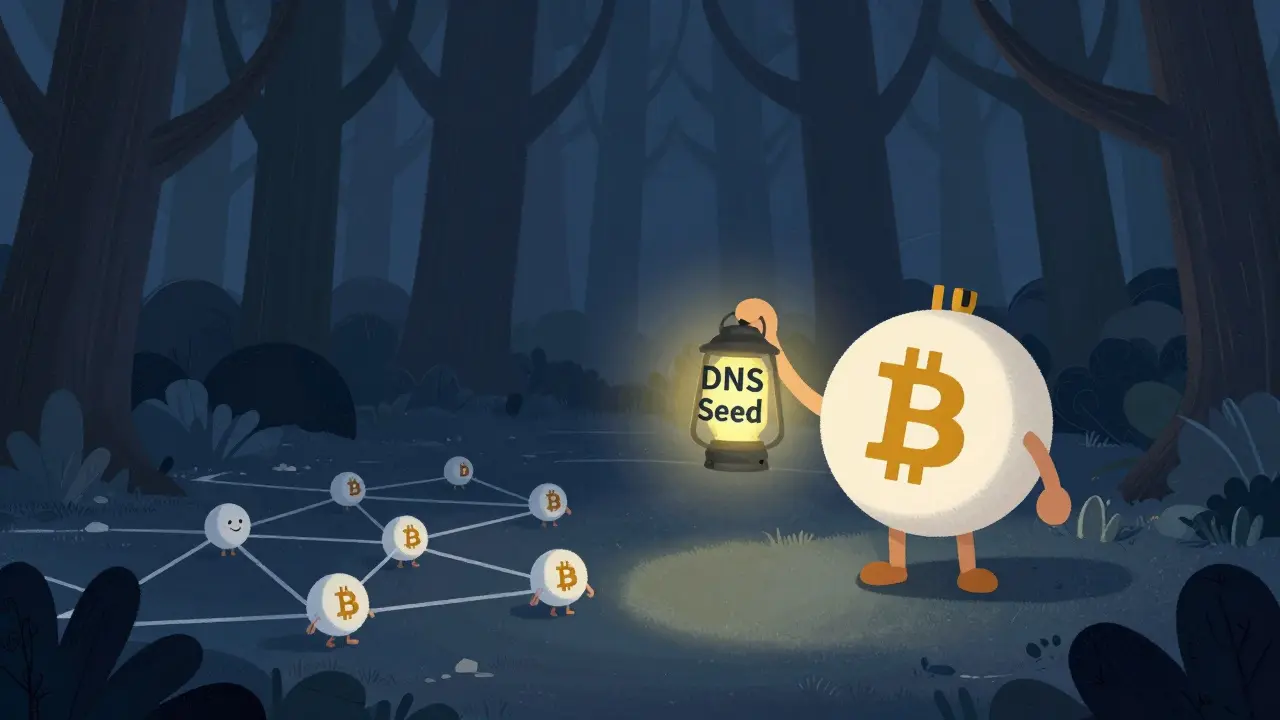
When a Bitcoin node starts without any saved peer addresses, it begins by querying DNS Seeds are hardcoded DNS names maintained by community members that return IP addresses of publicly available full nodes. These are not centralized servers in the traditional sense. They are distributed across various operators who run scripts to scan the network for healthy, well-connected nodes. There are two types: dynamic seeds that automatically update based on network activity, and static seeds that are manually curated. Nodes typically connect on port 8333 for the mainnet or 18333 for testnet.
If the DNS queries fail-perhaps due to censorship or local network issues-the node falls back to hardcoded seed nodes. These are specific IP addresses embedded directly into the Bitcoin client software. As a last resort, users can manually configure trusted peers obtained from friends or community channels. However, the goal of the Bitcoin protocol is to minimize reliance on these fixed resources as quickly as possible.
Once a node connects to its first peer, the magic happens. It sends a getaddr message, asking, "Who else do you know?" That peer responds with a list of addresses it has recently communicated with. The new node then attempts to connect to those addresses. Each successful connection triggers more getaddr requests, creating a cascading effect. Within minutes, a single node can map out a significant portion of the network topology.
| Mechanism | Description | Reliability | Decentralization Level |
|---|---|---|---|
| DNS Seeds | Dynamic DNS lookups returning active node IPs | High | Medium (depends on seed operators) |
| Hardcoded Seeds | Static IP addresses in client code | Low (can become outdated) | Low (centralized points of failure) |
| Peer Sharing | Nodes exchanging address lists via getaddr | Very High | High (organic growth) |
| Manual Configuration | User-defined trusted peers | Variable | Low (user-dependent) |
To maintain efficiency, Bitcoin nodes track statistics for every peer they encounter. They monitor availability, speed, reliability, and misbehavior scores. A node will prioritize connecting to peers that have proven reliable over time, effectively building a personal reputation system. This ensures that the network load is distributed evenly and that nodes spend less time reconnecting to flaky endpoints.
Ethereum 2.0: The Dynamic Shift to discv5
While Bitcoin focuses on stability and backward compatibility, Ethereum has undergone a radical shift. With the transition to Proof-of-Stake (PoS), the network architecture changed dramatically. Ethereum 2.0 utilizes the Node Discovery Protocol version 5.1 (discv5) for peer discovery in a Proof-of-Stake environment. This protocol is fundamentally different from Bitcoin’s TCP-based approach.
Discv5 operates over UDP, allowing for faster, lighter-weight communication. In the PoS model, nodes are not just validating transactions; they are validators proposing blocks and attesting to their validity. This requires constant, low-latency communication. Discv5 enables nodes to maintain dynamic routing tables that capture comprehensive networking layer information.
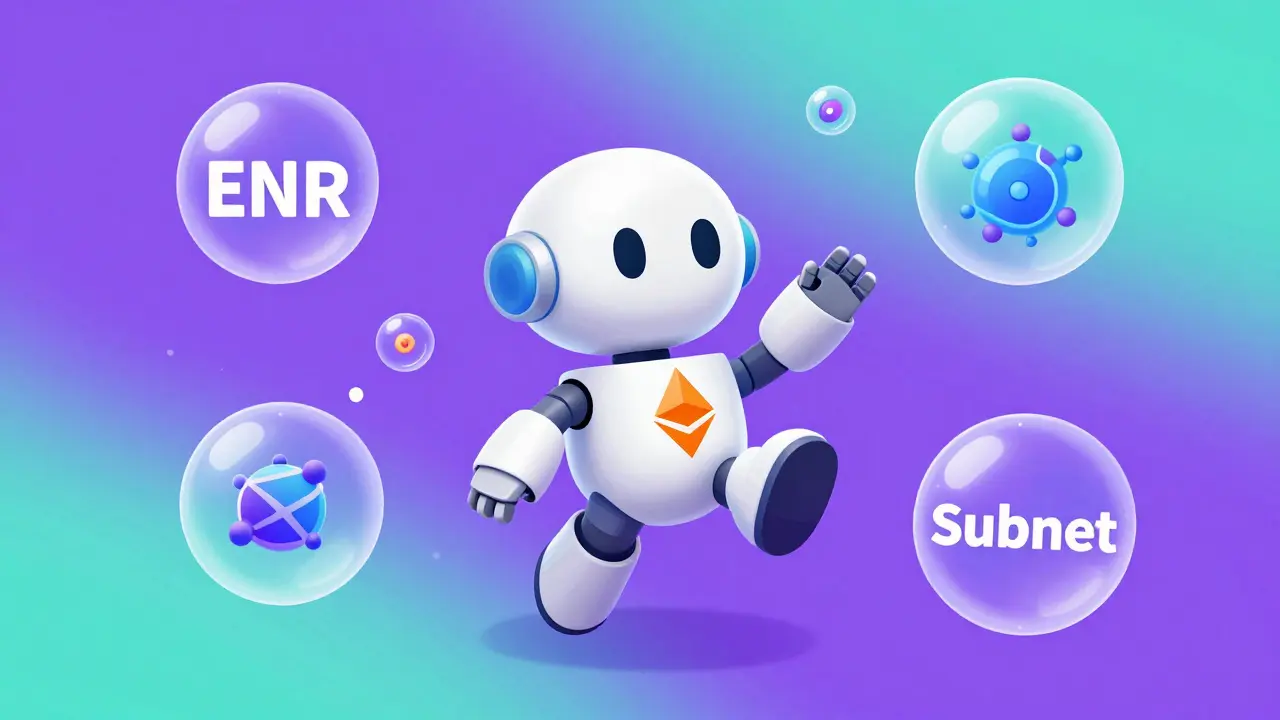
A key component here is the Ethereum Node Record (ENR) is a data structure containing node identity, public keys, and network location details. Nodes frequently update their ENRs to reflect changes in their status, such as moving to a different subnet. In Ethereum 2.0, the network is divided into subnets for attestation aggregation. Your ENR includes an attnets entry that tells other nodes which subnets you are listening to. This allows for efficient routing of attestations, ensuring that validators only talk to peers relevant to their current duties.
This adaptability is essential. Unlike Bitcoin, where the set of nodes is relatively stable, Ethereum’s validator set changes constantly as people stake and unstake ETH. Discv5 handles this flux by allowing nodes to discover peers specifically within their required subnets, reducing unnecessary traffic and improving sync speeds.
Security Implications: Eclipse Attacks and DoS
The way nodes find each other directly impacts the security of the entire network. The most significant threat is the Eclipse Attack is an attack where malicious actors isolate a target node by controlling all its peer connections. If an attacker can surround a node with fake peers, they can feed it false information about the blockchain state, potentially leading to double-spending or isolation from the true consensus.
Bitcoin mitigates this by encouraging nodes to maintain a large number of outbound connections (typically 8) and to prioritize long-standing, reliable peers. By diversifying its connections, a node makes it statistically difficult for an attacker to control all of them. Additionally, the use of multiple DNS seeds ensures that an attacker cannot easily censor the initial discovery phase unless they compromise a majority of the seed operators.
Denial-of-Service (DoS) attacks are another concern. Malicious actors might flood the network with fake peer advertisements, causing honest nodes to waste resources trying to connect to non-existent or malicious IPs. To combat this, both Bitcoin and Ethereum implement rate limiting and verification steps. For example, Bitcoin nodes send ping messages before 30 minutes of inactivity and assume a connection is dead after 90 minutes of silence. This keeps the network clean of zombie connections.

Technical Challenges: NAT Traversal and Churn
Not all nodes are created equal. Many users run nodes behind firewalls or Network Address Translation (NAT) devices, making them unreachable from the outside world. These nodes can initiate outgoing connections but cannot accept incoming ones. This creates a challenge for peer discovery: how do you ensure that these "hidden" nodes remain part of the network?
Most protocols handle this by distinguishing between inbound and outbound peers. A node behind NAT will still connect to several outbound peers, allowing it to receive blocks and transactions. While it cannot serve as a discovery source for others, it still contributes to the network's validation capacity. However, high churn rates-where nodes frequently join and leave-can destabilize the network. Protocols must balance the need for fresh peers with the cost of maintaining connections.
Another challenge is privacy. Peer discovery inherently reveals your IP address to the nodes you connect with. In a fully transparent P2P network, this can lead to correlation attacks, where observers link your node activity to your real-world identity. Future developments may integrate onion routing or other privacy-preserving techniques to obscure node locations while maintaining connectivity.
Why Peer Discovery Matters for You
You might wonder why this matters if you are just using a wallet. If you rely on third-party services, you don't see the network. But if you value self-sovereignty, running your own node is the gold standard. Understanding peer discovery helps you troubleshoot connectivity issues, choose the right client settings, and appreciate the robustness of the systems you trust with your assets.
Moreover, as networks grow, the efficiency of peer discovery becomes a bottleneck. Ethereum’s move to discv5 shows that legacy protocols can become obsolete. As we look toward 2026 and beyond, expect to see more emphasis on adaptive discovery mechanisms that can handle larger scales and stricter privacy requirements. The battle for decentralization is fought not just in consensus algorithms, but in the quiet, continuous process of nodes finding each other in the dark.
What happens if a Bitcoin node cannot reach any DNS seeds?
If DNS seeds are unreachable, the node falls back to hardcoded seed nodes embedded in the client software. If those also fail, the user must manually configure trusted peer IPs. This multi-layered fallback ensures the node can eventually connect, though it may take longer.
How does Ethereum 2.0 peer discovery differ from Bitcoin?
Ethereum 2.0 uses the discv5 protocol over UDP, which is faster and more dynamic than Bitcoin’s TCP-based approach. It relies on Ethereum Node Records (ENRs) to manage subnet membership and validator status, allowing for efficient routing in a Proof-of-Stake environment.
Can I run a node behind a firewall?
Yes. Nodes behind firewalls can still function by initiating outbound connections to other peers. While they cannot accept inbound connections, they can still sync the blockchain and validate transactions, contributing to network security.
What is an eclipse attack in cryptocurrency networks?
An eclipse attack occurs when an attacker isolates a target node by controlling all its peer connections. This allows the attacker to feed false information to the node, potentially disrupting its view of the blockchain consensus.
Why do nodes track peer reliability scores?
Tracking reliability helps nodes prioritize connections to stable, fast, and trustworthy peers. This reduces the load on DNS seeds, minimizes reconnection attempts to flaky nodes, and enhances overall network resilience.

Drew M
July 2, 2026 AT 07:55Oh, please. Another 'explain like I'm five' post on peer discovery? 🙄 I’ve been running a full node since 2013 and frankly, the comparison between Bitcoin’s robust TCP stability and Ethereum’s chaotic UDP shift is painfully obvious to anyone who actually reads the whitepapers instead of just buying the dip. The real issue isn't finding peers; it's that half these validators are running on cloud instances with terrible latency anyway. But sure, let's pretend discv5 is some revolutionary breakthrough when it's just UDP with extra steps. 😒
Ella Collinson
July 4, 2026 AT 03:10The semantic distinction between 'peer discovery' and 'topology maintenance' is woefully underappreciated here. You're conflating initial bootstrap mechanisms with ongoing churn mitigation strategies. While Bitcoin's DNS seed approach provides a static anchor point, it creates a single point of failure vector if those seeds are compromised or censored. Ethereum's ENR-based routing in discv5 allows for dynamic subnet aggregation, which is critical for PoS attestation propagation latency requirements. The article glosses over the cryptographic verification overhead inherent in validating ENRs versus simple IP whitelisting.
Ray Arney
July 4, 2026 AT 15:14I think both have their merits honestly. Bitcoin's way feels more 'set it and forget it' while Ethereum's seems more active but maybe more complex. Good read overall.
Tuan Nguyen
July 5, 2026 AT 17:03Absurdly simplistic analysis. The author clearly lacks any understanding of network topology theory. Bitcoin's reliance on hardcoded seeds is a design flaw, not a feature, and calling it 'resilient' is laughable. Meanwhile, Ethereum's discv5 is being hailed as superior despite its susceptibility to Sybil attacks during the bootstrap phase. This is why most people fail at decentralization-they don't understand the underlying graph theory. Pathetic.
Hazel Fruitman
July 7, 2026 AT 11:04i mean... its kinda scary how much trust we put in these dns seeds right? like what if they all go bad? we r basically trusting strangers with our money lol. but yeah good info i guess. typos aside :)
Autumn Story
July 8, 2026 AT 16:06This is such an interesting topic!! I never really thought about how my wallet finds other nodes before. It makes me feel so much better knowing there are fallbacks like hardcoded seeds. Thank you for explaining this so clearly! I hope everyone can learn from this because understanding tech helps us stay safe! :)
Mark Tuason
July 9, 2026 AT 23:15It is important to note that the security implications of eclipse attacks are often overstated in casual discourse. While theoretically possible, the computational resources required to isolate a well-connected Bitcoin node are prohibitive for most actors. The article correctly identifies the multi-layered fallback mechanism, which serves as a robust defense against such scenarios.
Nick Wengel
July 10, 2026 AT 13:03In many cultures, we rely on community networks to find information, similar to how these blockchain nodes find each other. It is fascinating to see how technology mimics human social structures. Both Bitcoin and Ethereum have unique ways of building trust without a central authority, which reflects different approaches to cooperation.
Alicia Hull
July 10, 2026 AT 23:20You claim that Bitcoin's method is 'stable,' yet you ignore the massive lag in block propagation caused by inefficient peer selection algorithms. How does one justify prioritizing legacy compatibility over network efficiency? The data clearly shows that Ethereum's discv5 reduces latency significantly. Are you intentionally ignoring the benchmarks?
Deep Rahman
July 12, 2026 AT 21:23When we consider the philosophical underpinnings of decentralized networks, we must ask ourselves what it truly means to be connected. Is connection merely a technical state of exchanging packets, or is it a deeper commitment to the shared truth of the ledger? Bitcoin chooses stability, a conservative approach that values history and continuity, whereas Ethereum embraces change, reflecting a more fluid view of reality where the network must adapt to survive. This dichotomy mirrors the eternal struggle between order and chaos in human society, suggesting that our technological tools are extensions of our collective psyche.
Melissa Beckwith
July 13, 2026 AT 21:26Let me educate you on the actual mechanics here because clearly, the summary provided is lacking depth. The discv5 protocol uses Kademlia-like DHT tables, which are exponentially more efficient for large-scale node discovery than Bitcoin's naive flooding approach. Furthermore, the ENR structure includes cryptographic proofs of validator status, preventing spam and ensuring that only valid participants consume bandwidth. If you think 'getaddr' messages are sufficient for modern scaling needs, you haven't kept up with the literature since 2018.
Josephine Finlayson
July 14, 2026 AT 20:27It is wonderful to see such detailed technical discussions happening here! I always appreciate when people take the time to explain complex topics like peer discovery. It helps bridge the gap between developers and everyday users. Keep up the great work everyone!
Eric Braddock
July 15, 2026 AT 17:13Wake up sheeple! The DNS seeds aren't random; they're controlled by the same oligarchs who run the mining pools. They want you to connect to their nodes so they can track your IP and sell your data to the NSA. That's why Ethereum moved to UDP-to hide the traffic patterns from the surveillance state. But even discv5 is compromised by the deep state. Nothing is free. Trust no one.
Nick G
July 16, 2026 AT 14:53It is quite fascinating to observe how different cultural perspectives influence the development of these protocols. For instance, the emphasis on individual sovereignty in Western crypto communities aligns with Bitcoin's rigid adherence to established rules, whereas the more collaborative and adaptive nature of Ethereum's development might reflect a broader, more inclusive global perspective. We should encourage open dialogue to understand these nuances better.
Johan Otto
July 16, 2026 AT 15:45Boring stuff. Who cares how they find each other? Just give me my Lambo. 🚗💨
Tracy Marshall
July 18, 2026 AT 03:38The moral decay of relying on centralized DNS seeds is evident. We are handing over our digital freedom to corporations who care nothing for privacy. Eclipse attacks are just the beginning. Soon they will control every transaction. We must resist. ;(
Guy Davis
July 19, 2026 AT 12:58typo in the article btw. also ur wrong about bitcoin being secure. its not. stop lying.
Jessie Smith
July 19, 2026 AT 19:48Oh, look at you, trying to sound smart with your 'DNS seeds' talk. Please. Real power lies in the shadows, in the unspoken connections between nodes that the mainstream ignores. Bitcoin is a dinosaur, clanking along with its rusty TCP joints, while Ethereum dances on the light breeze of UDP. But neither understands the true essence of decentralization, which is not code, but consciousness. You're all just playing checkers while I play 4D chess with the fabric of reality itself. 🧠✨
Andrew Schneider
July 20, 2026 AT 20:34Wow, another boring tech post! 🥱 Can we talk about something fun instead? Like how moon shots will make us all rich? Because this peer discovery stuff is giving me a headache. 😫 #HODL #ToTheMoon
Anuj Kashyap
July 21, 2026 AT 16:36Interesting read. Though I wonder if the obsession with 'discovery' misses the point of 'presence'. A node that cannot be found is merely a ghost in the machine. 🤖 But then again, perhaps invisibility is the ultimate form of participation in a surveillance capitalist dystopia. Who knows? 🤷♂️
Kumaran sowkarpet
July 23, 2026 AT 01:10Hello friends! In India, we often use community networks to share resources, which is very similar to how P2P networks work. It is beautiful to see technology enabling this kind of cooperation globally. If you have trouble connecting, try checking your firewall settings first. Hope this helps! :)
Mauricio Contreras Loredo
July 23, 2026 AT 07:59Sarcasm alert: Oh wow, I never knew that computers needed to find each other! Mind blown! 🤯 But seriously, if you're going to run a node, do it right. Don't be that guy who connects to a botnet and wonders why his sync fails. Get off your couch and configure your ports properly!