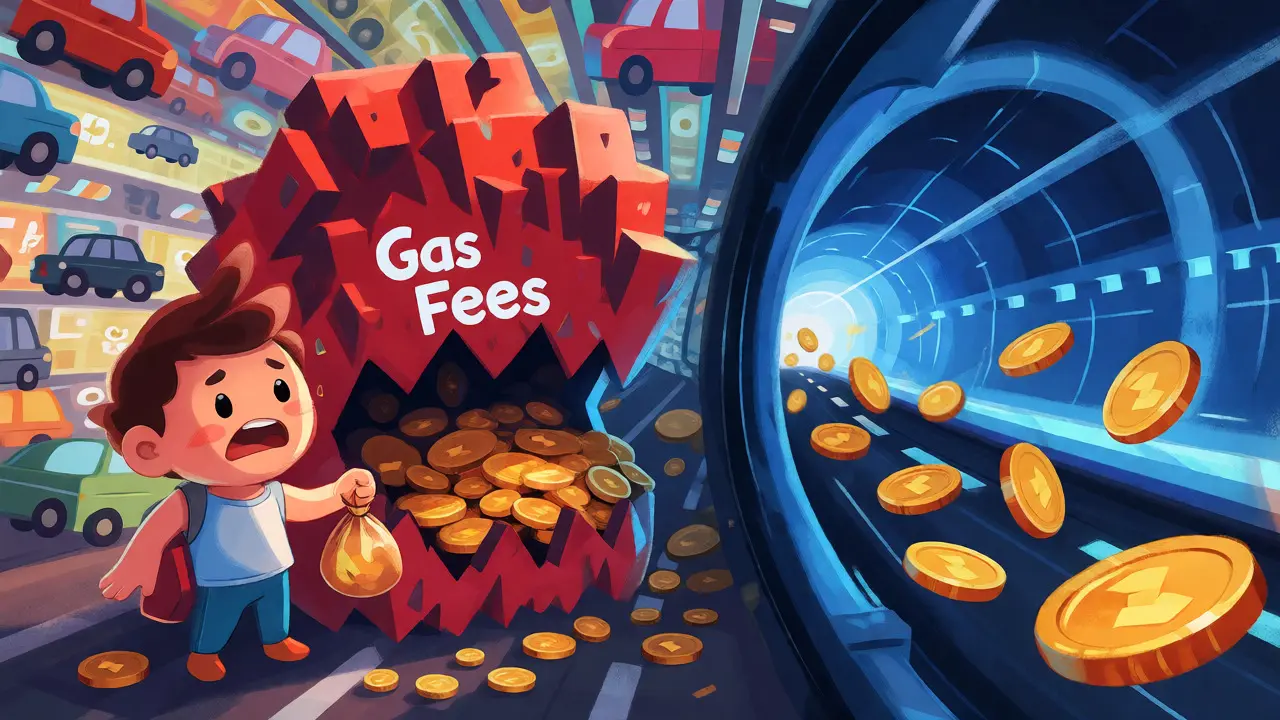
Most people quit using decentralized exchanges because gas fees eat their profits. You spend more on network costs than you make on the trade. Loopring is a decentralized exchange protocol and Ethereum Layer-2 scaling solution that uses zero-knowledge rollups to slash transaction costs while keeping your assets in your own wallet. It launched back in 2017, making it one of the older players in the game. But does it still hold up in 2026? If you are tired of paying $50 for a swap or trusting a centralized exchange with your life savings, this review breaks down exactly how Loopring works, what it costs, and where it falls short.
The Core Problem Loopring Solves
Traditional Ethereum trading is slow and expensive. When you buy ETH on a standard decentralized exchange (DEX), you pay high gas fees and wait for block confirmations. Centralized exchanges fix the speed issue but take custody of your funds. If they get hacked or freeze your account, you lose access to your money.
Loopring attempts to solve both issues at once. It operates as a Layer-2 protocol that bundles thousands of transactions into a single cryptographic proof before sending them to the main Ethereum blockchain. This process, known as zkRollup technology, means you get the security of Ethereum without the congestion and high fees. You keep control of your private keys, but the trading experience feels much closer to a centralized platform like Binance or Coinbase.
How Loopring Actually Works
Unlike many modern DEXs that use Automated Market Makers (AMMs) like Uniswap, Loopring uses an order book model. This is a crucial distinction. In an AMM, you trade against a pool of liquidity provided by other users. On Loopring, you place limit orders or market orders just like you would on a traditional stock exchange. The system matches buyers and sellers directly.
This approach allows for better price discovery. Because trades are matched off-chain within the Layer-2 environment, the matching engine can handle high throughput. It supports up to 16 trades executed as atomic swaps in a single "ring." If any part of the ring fails, the entire batch reverts, ensuring no partial executions mess up your portfolio. This technical setup is why Loopring appeals to traders who want precise control over entry and exit prices rather than just swapping tokens at whatever rate the pool offers.
Fees: The Good and The Bad
Let’s talk money. This is usually the deciding factor for most users. Loopring’s fee structure is aggressive compared to competitors.
- Taker Fees: 0.10%. This is lower than the industry average of roughly 0.21%.
- Maker Fees: 0%. If you place a limit order that doesn’t fill immediately, you pay nothing to create the order.
- Gas Fees: Near zero for internal transfers and trades within the Loopring ecosystem.
However, there is a catch. Withdrawing your assets from Loopring back to the main Ethereum network isn't free. The current withdrawal fee for ETH is approximately 0.002 ETH. While this sounds small, it adds up if you are moving small amounts frequently. Compared to some newer Layer-2 solutions that charge pennies, this is relatively high. But when you weigh it against the massive gas savings on the trades themselves, it often balances out for active traders.
| Feature | Loopring (L2) | Standard Ethereum DEX | Centralized Exchange |
|---|---|---|---|
| Custody | Self-Custody (Non-custodial) | Self-Custody | Custodial |
| Trading Fee | 0.10% Taker / 0% Maker | 0.30% + High Gas | ~0.10% - 0.20% |
| Withdrawal Cost | ~0.002 ETH | High Gas Fee | Low/Fixed Network Fee |
| Asset Control | You hold keys | You hold keys | Exchange holds keys |
The LRC Token and Economic Model
The native token of the platform is LRC. As of late 2025, LRC trades around $0.09 with a circulating supply of over 1.3 billion tokens. Its market cap sits near $121 million, placing it outside the top 300 cryptocurrencies.
Why do you need LRC? It serves two main purposes. First, holding LRC can reduce your trading fees further through staking mechanisms. Second, it plays a role in the governance and operational rewards of the protocol. However, don’t expect LRC to skyrocket just because you use the exchange. Its value is tied to the overall adoption of the Loopring protocol across various apps and wallets that integrate its API. Many major wallets now support Loopring deposits and withdrawals natively, which drives demand for the token as a utility asset.
User Experience and Learning Curve
If you have never used a Layer-2 solution, the interface might feel slightly different at first. You cannot simply connect your MetaMask and start trading instantly like you might on Uniswap. You need to deposit funds into your Loopring wallet first. This involves signing a transaction on the main Ethereum chain, which costs gas. Once your funds are on Loopring, however, everything else is fast and cheap.
The interface itself is clean but dense. It looks more like a professional trading terminal than a simple swap app. You will see depth charts, order books, and recent trades. For beginners, this can be intimidating. There is no "one-click" simplicity here. You need to understand what a limit order is versus a market order. If you are coming from a centralized exchange, you will feel right at home. If you are new to crypto, expect a few hours of reading documentation to get comfortable.
Pros and Cons at a Glance
No platform is perfect. Here is the honest breakdown based on current performance and community feedback.
Pros:
- Security: Inherits Ethereum’s security. No risk of exchange insolvency because you hold your own keys.
- Cost Efficiency: Extremely low trading fees and negligible gas costs for on-platform activity.
- Order Book Model: Better for precise trading strategies than AMMs.
- Transparency: Open-source code and public audits.
Cons:
- Withdrawal Fees: The cost to move assets off the platform can be annoying for small balances.
- Limited Assets: Primarily supports ERC-20 tokens. No direct Bitcoin or non-Ethereum chain support.
- Learning Curve: Requires understanding Layer-2 mechanics and deposit processes.
- Liquidity Depth: While good, it may not match the sheer volume of giants like Binance for obscure altcoins.
Who Should Use Loopring?
Loopring is not for everyone. It is ideal for intermediate to advanced traders who want self-custody but hate high gas fees. If you trade frequently and care about maker rebates or zero maker fees, this is a strong option. It is also great for developers building dApps that need fast, cheap Ethereum settlements.
It is probably not for you if you are a complete beginner who just wants to buy Bitcoin and hold it. The extra steps of depositing to Layer-2 and managing the wallet add friction that casual users often dislike. Similarly, if you need to trade Bitcoin or Solana directly, you will need to bridge assets first, which complicates things.
Final Verdict
Loopring remains a robust choice in the decentralized finance space. It successfully delivers on its promise of combining DEX security with CEX-like efficiency. The zkRollup technology is proven and battle-tested. While the user experience has room for improvement-particularly regarding onboarding and withdrawal clarity-the financial benefits are undeniable for active traders.
If you are already deep in the Ethereum ecosystem and frustrated by gas fees, give Loopring a try. Start with a small amount to test the deposit and withdrawal flow. Once you see how cheap and fast the trades are, you might wonder why you ever paid full gas prices on the mainnet.
Is Loopring safe to use?
Yes, Loopring is considered highly secure because it is non-custodial. You retain control of your private keys, meaning even if the interface goes down, your funds remain on the blockchain under your control. Additionally, the smart contracts are audited, and the zkRollup technology ensures that all transactions are verified against the Ethereum mainnet.
Does Loopring require KYC verification?
Generally, no. As a decentralized exchange, Loopring typically does not require Know Your Customer (KYC) identity verification for basic trading. This allows for anonymous trading, though regulations vary by jurisdiction and specific integrated services may have their own requirements.
Can I trade Bitcoin on Loopring?
Not directly. Loopring is built on Ethereum, so it primarily supports ERC-20 tokens. To trade Bitcoin, you must use wrapped versions of BTC (like WBTC) that exist on the Ethereum network. You cannot trade native Bitcoin directly on the Loopring order book.
Why are my withdrawal fees higher than expected?
Withdrawing from Loopring to the main Ethereum layer requires submitting a proof to the mainnet, which incurs a gas fee plus a protocol fee. The current ETH withdrawal fee is around 0.002 ETH. This is designed to cover the computational cost of verifying the batch on Layer-1. It is cheaper than doing multiple individual trades on mainnet but higher than some other Layer-2 bridges.
What is the difference between Loopring and Uniswap?
Uniswap uses an Automated Market Maker (AMM) model where you trade against liquidity pools, and it runs on Layer-1 (though V3 has optimizations). Loopring uses an order book model on Layer-2. Loopring generally offers lower fees and faster execution due to its Layer-2 architecture, while Uniswap offers broader asset accessibility and simpler one-click swaps for less frequent traders.