
Imagine trying to buy a coffee in London using Bitcoin. You’d likely pay more in network fees than the latte costs. That’s exactly why traders flock to layer-2 solutions like Polygon is a scaling solution for Ethereum that offers faster transaction speeds and significantly lower gas fees compared to the mainnet. When you combine this efficiency with Uniswap v2 is a decentralized exchange protocol launched in May 2020 that uses automated market maker mechanics to facilitate token swaps without intermediaries., you get a powerful tool for moving crypto around without draining your wallet on transaction costs.
In 2026, the landscape of decentralized finance (DeFi) has shifted. While newer versions of protocols promise complex features, many users still prefer the simplicity and reliability of established systems. This review breaks down what Uniswap v2 actually delivers on the Polygon network, who it serves best, and whether it still holds up against modern competitors.
Why Uniswap v2 Still Matters on Polygon
You might wonder why anyone would use a protocol from 2020 when Uniswap v3 is an upgraded version of the Uniswap protocol that introduces concentrated liquidity, allowing providers to allocate capital within specific price ranges for higher efficiency. exists. The answer lies in simplicity. Uniswap v2 introduced a crucial change over its predecessor: arbitrary ERC20-to-ERC20 liquidity pools. In the old days (v1), every trade had to route through ETH. If you wanted to swap Token A for Token B, you sold A for ETH, then bought B with ETH. That meant paying the standard 0.3% fee twice.
V2 fixed this by allowing direct swaps. Now, if a pool exists for Token A and Token B, you swap them directly. You pay the 0.3% fee only once. On Polygon, where base gas fees are already negligible, this architectural efficiency translates to real savings and less price impact, especially for larger trades or long-tail assets.
Furthermore, the security model of v2 is battle-tested. It uses a core/periphery design pattern. The "core" contracts hold the funds and are immutable-they don’t change. The "periphery" contracts handle user interactions and can be updated if needed. This separation minimizes risk. Since its launch, Uniswap v2 has processed billions in volume across multiple chains, proving its resilience.
The Cost Advantage: Polygon vs. Ethereum Mainnet
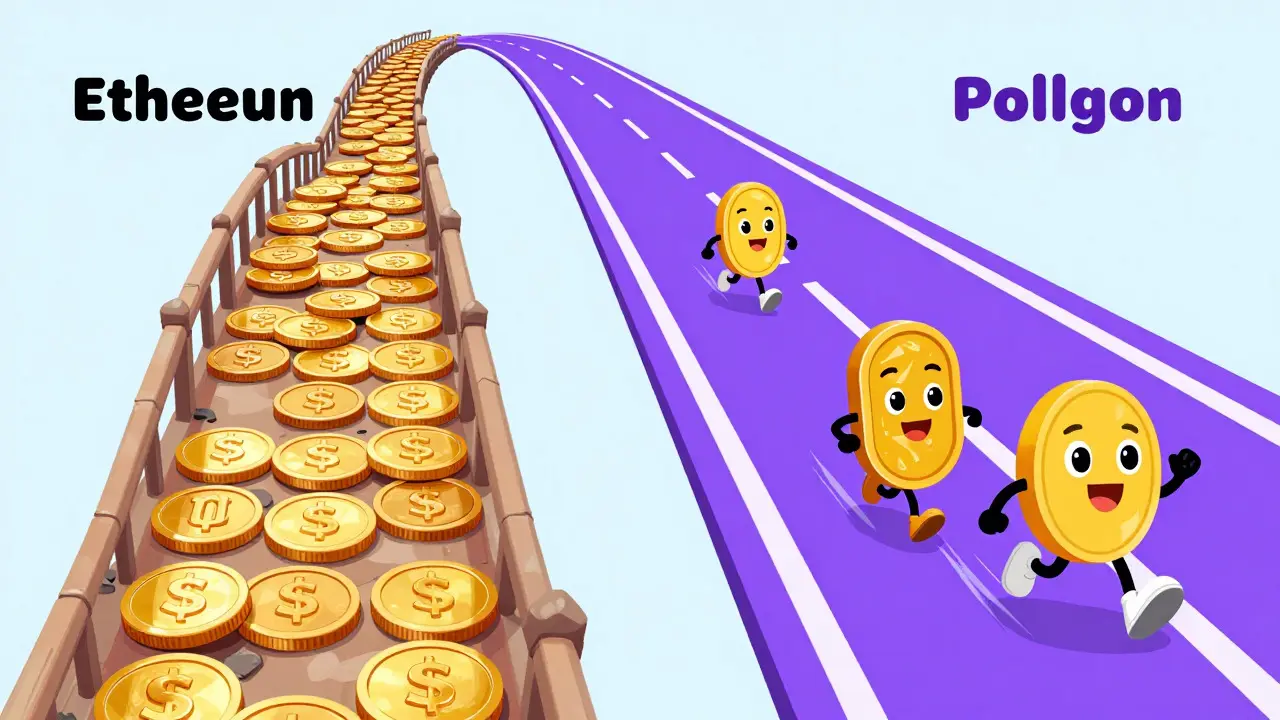
Let’s talk numbers, because that’s usually the deciding factor. On the Ethereum mainnet, a simple swap can cost anywhere from $5 to $50 depending on network congestion. In 2026, average fees often hover around $35 per swap during peak times. That’s expensive for small trades.
On Polygon, the story is different. Transaction fees typically stay under $1, often costing just a few cents. For active traders who make multiple swaps a day, this difference is massive. It’s the difference between buying a car and renting one for the same journey.
| Feature | Ethereum Mainnet | Polygon Network |
|---|---|---|
| Average Swap Fee | $35+ | < $1 |
| Confirmation Time | 15 seconds - 2 minutes | Near-instant (< 2 seconds) |
| MEV Exposure | High (public mempool) | Low (sequencer-based) |
| Protocol Version Support | v2, v3, v4 | v2, v3 |
Beyond just low fees, Polygon offers minimal MEV (Maximum Extractable Value) exposure. MEV happens when bots front-run or sandwich your trades to profit at your expense. Because Polygon uses a sequencer-based architecture, these predatory practices are far less common than on Ethereum’s public mempool. This makes Polygon a safer environment for swapping smaller, less liquid tokens.
Liquidity Provision: Passive Income Made Simple
If you’re looking to earn yield by providing liquidity, Uniswap v2 on Polygon is arguably the easiest entry point. Unlike v3, which requires you to set specific price ranges and actively manage your position to avoid impermanent loss spikes, v2 pools cover the entire price range by default.
This means you can deposit your tokens-say, USDC and MATIC-and walk away. Your liquidity is always active, no matter where the price goes. You earn a share of the 0.3% trading fee from every swap that uses your pool. It’s true passive income.
For sophisticated traders, this lack of control might seem inefficient. But for most people, the mental load of constantly rebalancing v3 positions is too high. V2 removes that friction. Creating a new pool on v2 is also straightforward. You simply connect your wallet, select two tokens, and provide the initial liquidity. There are no complex parameters to tweak.
User Experience and Interface
The interface at app.uniswap.org is clean and intuitive. When you switch to the Polygon network, the experience remains smooth. The platform supports major wallets like MetaMask is a popular multi-blockchain digital wallet that allows users to manage cryptocurrencies and interact with decentralized applications., which automatically detects new tokens on the Polygon network. This saves you from manually adding contract addresses, reducing the risk of interacting with scam tokens.
The routing system is intelligent. Even though you’re accessing the v2 interface, Uniswap’s smart router will check both v2 and v3 pools to find you the best price. However, on Polygon, the liquidity depth in v2 pools for certain pairs might differ from v3. The interface handles this seamlessly, showing you the expected output before you confirm the transaction.
One minor hurdle: native ETH must be wrapped into WETH (Wrapped Ethereum) to trade on Uniswap. The interface does this automatically for you, but it’s good to know what’s happening under the hood. You’re not losing money; you’re just converting ETH into an ERC20-compatible format so the smart contracts can process it.
Market Activity and Competition
Is Uniswap v2 still relevant on Polygon? Yes, but it faces competition. Platforms like QuickSwap is a decentralized exchange built specifically for the Polygon network, offering optimized performance and a user-friendly interface for Polygon-native tokens. have tailored their experiences specifically for Polygon users. QuickSwap sometimes offers better UI optimizations or exclusive rewards for Polygon holders.
However, Uniswap retains the advantage of brand trust and cross-chain consistency. If you trade on Ethereum, Arbitrum, and Optimism, using Uniswap everywhere means you learn one interface instead of five. Market data shows moderate trading volumes on Uniswap v2 Polygon, with pairs like AIPF/USDT seeing significant activity. While total volume may fluctuate, the infrastructure remains robust.

Security Considerations
Security in DeFi isn’t just about code audits; it’s about design. Uniswap v2’s requirement that users transfer tokens to the pair contract before calling the swap function improves security. The contract infers amounts by checking balance deltas, which is more gas-efficient and less prone to certain types of manipulation.
Since v2 has been live since 2020, it has survived numerous market crashes, hacks of other protocols, and evolving attack vectors. It is considered "battle-tested." However, always remember: you are responsible for your own security. Connect only to official URLs, verify token addresses, and never share your seed phrase.
Who Should Use Uniswap v2 on Polygon?
- Beginners: The full-range liquidity model is easy to understand. No need to monitor price charts to keep your LP position active.
- Small Traders: If you’re swapping $50 worth of tokens, paying $35 in Ethereum fees makes no sense. Polygon keeps your costs near zero.
- Passive Investors: Want to earn fees without stress? Deposit into a stablecoin pair (like USDC/DAI) on v2 and let it run.
- Developers: The v2 API and contract structure are well-documented and widely used, making integration easier for new dApps.
Limitations to Keep in Mind
It’s not all perfect. Uniswap v2 lacks the capital efficiency of v3. If you’re a professional liquidity provider managing millions in assets, v2 will leave money on the table because your capital is spread across the entire price curve, not concentrated where trading is happening.
Also, while Polygon is fast, it is still a separate chain. Moving assets from Ethereum mainnet to Polygon requires bridging, which takes time and carries its own risks. Always allow extra time for bridges to settle.
Is Uniswap v2 safe to use on Polygon?
Yes, Uniswap v2 is considered highly secure due to its battle-tested codebase and core/periphery architecture. However, security also depends on user behavior. Always ensure you are on the official Uniswap website and double-check token contract addresses to avoid scams.
How do I add liquidity to Uniswap v2 on Polygon?
Connect your wallet (like MetaMask) to app.uniswap.org, switch the network to Polygon, go to the 'Pools' tab, and select 'Add Liquidity.' Choose your token pair, enter the amounts, and approve the transactions. Your liquidity will be active immediately across the full price range.
What is the difference between Uniswap v2 and v3 on Polygon?
Uniswap v2 uses full-range liquidity pools, meaning your capital is exposed to all price movements. It’s simpler and better for passive investors. Uniswap v3 allows concentrated liquidity, where you set a specific price range. This is more efficient for advanced users but requires active management to maximize returns and minimize impermanent loss.
Are there any fees for swapping on Uniswap v2?
Yes, there is a standard 0.3% trading fee on all swaps. Additionally, you will pay a small network gas fee on Polygon, which is typically less than $1. This is significantly cheaper than the Ethereum mainnet, where gas fees can exceed $35.
Can I create a new token pair on Uniswap v2 Polygon?
Yes, anyone can create a new liquidity pool on Uniswap v2. You need to provide the initial liquidity for both tokens in the pair. Once created, other users can add liquidity or trade against your pool. Be cautious when creating pools for new tokens, as they may be vulnerable to manipulation.


Carl Michaud
August 14, 2026 AT 07:17Another day, another article praising the centralization of Polygon while pretending it's 'decentralized finance.' The sequencer model is a single point of failure wrapped in blockchain aesthetics. Uniswap v2 is just a relic keeping the illusion alive for retail users who don't understand that their liquidity is trapped in an opaque system controlled by a corporate entity. It’s not efficiency; it’s dependency.
Alex Di Mango
August 14, 2026 AT 09:28I think we should give credit where it's due though. For someone like me who just wants to swap some tokens without paying $50 in gas, Polygon with Uniswap v2 has been a lifesaver. Sure, maybe it's not perfectly decentralized, but it works and it's cheap. That matters for actual adoption.
Carl Michaud
August 14, 2026 AT 22:35It works until the sequencer pauses or gets hacked. Then your 'cheap' swaps are frozen assets. You're trading sovereignty for convenience. Classic retail mistake.
Rita Dutta
August 16, 2026 AT 21:34oh my god stop with the doom mongering already. life is about flow and energy not just cold hard code. i use uniswap on polygon all the time and its like dancing with the universe. the fees are low so my chakras stay aligned. why do you people always have to be so negative about progress? its beautiful really how simple it is. just plug in and go. no stress no big fees. pure joy basically. also i love the color blue on the interface it feels very calming. anyway keep doing what you are doing because simplicity is the ultimate sophistication as they say. dont let the haters get you down. peace out.
Matt Kay
August 18, 2026 AT 21:18boring
Namrata Mapgaonkar
August 19, 2026 AT 20:58i totally agree with the simplicity part! :) in india we love quick transactions too. sometimes internet is slow so fast confirmation is nice. uniswap v2 is easy to use for beginners like me. no need to worry about complex ranges. just deposit and forget. its very chill vibe. thanks for sharing this info. :)
Paul Smith
August 21, 2026 AT 03:33Great breakdown! 🚀 I’ve been using QuickSwap mostly but switching back to Uniswap on Polygon for the brand trust. The UI is so much cleaner now. Also, loving the emoji support in wallets lately 😂. Makes DeFi feel less like coding and more like social media.
Candice Cornett
August 22, 2026 AT 05:21everyone is asleep at the wheel here. uniswap v2 is outdated tech from 2020. why are we still talking about it like its new? concentrated liquidity is the future. if you are using v2 you are leaving money on the table. its that simple. stop being lazy and upgrade your knowledge base. the market rewards efficiency not nostalgia.
Amor Jordan
August 22, 2026 AT 09:47I hear you, Candice, but for many of us, the mental load of managing v3 positions is just too high. We have jobs, families, lives outside of crypto. V2 allows us to participate without needing to watch charts every hour. It’s not about laziness; it’s about accessibility. Not everyone wants to be a full-time liquidity manager. There’s value in simplicity, even if it’s less efficient.
Candice Cornett
August 22, 2026 AT 23:18accessibility is a buzzword for inefficiency. you are paying for your comfort. that is the cost of ignorance.
Prudence Flemming
August 23, 2026 AT 08:45the philosophical underpinning of v2 is democratic liquidity distribution whereas v3 is capitalist concentration of capital. v2 spreads risk across the entire curve which mirrors a more egalitarian approach to market participation. v3 requires active management which favors those with time and resources thus creating a hierarchy among liquidity providers. interesting how protocol design reflects societal values. v2 is perhaps more humanistic in its acceptance of passive existence.
Matthew Smith
August 23, 2026 AT 15:18security is paramount. the core periphery architecture of v2 is robust. immutable core contracts mean no surprise updates. this is good. trust is earned through time not features. v2 has survived. that is enough proof for me. keep it simple keep it safe.
Rodmun Tarnowski
August 25, 2026 AT 05:41This is an exceptionally well-researched review! The comparison table is particularly illuminating regarding the fee structures. One must consider that while Polygon offers lower costs, the bridge risks are non-trivial. However, for the average user, the savings are undeniable. A splendid analysis indeed!
Eric Zehr
August 26, 2026 AT 18:43Exactly! And let's not forget the MEV protection aspect mentioned in the post. On Ethereum mainnet, getting sandwiched is almost a guarantee during high volatility. Polygon's sequencer model, despite its flaws, significantly reduces this predatory behavior. It makes the experience much fairer for small traders. Great points all around.
Nick Darring
August 27, 2026 AT 12:39You guys are missing the forest for the trees. Yes, fees are low. But have you noticed how the liquidity depth on Polygon v2 pairs is often shallow compared to Ethereum? You might save on gas but you pay in slippage. And let's talk about the environmental impact. People say L2s are green but the underlying Ethereum chain still burns energy. So you're just shifting the problem. Plus, I find the interface clunky. Why wrap ETH automatically? Just let me choose. It's annoying when systems make decisions for you. I prefer transparency over convenience. Anyway, just my two cents. Probably wrong but whatever.
Eden Tadesse
August 27, 2026 AT 12:55i think nick has a point about slippage. i once tried swapping a smaal amount of a obscure token and lost like 5% to slippage even though gas was cheap. so yeah it depends on the pair. for major pairs like usdc eth it is fine but for altcoins be carefull. also typos happen lol.
Dave Kjendal
August 29, 2026 AT 00:01it is what it is. most people dont care about slippage on small trades. they just want to move money. v2 is good enough for 90% of users. stop overthinking it.
Kat Bennett
August 30, 2026 AT 08:03I've been experimenting with both v2 and v3 on Polygon lately and I'm fascinated by the difference in yield stability. With v2, I just set it and forget it, which fits my lifestyle perfectly since I travel a lot and don't always have stable internet to monitor positions. The impermanent loss is there, sure, but knowing my liquidity is always active gives me peace of mind. It's interesting how different protocols cater to such different psychological needs in investors. Some want control, others want freedom from decision fatigue.