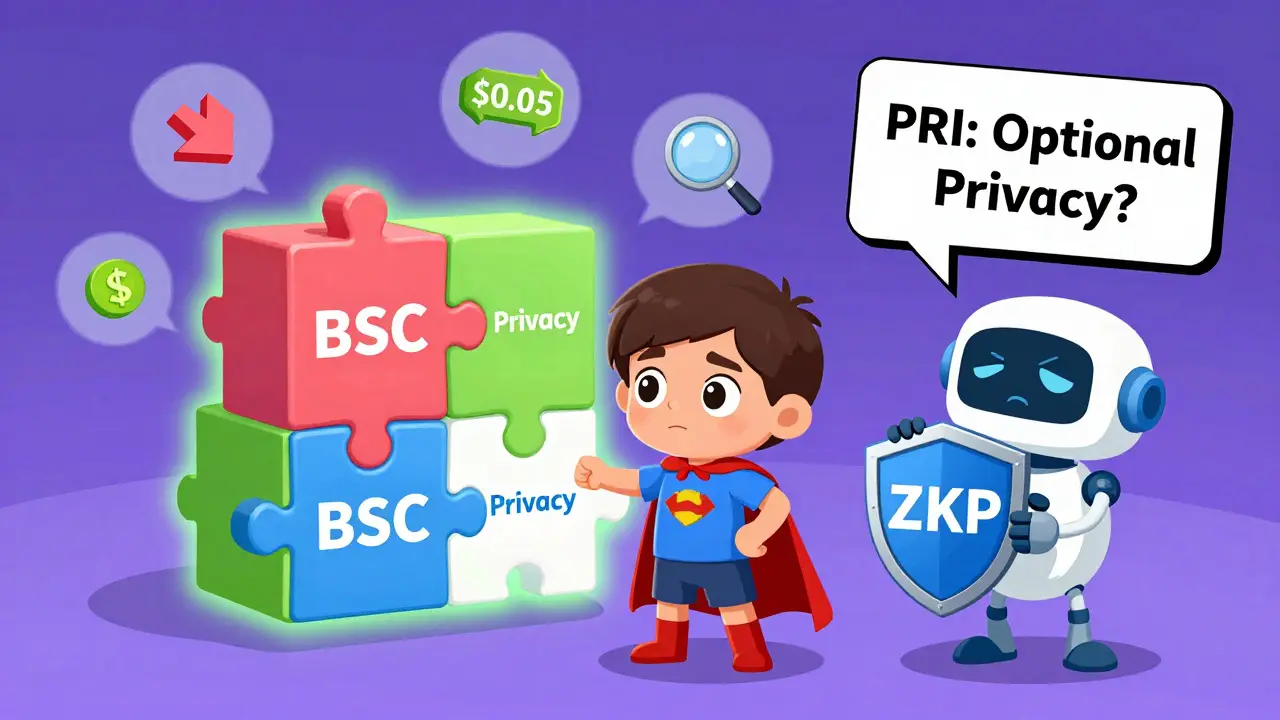
PRIVATEUM GLOBAL (PRI) is a privacy-focused cryptocurrency built on the Binance Smart Chain (BSC), designed to let users send money without revealing transaction details. Unlike Bitcoin or Ethereum, where every transfer is public, PRI aims to hide who sent what, to whom, and how much - all while keeping fees low and transactions fast. But is it truly private? And does it work in the real world? Let’s cut through the marketing and look at what PRI actually is, how it works, and whether it delivers on its promises.
How PRIVATEUM GLOBAL Works: Privacy on BSC
PRIVATEUM GLOBAL isn’t its own blockchain. It’s a BEP-20 token, meaning it runs on top of Binance Smart Chain. This gives it two big advantages: transaction speeds of about 3 seconds and fees under $0.10 per transfer. That’s a huge jump from Ethereum, where fees can spike over $50 during peak times.
The project claims to use advanced encryption and zero-knowledge proofs to anonymize transactions. Zero-knowledge proofs are a real cryptographic technique used by Zcash and other privacy coins. They let one party prove they know something (like a valid transaction) without revealing the details. But here’s the catch: unlike Monero, where privacy is mandatory, PRI makes privacy optional. Users can choose to make transactions public or private. That weakens its core promise. If most people use it without privacy enabled, the network becomes easier to trace overall.
For now, PRI’s privacy features aren’t independently audited. No public security report from firms like CertiK or Hacken exists. That’s a red flag. When a crypto project says it’s “secure” but won’t let outsiders verify it, you’re trusting code you can’t see.
Market Stats: Where PRI Stands Today
As of late 2023, PRI had:
- Total supply: 80 million tokens
- Circulating supply: 30.85 million
- Market cap: $103.88 million
- Price: Around $3.95 USD
- 24-hour trading volume: $42,849
- Token holders: 4,020
Those numbers tell a story. The market cap is solid for a niche coin, but the trading volume is tiny - less than 0.025% of its market cap. That means very few people are actively buying and selling. Low volume + high market cap = high risk of price manipulation. A single large trade could swing the price 10% or more.
It’s ranked #4,596 on CoinMarketCap. Compare that to Monero (#25) or Zcash (#125). PRI isn’t just smaller - it’s barely on the map in the privacy coin space.
Where PRI Is Used (And Where It’s Not)
PRIVATEUM GLOBAL says it’s built for “global businesses” and “cross-border payments.” But the numbers don’t back that up. As of November 2023, only 127 businesses worldwide accepted PRI as payment. That’s not a network - it’s a list.
Most transactions happen on exchanges, not stores. Over 98% of PRI moves between traders, not merchants. That makes it a speculative asset, not a currency. You can’t use PRI to pay your rent, buy groceries, or send money to a family member abroad unless you find one of those 127 businesses - and even then, you’d need to convert PRI to fiat first.
Adoption is strongest in Europe, where 62% of transactions originate. That fits with its mission to offer “digital finance across Europe.” But even there, adoption is minimal. Most users are speculators, not shoppers.

How to Get and Use PRI
If you want to try PRI, here’s how:
- Get a BSC-compatible wallet like Trust Wallet or MetaMask (make sure you add the Binance Smart Chain network manually - most new users mess this up).
- Buy BNB (Binance Coin) from an exchange like Binance or Coinbase. You’ll need it to pay gas fees.
- Go to PancakeSwap, connect your wallet, and swap BNB for PRI.
- To use privacy features, you must manually enable them in the wallet - they’re not automatic.
Most users report smooth transactions once the network is set up correctly. But 63% of newcomers fail their first attempt because they don’t configure BSC properly. There’s no official app, no easy on-ramp, and no customer support chat. Help comes from YouTube tutorials (there are 17) and a Telegram group with 2,300 members - where responses take 4 hours on average.
How PRI Compares to Other Privacy Coins
Here’s how PRI stacks up against top privacy coins:
| Feature | PRIVATEUM GLOBAL (PRI) | Monero (XMR) | Zcash (ZEC) |
|---|---|---|---|
| Privacy Model | Optional | Mandatory | Optional (Shielded) |
| Blockchain | Binance Smart Chain | Own Chain (CryptoNote) | Own Chain (zk-SNARKs) |
| Transaction Speed | 3 seconds | 2 minutes | 2-5 minutes |
| Avg. Fee | $0.05 - $0.10 | $0.15 - $0.30 | $0.20 - $0.80 |
| Exchange Listings | 15 pairs | 150+ pairs | 120+ pairs |
| Third-Party Audit | No public audit | Yes (multiple) | Yes |
| Merchant Adoption | 127 businesses | 500+ businesses | 300+ businesses |
PRI wins on speed and cost - but loses on trust. Monero and Zcash have been around for years, have been audited repeatedly, and have real merchant networks. PRI is still a prototype with no real-world proof.
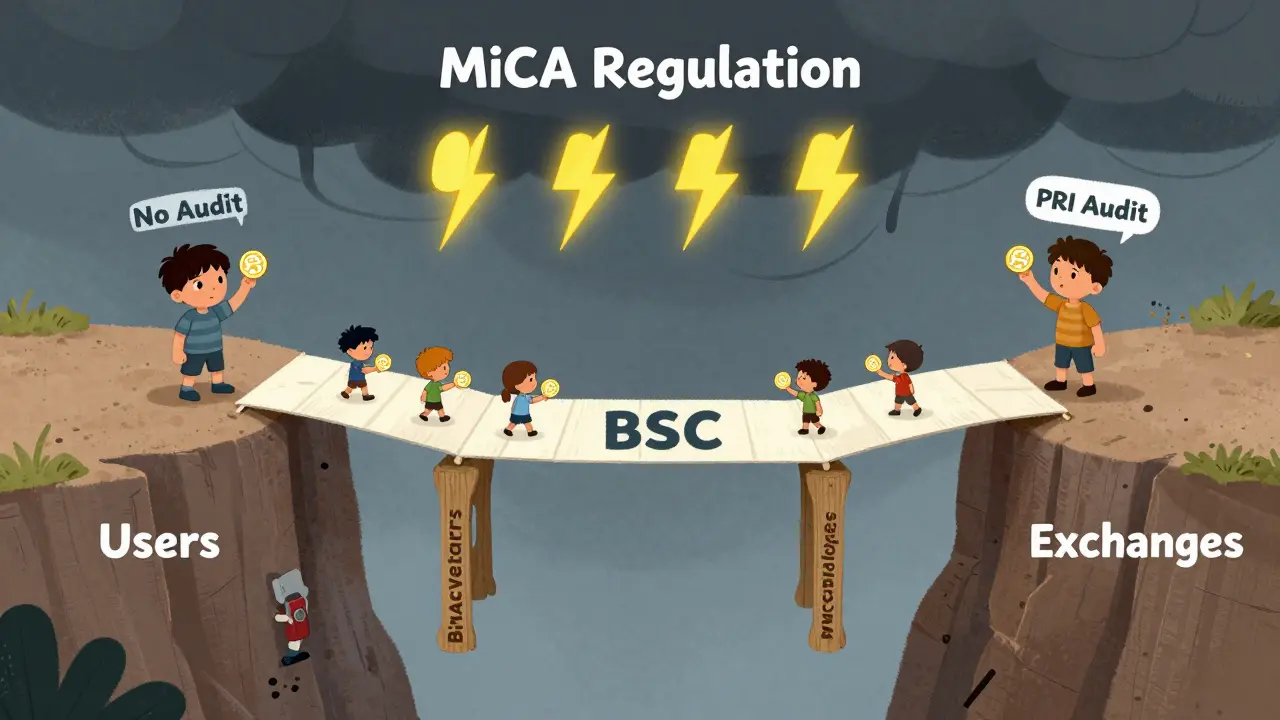
The Big Risks: Regulation and Centralization
PRI’s biggest problem isn’t tech - it’s regulation and infrastructure.
First, Binance Smart Chain is controlled by just 41 validators. That’s centralized. If Binance decides to block PRI transactions, it can. That defeats the whole point of decentralization. Monero and Zcash run on thousands of independent nodes - no single entity can shut them down.
Second, the EU’s MiCA regulation (effective 2024) will require crypto services to trace transactions. Privacy coins that hide sender/receiver info may be banned from major exchanges. Binance already delisted Monero in Japan in 2022. PRI could be next.
Third, the project’s roadmap promises “enhanced privacy protocols” and “multi-chain expansion,” but there are no timelines, no technical specs, and no public development team. No GitHub activity. No commit history. That’s not how real projects move forward.
Final Verdict: A Speculative Bet, Not a Currency
PRIVATEUM GLOBAL (PRI) is not a breakthrough. It’s a clever use of BSC’s low fees and fast speed, wrapped in privacy buzzwords. It’s faster and cheaper than Monero - but far less private, less trusted, and far less adopted.
If you’re looking for a real privacy coin, stick with Monero or Zcash. If you’re just curious about a new token with low volume and high volatility, PRI might be a gamble. But don’t expect it to replace banks, pay your bills, or protect your finances in any meaningful way.
Right now, PRI is a speculative asset with no utility beyond trading. Its value depends entirely on whether more people buy it - not on whether it solves a real problem.
Is PRIVATEUM GLOBAL (PRI) a good investment?
PRI is not a reliable investment. Its market cap is $100M+, but daily trading volume is under $50K - a sign of low liquidity and high manipulation risk. It lacks real merchant adoption, third-party audits, and a transparent development team. Most holders are speculators, not users. Only consider it if you’re comfortable losing your entire stake.
Can I use PRI to send money internationally?
Technically yes, but practically no. You can send PRI to anyone with a BSC wallet. But you can’t spend it anywhere meaningful. Only 127 businesses accept it globally. To use it for payments, you’d need to convert it to fiat first - which defeats the purpose of using crypto for cross-border transfers.
Is PRI truly anonymous like Monero?
No. Unlike Monero, which hides all transaction details by default, PRI’s privacy features are optional. Most users don’t enable them. That means most PRI transactions are visible on the blockchain. It also lacks independent verification of its privacy tech. You’re trusting claims, not proof.
Where can I buy PRIVATEUM GLOBAL (PRI)?
PRI is available on decentralized exchanges like PancakeSwap and a few smaller centralized exchanges. It’s not listed on Coinbase, Kraken, or Binance. You’ll need BNB to swap for PRI, and you must manually add the BSC network to your wallet. There’s no easy way to buy it with a credit card.
What happens if Binance shuts down BSC?
If Binance stopped supporting BSC, PRI would lose its entire infrastructure. Unlike Monero or Bitcoin, PRI has no independent blockchain. It’s entirely dependent on BSC. If BSC goes down, PRI becomes unusable. That’s not decentralization - it’s a single point of failure.
Is PRIVATEUM GLOBAL regulated?
PRI is not regulated by any government or financial authority. It operates outside traditional finance. But that’s changing. The EU’s MiCA regulation (2024) will likely restrict privacy coins that hide transaction data. PRI could be banned from major exchanges or require KYC to use - which contradicts its privacy promise.
PRIVATEUM GLOBAL (PRI) isn’t evil. It’s just underdeveloped. It has potential - speed, low cost, a clear target market - but it lacks the trust, adoption, and transparency to be taken seriously. Until it proves it can do more than just move tokens between traders, it remains a curiosity, not a currency.

Florence Pardo
March 24, 2026 AT 08:02Okay, I read this whole thing and I’m just sitting here wondering if anyone actually uses PRI for anything besides gambling on a coin with 0.025% trading volume. Like, I get the BSC speed thing, but if your privacy feature is optional and 98% of users don’t even turn it on, then what’s the point? It’s not privacy-it’s a checkbox. I’ve seen way scarier crypto projects, but this one just feels… lazy. Like someone slapped a ‘privacy’ sticker on a shopping list.
Also, 127 businesses? That’s less than a single mall in Atlanta. I could probably find more places that take Monero in my small town than PRI accepts globally. It’s not even a joke at this point-it’s a footnote in a crypto textbook that nobody’s reading anymore.
Dheeraj Singh
March 26, 2026 AT 02:11Lmao pri is just another rugpull with a fancy whitepaper and zero audits. You guys really think bsc is decentralized? Bro its literally binance’s playground. And you wanna trust privacy to a token that needs you to manually enable encryption like its a windows firewall setting? LOL. Monero exists for a reason. Pri is just a meme coin with a blockchain tattoo.
Mike Yobra
March 26, 2026 AT 16:37It’s fascinating how we’ve turned ‘privacy’ into a marketing buzzword rather than a technical standard. We don’t need more coins that say ‘we’re private’-we need coins that prove it. PRI’s optional privacy is like offering a vault with a sign that says ‘you can lock it, but we’ll leave the key on the counter.’
And yet, here we are, debating whether a coin with no GitHub commits and a Telegram group that takes four hours to reply is ‘innovative.’ I’m not angry. I’m just… disappointed. We used to build things. Now we build PowerPoint decks with blockchain in the footer.
Mansoor ahamed
March 26, 2026 AT 19:12Pri is not dead, just sleeping. BSC is fast and cheap, and if they fix the audit gap and make privacy default, it could grow. Many coins started with low volume. Give it time.
Domenic Dawson
March 27, 2026 AT 23:59I really appreciate how thorough this breakdown is. I’ve been watching PRI for a few months and kept thinking, ‘There’s gotta be a catch,’ and this nails it. The fact that it’s built on BSC is a double-edged sword-speed and low fees are great, but you’re basically renting infrastructure. If Binance ever decides to de-list or restrict it, PRI just… vanishes.
Also, the 63% failure rate for new users? That’s not a UX issue-that’s a red flag screaming ‘this isn’t ready for mass adoption.’ I’d love to see someone build a simple guide video for beginners. Maybe I’ll make one if I have time. Community support > marketing hype any day.
Pradip Solanki
March 29, 2026 AT 01:48Pri is a joke its not even a coin its a liquidity pool with a name. 80m supply 30m circulating and 42k volume? That’s not a market thats a dice roll. And optional privacy? Thats like saying you have a gun but you only use it if you feel like it. No audit no team no roadmap. Just vibes and a website built in 2021. Why are we even talking about this
Brad Zenner
March 29, 2026 AT 08:05As someone who’s run a small crypto payment processor for five years, I’ve seen dozens of these ‘privacy coins.’ Most die quietly. PRI’s not the first, won’t be the last.
The real takeaway here is the BSC dependency. It’s not just risky-it’s existential. Monero’s power comes from its independence. PRI’s strength is its speed, but that speed is borrowed. You can’t build trust on rented land.
That said, if the team ever opens up their dev pipeline, gets audited, and makes privacy mandatory, I’d give them a second look. Until then? It’s a speculative token. Not a currency. Not a tool. Just a bet.
Tony Phillips
March 29, 2026 AT 15:50I like how this post doesn’t just trash PRI-it explains why. That’s rare. Most crypto posts are either fanboys or fearmongers.
I’m not saying PRI is evil. I’m saying it’s unfinished. Like a car with a fancy paint job but no engine.
If you’re into crypto and want to experiment, go ahead. But don’t call it ‘privacy’ if you’re not even using the privacy feature. And please, for the love of decentralization, don’t invest more than you’re willing to lose. There’s a whole world of better options out there.
Abhishek Thakur
March 31, 2026 AT 14:17Pri is on pancake swap. You can buy it. But you cant spend it. So its not money. Its a token. Thats all. Stop pretending its something else
Jackie Crusenberry
April 1, 2026 AT 19:30I just feel so tired of crypto. Every month there’s a new ‘privacy coin’ that’s just a copy of Monero but slower and with worse tech. Why do we keep doing this? Why do we keep giving money to people who can’t even write a proper whitepaper? I just want to buy coffee with crypto and not have to read 10,000 words about zero-knowledge proofs. Is that too much to ask?
YANG YUE
April 3, 2026 AT 16:47You know what’s wild? We live in a world where someone can build a token called ‘PRIVATEUM GLOBAL’ and people still believe it. Not because it works-but because the name sounds like a James Bond villain’s startup.
Privacy isn’t a feature you toggle. It’s a philosophy. And philosophy doesn’t live on BSC. It lives in code that’s open, audited, and run by thousands-not 41 validators controlled by one company.
PRI isn’t a failure. It’s a mirror. And it’s showing us how desperate we are to believe in something that’s just… shiny.
Anna Lee
April 5, 2026 AT 03:10Hey everyone, I just bought my first PRI yesterday and I’m so excited!! I know it’s early but I believe in the vision!! The team is working hard and I’ve seen the roadmap!! 🙌✨
Also, if you’re new, just follow my guide: 1. Get Trust Wallet 2. Send BNB 3. Swap on PancakeSwap 4. Enable privacy (it’s in settings!)
Let’s all hold to the moon!! 💫💰 I’m posting updates every week on my Twitter-I’ll link it below!!
Alice Clancy
April 5, 2026 AT 18:48USA built the internet. EU built regulation. India built memes. And this PRI thing? Built by people who think ‘BSC’ is a type of sushi. This isn’t innovation. It’s a scam with a .com domain. If you’re buying this, you’re not investing-you’re donating to someone’s vacation fund.
Shana Brown
April 7, 2026 AT 06:02I love how this post is calm but brutal. It’s like someone gently handed you a truth sandwich and said, ‘Here, eat this.’
I’ve been in crypto since 2017. I’ve seen coins rise and crash. PRI doesn’t scare me-it makes me sad. There’s so much potential in privacy tech. We’re wasting it on half-baked tokens.
But hey, if you’re curious, try it with $10. Not because you think it’ll moon-but because you want to learn. That’s the real crypto spirit. Not FOMO. Not hype. Just curiosity.
Marie Mapilar
April 8, 2026 AT 13:32I’ve been reading this thread and I just want to say-thank you for the clarity. I’m new to crypto and I was considering PRI because it seemed ‘affordable’ and ‘fast.’ But now I see how dangerous that logic is.
It’s not about the price. It’s about the foundation. A coin with no audit, no team, and optional privacy isn’t a currency-it’s a gamble with extra steps.
I’m going to stick with Monero for now. It’s slower, yes, but I know it’s real. And that’s worth more than speed any day.
Dominic Taylor
April 8, 2026 AT 16:49From a technical standpoint, the BSC dependency is the real killer. Even if PRI improved its privacy protocol tomorrow, it’s still tethered to a centralized chain.
Compare that to Monero’s decentralized, proof-of-work network with over 100,000 nodes. PRI has… what? 41 validators? That’s not blockchain. That’s a private server with a blockchain-shaped label.
Also, the fact that they’re targeting Europe while ignoring the US and Asia? That’s not global. That’s a regional niche with delusions of grandeur.
Shelley Dunbrook
April 9, 2026 AT 19:44This is the most balanced take I’ve read on PRI. Not overly negative. Not blindly optimistic. Just… factual.
I find it ironic that we’re now in an era where ‘privacy’ is marketed as a feature, not a default. That tells us more about society than about the technology.
If you want privacy, use Monero. If you want speed and low fees, use BSC-native tokens without privacy claims. Don’t try to force a square peg into a round hole and call it innovation.
Aman Kulshreshtha
April 10, 2026 AT 01:19Pri is just a new way to trade BNB. Everyone who buys it is just swapping BNB for PRI and back. No one is using it to pay. The 127 businesses? Probably the dev’s friends. This isn’t crypto. This is a liquidity game.