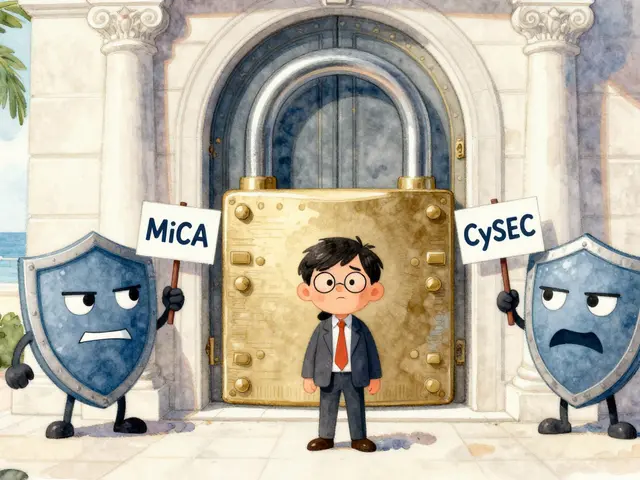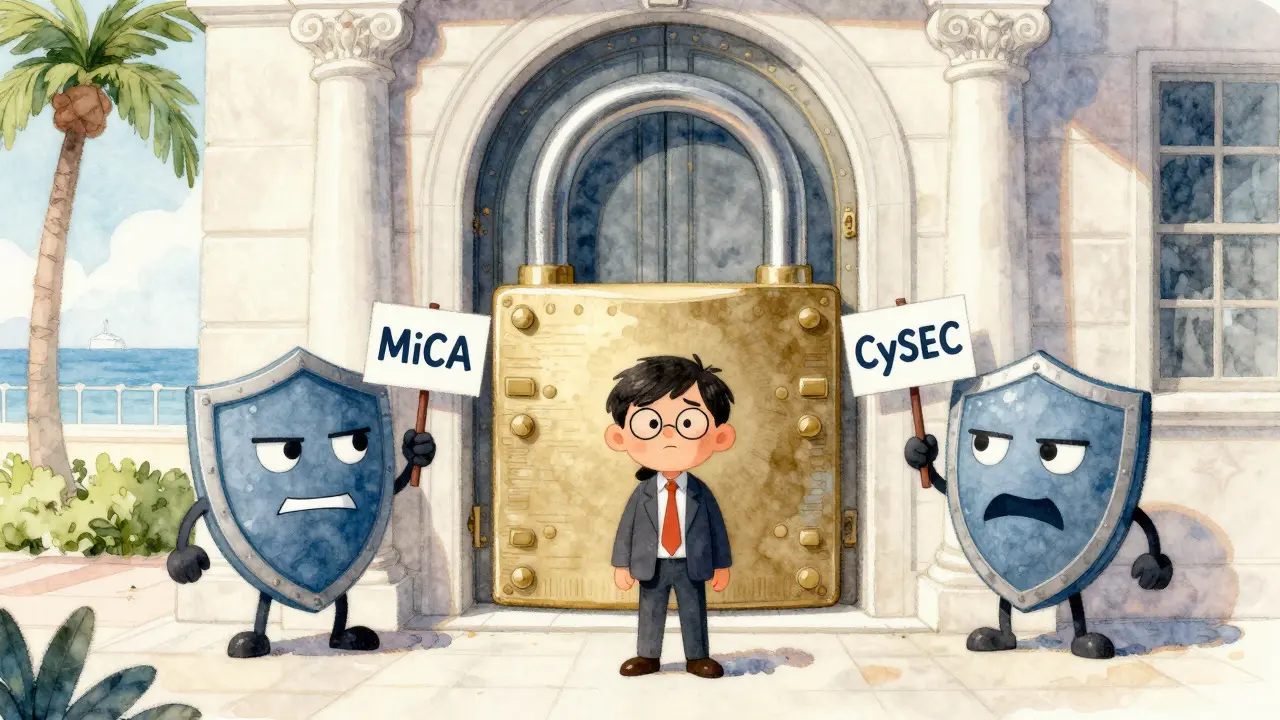
You might think that because Cyprus is a Mediterranean island nation known for its favorable tax laws and business-friendly environment, opening a bank account for your cryptocurrency business would be easy. The reality in mid-2026 is much more complex. While the country boasts zero capital gains tax on crypto sales, traditional banks are walking on eggshells. They are terrified of regulatory penalties.
If you are trying to move money between a fiat bank account and a crypto wallet in Cyprus right now, you have likely hit a wall. Transactions get frozen, accounts get closed without warning, or you spend weeks filling out forms that seem to multiply overnight. This isn't because banks hate crypto. It's because the regulatory framework has tightened significantly under the EU's Markets in Crypto-Assets (MiCA) regulation and new national anti-money laundering (AML) laws.
The New Reality: MiCA and the End of the Wild West
To understand why your transaction was blocked, you need to look at the bigger picture. For years, Cyprus operated with a relatively loose interpretation of crypto rules. That changed dramatically as the European Union rolled out MiCA. By mid-2025, the transitional periods for most regulations had ended. Now, full enforcement is the norm.
CySEC is the Cyprus Securities and Exchange Commission, the primary regulator overseeing financial markets and crypto-asset service providers in Cyprus. As of Q2 2025, CySEC supervised over 87 registered crypto-asset service providers (CASPs). If your exchange or wallet provider isn't on that list, your local bank will likely treat your transaction as high-risk. Banks are required by law to perform customer due diligence on their correspondent CASPs. If they can't verify the license, they block the flow of funds.
This creates a dual-regulatory structure that is tricky to navigate. The Central Bank of Cyprus (CBC) handles electronic money tokens (EMTs), while CySEC oversees everything else. For a regular user or a small business owner, this means you aren't just dealing with one set of rules. You are navigating a maze where every step requires specific documentation.
The €1,000 Threshold and the Travel Rule
One of the biggest changes hitting your wallet in 2026 is the strict application of the 'Travel Rule.' This rule mandates that identity information must travel with the transaction. But it’s not just about big whales moving millions. The threshold is surprisingly low.
Under the Prevention and Suppression of Money Laundering from Illegal Activities (Amendment) Law of 2025, any crypto transaction above €1,000 triggers mandatory identity verification. Both the sender and the receiver must be identified. If you send €1,001 to a friend, both of you need to provide verified details to the service providers involved.
Here is how this affects banking specifically:
- Real-time Verification: Payment service providers, including banks, must verify beneficiaries in real-time before executing transfers. Eurofast reports this adds about 15-20 seconds to processing times, but if data is missing, the transaction fails entirely.
- Self-Hosted Wallets: Transfers involving self-hosted wallets (like MetaMask or Ledger) face enhanced due diligence. Banks must verify the identity of parties transferring to or from these non-custodial wallets. This is often where transactions stall because the bank cannot easily verify who owns the private keys on the other end.
- Audit Trails: Banks must maintain detailed audit trails for all crypto-related activity. If your history looks messy or inconsistent, expect questions.

Why Banks Are Still Saying No
You might ask, "If there are clear rules, why is it still so hard?" The answer lies in risk appetite. Even with a clear regulatory framework, traditional banks in Cyprus remain cautious. The CBC explicitly states that cryptocurrency is not legal tender. It is not backed by any government or central bank.
A survey by the Cyprus Blockchain Association in Q2 2025 revealed that 68% of crypto businesses struggled to establish traditional banking relationships. Why? Because the cost of compliance is high. If a bank makes a mistake in screening a crypto transaction against EU and UN sanctions lists, the penalty can be up to 10% of their annual turnover or €5 million. Most regional banks simply don't want to take that risk unless they are absolutely sure.
This leads to a phenomenon known as 'de-risking.' Banks close accounts of crypto-linked entities to avoid scrutiny altogether. It’s not personal; it’s defensive accounting. To survive this, businesses need to prove they are compliant before they even walk through the bank door.
Compliance Checklist for Crypto Businesses
If you are running a crypto business in Cyprus, you need to be proactive. Waiting for the bank to ask for documents is too late. Here is what you need to have ready to satisfy both CySEC and your banking partner:
- CASP Registration: Ensure you are registered with CySEC. There is no grace period left for most services. Unregistered operators are dead in the water when it comes to banking.
- Internal AML/CFT Policies: Create robust internal policies for Anti-Money Laundering and Counter-Terrorist Financing. Train your staff regularly. Regulators check training logs.
- Transaction Monitoring Systems: Implement software that monitors transactions in real-time. You need to flag suspicious activities before MOKAS (the Unit for Combating Money Laundering) does. Since June 2025, CASPs have filed over 1,200 suspicious transaction reports. Being on top of this shows good faith.
- Sanctions Screening: Apply enhanced due diligence for any transaction touching self-hosted wallets or high-risk jurisdictions. Screen against EU and UN lists automatically.
- Clear Source of Funds: Be able to explain exactly where your crypto came from and where the fiat is going. Vague answers lead to frozen accounts.

Tax Benefits vs. Regulatory Hurdles
It is worth noting the silver lining. Despite the banking headaches, Cyprus remains attractive for taxation. There is no capital gains tax on cryptocurrency sales or exchanges. This policy hasn't changed in 2026. However, don't let the tax benefit blind you to the operational costs.
Global Referral Group noted in 2025 that Cyprus initiated broader tax reforms, including formal recognition of crypto trading. While this sounds positive, it also means more visibility. The tax authority knows you are trading. If your banking records don't match your tax declarations due to poor record-keeping during those frozen transactions, you could face double trouble.
| Aspect | Pre-2025 Era | Current 2026 Status |
|---|---|---|
| Regulatory Oversight | Limited, ad-hoc guidance | Strict MiCA enforcement by CySEC |
| Travel Rule Threshold | Variable, often higher | Strictly enforced at €1,000 |
| Bank Risk Appetite | Moderate | Very Low (High De-risking) |
| CASP Registration | Optional for many | Mandatory for all service providers |
| Penalties for Non-Compliance | Fines | Up to 10% of annual turnover or €5M |
Looking Ahead: Instant Payments and Future Friction
The landscape won't stay static. Cyprus is aligning with Regulation (EU) 2024/886, which mandates instant payment services in euros by 2027. This is good for speed but bad for anonymity. Every cent will be tracked instantly. The European Central Bank projects cross-border digital payment volume will rise by 35% annually through 2027. With that volume comes increased scrutiny.
Analysts predict that by 2027, 95% of crypto transactions in Cyprus will occur through registered CASPs, up from 78% in early 2025. The unregulated sector is shrinking fast. If you are relying on offshore, unlicensed exchanges to bypass local banking restrictions, you are swimming upstream. The National Sanctions Unit established in 2025 is actively hunting down non-compliant flows.
For individuals, the advice is simple: stick to regulated exchanges like those listed by CySEC. Use them as intermediaries. Don't try to wire large sums directly to obscure crypto addresses from your main salary account. Keep your finances segmented. Use dedicated business accounts for crypto activities, and ensure those accounts are fully documented with your bank beforehand.
Is cryptocurrency legal in Cyprus?
Yes, cryptocurrency is legal in Cyprus. However, the Central Bank of Cyprus clarifies that it is not considered legal tender. It is treated as an asset or commodity, subject to strict anti-money laundering (AML) and counter-terrorist financing (CFT) regulations.
Do I need a CySEC license to trade crypto personally?
No, individual investors do not need a CySEC license to buy and hold crypto. However, if you are providing services to others-such as operating an exchange, wallet service, or advisory firm-you must register as a Crypto-Asset Service Provider (CASP) with CySEC.
What happens if my bank freezes my crypto transaction?
If your transaction is frozen, contact your bank immediately to request the specific reason. Often, it is due to missing Travel Rule data or sanctions screening flags. Provide proof of identity, source of funds, and destination details. If the issue persists, you may need to escalate to the bank's compliance department or seek legal advice regarding the Transfer of Funds Regulation.
Are there taxes on crypto profits in Cyprus?
Currently, Cyprus does not charge capital gains tax on the sale or exchange of cryptocurrencies. However, income derived from professional crypto trading or mining may be subject to income tax. Always consult a local tax advisor as regulations can evolve.
How does the Travel Rule affect small transactions?
The Travel Rule applies to transactions exceeding €1,000. Both the sender and receiver must have their identities verified by the respective service providers. For amounts below €1,000, standard KYC procedures apply, but the strict requirement for data to 'travel' with the transfer is less intensive.