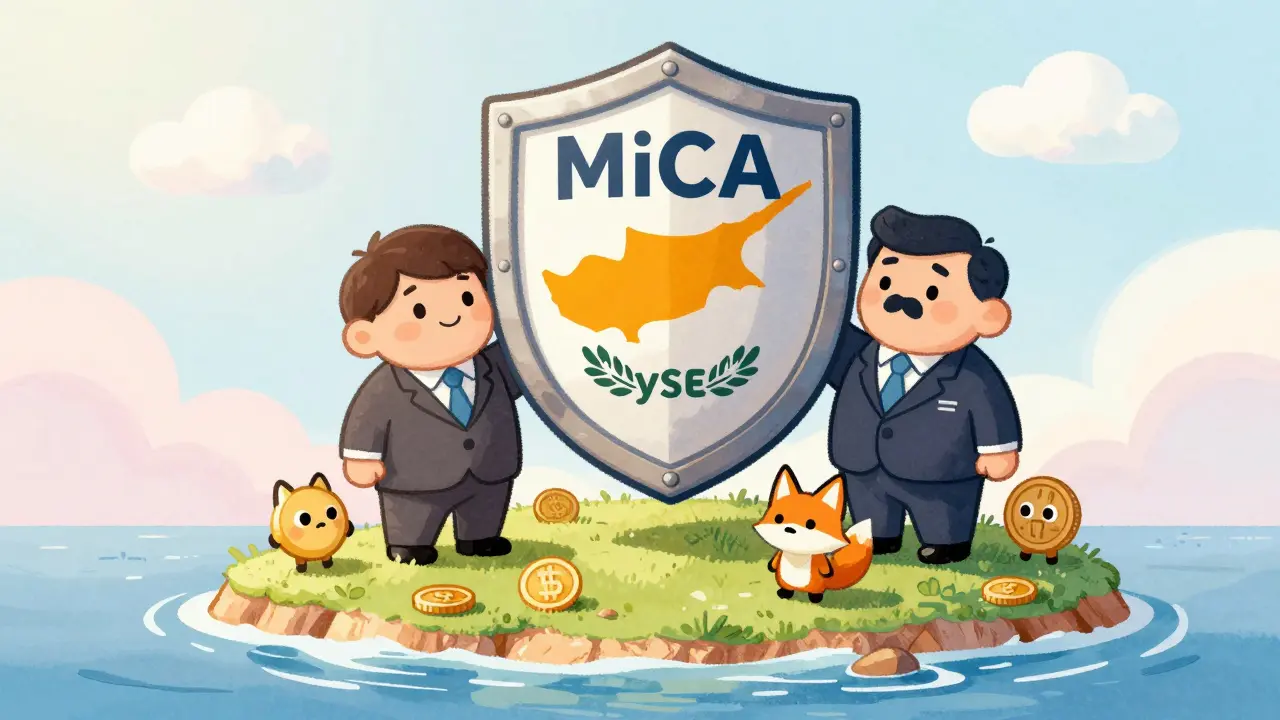
The landscape for cryptocurrency in Cyprus has shifted dramatically since December 30, 2024. That was the day the European Union’s Markets in Crypto-Assets (MiCA) regulation fully took effect, replacing fragmented national rules with a single, strict EU-wide framework. For the island nation, known for its progressive stance on digital assets, this wasn't just an update-it was a total overhaul. If you are running a crypto business in Cyprus or looking to enter the market, the old ways of operating are gone. The era of loose interpretation is over; now, every move is scrutinized under heavy regulatory weight.
This change brings clarity, yes, but it also brings significant restrictions. Companies that once operated with minimal oversight now face rigorous capital requirements, complex governance structures, and intense reporting duties. The question isn't whether MiCA affects your business-it does. The real question is how you adapt before the final deadline hits. With the transitional period ending on July 1, 2026, the clock is ticking for all existing entities to secure full authorization or risk shutting down.
Who Controls the Game Now?
Under the new regime, power has been clearly divided between two main bodies. The Cyprus Securities and Exchange Commission (CySEC) acts as the primary gatekeeper. They are the designated national competent authority responsible for authorizing and supervising Crypto-Asset Service Providers (CASPs). This includes exchanges, brokers, and custodians. Meanwhile, the Central Bank of Cyprus (CBC) oversees Electronic Money Tokens (EMTs).
This split matters because it means different rules apply depending on what kind of token you handle. If you are dealing with stablecoins backed by fiat currency, you fall under the CBC's watch. If you are providing trading services for other crypto-assets, CySEC is your boss. Before October 2024, CySEC accepted registrations under domestic rules. That door is now closed. All new applications must meet the full MiCA standard from day one. There is no backdoor entry anymore.
For existing firms, there was a grace period. Cyprus utilized the full 18-month transitional window allowed by the EU. This means companies already operating under national laws had until July 1, 2026, to upgrade their licenses. But don't let that date lull you into a false sense of security. The preparation work-gathering documentation, restructuring boards, upgrading tech-needs to be done well before then. CySEC will not grant extensions simply because you ran out of time.
The New Rules for Company Structure
MiCA doesn't just look at your finances; it looks at who runs your company. One of the biggest shocks for many Cyprus-based startups was the requirement for effective management. You can no longer have a "mailbox company" where directors live abroad and only show up for meetings via Zoom. The majority of board members must be based in Cyprus and actively involved in daily decision-making.
Furthermore, at least half of your board must consist of independent non-executive directors. These aren't friends or family members. They need to be truly independent professionals who can challenge executive decisions and ensure robust governance. This rule aims to prevent rogue operators from hiding behind shell structures. It forces companies to build serious, local corporate infrastructure.
To get authorized, you must submit a comprehensive package to CySEC. This includes:
- A detailed program of operations explaining exactly how you will run your business.
- Proof of prudential safeguards, showing you have enough capital to absorb losses.
- Detailed descriptions of your governance arrangements, proving your board structure meets the independence criteria.
- Evidence of robust IT systems and cybersecurity measures.
This process is expensive and time-consuming. Smaller firms without deep pockets often find themselves unable to afford the legal and consulting fees required to prepare these documents. This leads directly to the next major impact: market consolidation.

Market Consolidation: The Survival of the Fittest
If you thought the crypto boom meant endless growth for everyone, think again. MiCA has triggered a wave of exits and mergers in Cyprus. The cost of compliance is high. Between licensing fees, hiring qualified compliance officers, upgrading technology to meet reporting standards, and maintaining higher capital reserves, the barrier to entry has skyrocketed.
Many smaller players, lacking the resources to meet these demands, have chosen to leave the market entirely. Others have merged with larger, more established firms to share the burden of compliance. The result? Fewer companies, but stronger ones. While some worry this reduces diversity and stifles innovation, regulators argue it boosts investor confidence. When you know every active player has passed a rigorous vetting process, you feel safer putting your money into their platform.
This shift benefits institutional investors who were previously hesitant to engage with the crypto sector due to fears of fraud or instability. With MiCA ensuring that all CASPs adhere to strict operational standards, the gap between traditional finance and crypto narrows. Traditional custodians are now entering the Cyprus market, bringing professional-grade services and competitive pressure that pushes local firms to improve.
The Travel Rule and Privacy Challenges
One of the most operationally complex parts of MiCA, especially with updates rolled out in 2025, is the integration of the Transfer of Funds Regulation (TFR) Travel Rule. This rule requires CASPs to include specific sender and receiver information with every crypto-asset transfer. No more anonymous transactions. Every movement of funds must be traceable.
This applies even to transfers involving self-hosted wallets if the amount exceeds EUR 1,000. Imagine trying to verify the identity of someone using a private wallet they control entirely. It’s technically difficult and legally tricky. CASPs are forced to invest heavily in systems that can collect, verify, and securely transmit this data. If they fail to do so, they risk hefty fines or losing their license.
Additionally, CASPs are now designated as obliged entities under the EU Anti-Money Laundering (AML) framework. This means they must implement risk-based Customer Due Diligence (CDD). For customers from high-risk countries, Enhanced Due Diligence (EDD) is mandatory. You also need to keep meticulous records of beneficial ownership. Compliance teams are no longer just checking boxes; they are conducting deep dives into customer backgrounds.
| Aspect | Pre-MiCA (National Rules) | Post-MiCA (EU Harmonization) |
|---|---|---|
| Governance | Flexible board structures | Majority Cyprus-based directors; 50% independent non-executives |
| Licensing Authority | CySEC (domestic registration) | CySEC (full authorization); CBC (for EMTs) |
| Transaction Traceability | Basic AML checks | Strict Travel Rule implementation for all transfers >€1,000 |
| Market Entry | Lower barriers, faster setup | High capital requirements, extensive documentation |
| Transitional Period | N/A | Ended July 1, 2026 for existing CASPs |

Innovation Under Pressure
Despite the heavy restrictions, Cyprus hasn't shut the door on innovation. In fact, it has doubled down on structured support. CySEC’s Innovation Hub, launched in 2018, remains a key asset. It operates a Regulatory Sandbox where fintech innovators can test new business models in a supervised environment. This allows startups to interact with regulators early, getting feedback before committing millions to full-scale launches.
Even the Central Bank of Cyprus, historically cautious about crypto, has launched its own Innovation Hub. This signals a cultural shift within the financial establishment. They recognize that digital transformation is inevitable and prefer to guide it rather than fight it. However, participation in the sandbox doesn't guarantee a license. It merely provides a pathway to demonstrate viability.
Tokenization is emerging as a major opportunity within this framework. Issuing fund units as digital tokens on blockchain platforms offers increased efficiency and liquidity. With MiCA providing clear rules for Asset-Referenced Tokens (ARTs) and EMTs, traditional asset managers are exploring how to bring real-world assets onto the blockchain. Cyprus, with its strong trust and corporate services sector, is well-positioned to become a hub for tokenized funds.
Looking Ahead: What Comes Next?
MiCA is not the end of the story; it’s just the beginning. As Theocharides from CySEC noted, "MiCA should only be considered a starting point." The pace of digitalization continues to outstrip regulation. We are already seeing discussions around the EU Anti-Money Laundering Authority (AMLA), which will supervise high-risk entities across member states, further standardizing rules.
There is also the Distributed Ledger Technology (DLT) Pilot Regime, which became operational in March 2023. This allows testing of market infrastructures for DLT-based financial instruments. Uptake has been slow due to complexity, but as technology matures, we may see more adoption in Cyprus. For now, the focus remains on survival and adaptation.
For businesses, the message is clear: compliance is no longer optional. Whether you are preparing for authorization or planning a token issuance, you need to embed MiCA requirements into your core strategy. Hire experts who understand both the technical and legal sides. Build relationships with regulators through the Innovation Hub. And remember, the goal isn't just to avoid penalties-it's to build a sustainable business that thrives in a regulated world.
What happens if my Cyprus crypto firm doesn't get MiCA authorization by July 1, 2026?
If you fail to obtain full MiCA authorization by the July 1, 2026 deadline, you will lose your legal right to operate as a Crypto-Asset Service Provider (CASP) in Cyprus. CySEC will revoke your previous national registration. Continuing to operate without authorization is illegal and can result in severe fines, criminal charges, and permanent bans from the industry. You must either secure the license or cease operations immediately.
Does MiCA affect small startups in Cyprus?
Yes, significantly. While MiCA aims to protect consumers, its strict capital and governance requirements make it difficult for small startups to comply. Many small firms lack the resources to hire independent board members, maintain high capital reserves, or build complex compliance systems. This has led to market consolidation, where smaller players either merge with larger firms or exit the market entirely. Startups must carefully assess their ability to meet these costs before launching.
How does the Travel Rule impact user privacy?
The Travel Rule drastically reduces anonymity in crypto transactions. CASPs must attach sender and receiver information to every transfer, including those to self-hosted wallets above €1,000. This means your personal data travels with your funds. While this combats money laundering and terrorist financing, it raises privacy concerns for users who value financial secrecy. Users should expect less anonymity and more scrutiny on their transaction histories.
Can I still use the CySEC Innovation Hub if I am a foreign company?
Yes, the Innovation Hub is open to fintech innovators regardless of origin, but you must eventually establish a legal presence in Cyprus to operate commercially. The hub allows you to test models and engage with regulators, but to get a CASP license, you need a Cyprus-registered entity with local management. Foreign companies often use the hub to validate their business case before committing to setting up a local office.
What is the role of the Central Bank of Cyprus in MiCA?
The Central Bank of Cyprus (CBC) specifically oversees Electronic Money Tokens (EMTs), which are stablecoins pegged to a single fiat currency like the Euro. While CySEC handles general crypto-asset service providers, the CBC ensures that issuers of EMTs maintain sufficient reserves and adhere to strict monetary stability rules. If your project involves issuing stablecoins, you will deal primarily with the CBC, not CySEC.

Jon Milton
June 27, 2026 AT 22:33Look, I get the need for order, but this feels like a total crackdown on freedom. We are essentially handing over our financial sovereignty to bureaucrats who don't understand the tech. It's not just about compliance; it's about control. The idea that we need 'independent directors' just to run a digital wallet is absurd. It kills the spirit of decentralization before it even starts.
Rebecca Shoniker
June 29, 2026 AT 13:15You are completely missing the point here! The lack of regulation was exactly what allowed fraudsters and scammers to operate with impunity for years! MiCA isn't 'control'; it is basic consumer protection! You cannot expect institutional money to enter a space that operates like the Wild West! The governance requirements are not 'absurd'; they are fundamental corporate standards that every other industry has adhered to for decades! If you cannot afford independent board members, perhaps you should not be handling other people's assets in the first place!
Jay Sharma
June 30, 2026 AT 06:16Don't believe the hype. This is all part of the CBDC rollout. They want to kill privacy so they can track every single transaction you make. The Travel Rule is just the first step toward total surveillance. Once they have your data linked to your identity, they can freeze your assets whenever they want. Cyprus is just the testbed for Europe-wide control. Wake up people.
Scott Miller
July 1, 2026 AT 00:45Come on guys, stop being so negative! This is actually huge news for the legitimacy of crypto! Think about it, when banks start trusting these platforms because they are regulated, the whole market stabilizes. Yes, it's harder now, but that means fewer rugs and more real projects. We are building something sustainable here, not just gambling sites. Let's focus on the opportunities for tokenization and real asset backing instead of complaining about paperwork!
Abby Martin
July 2, 2026 AT 07:08I mean, obviously the small guys are getting crushed, but let's be honest, most of them were garbage anyway. The ones surviving are the ones who actually have a business model. I love seeing the cleanup crew come in. It makes the ecosystem cleaner for everyone else. Plus, if you're smart enough to build a blockchain app, you're smart enough to hire a lawyer. Stop whining about costs.
Mélanie Boulay
July 2, 2026 AT 08:43While I appreciate the sentiment regarding market cleanliness, one must consider the significant barrier to entry that these new regulations impose upon smaller innovators who may lack the substantial capital reserves required for such rigorous compliance structures, thereby potentially stifling the very innovation that the sector aims to foster, which creates a somewhat paradoxical situation where the intent to protect consumers may inadvertently lead to a monopoly of large, established entities that have the resources to navigate the complex bureaucratic landscape effectively.
nancy jarecki
July 3, 2026 AT 18:46The entire premise of 'decentralized finance' is an oxymoron when subjected to centralized regulatory frameworks like MiCA. The requirement for local physical presence and specific board compositions fundamentally undermines the borderless nature of blockchain technology. It is merely traditional finance rebranding itself as 'crypto-friendly' while stripping away its disruptive potential. The jargon-heavy compliance reports will drown out any genuine technological advancement.
Robert Hundley
July 5, 2026 AT 03:12Hey there! I think we should look at the bright side! The Innovation Hub is actually pretty cool! It gives startups a chance to talk to regulators before diving in. That's super helpful! Also, tokenizing real-world assets could open up new investment avenues for regular folks. Let's keep the energy positive and see how this plays out! 🚀
Melissa L
July 6, 2026 AT 09:54i dont really get why its such a big deal tho. if u cant follow rules then maybe dont do crypto? seems pretty simple to me. lots of ppl leaving though so guess it must be hard.
Routh Middaugh
July 7, 2026 AT 22:45I suppose there is merit to both sides of this argument! On one hand, the clarity provided by a unified EU framework reduces legal uncertainty for cross-border operations! On the other hand, the stringent capital requirements might indeed price out smaller, agile firms! Perhaps the key lies in how effectively the Regulatory Sandbox can support these smaller entities during their transition phase! It is certainly a pivotal moment for the industry!
Carl Hanzel
July 9, 2026 AT 04:33You are all delusional if you think this helps anyone but the big banks. The 'clarity' is just a euphemism for restriction. The cost of compliance is designed to bankrupt small players. And don't get me started on the Travel Rule. It's a privacy nightmare. You think you're safe with your self-hosted wallet? Good luck proving you aren't laundering money when your exchange refuses to send funds without verifying your neighbor's identity. It's a disaster waiting to happen.
Daniel J. Cox
July 9, 2026 AT 08:13I've been watching the scene in Cyprus closely. It's interesting to see how the cultural shift towards formalizing digital assets is playing out. While the regulations are strict, they do provide a certain stability that attracts serious investors. The use of emoticons in discussions about finance is rare, but I find it refreshing when people try to lighten the mood amidst heavy topics! 😊
Emma Rémond
July 10, 2026 AT 02:46The narrative surrounding MiCA as a mere 'restriction' is profoundly misguided. In reality, it represents the maturation of the asset class into a legitimate component of the global financial architecture. The emphasis on robust governance and independent oversight is not an impediment but a prerequisite for institutional adoption. Those who complain about the loss of anonymity fail to grasp that trust, not secrecy, is the currency of value in modern markets. The consolidation is inevitable and beneficial.
ELNORA JEFFERSON
July 11, 2026 AT 00:54Ugh, another article full of buzzwords. 'Innovation under pressure'? More like suffocation. I'm tired of reading about how great this is for 'investor confidence.' Who cares if the suits feel safe? The soul of crypto is gone. I'm just waiting for the next crash to prove that none of this matters. Drama much?
Carol @minaszilda
July 11, 2026 AT 18:06It is important to remember that change is difficult. However, embracing these standards can lead to long-term growth. Small teams can still thrive by focusing on niche areas or partnering with larger entities. Stay positive and adapt.
Maurice Flynn
July 12, 2026 AT 18:21Sitting back and watching this unfold. The philosophical implication is that we are trading liberty for security again. A classic dilemma. But hey, maybe that's just how society evolves. One day we'll look back and laugh at how wild the early days were. For now, I'll just observe from the sidelines. No need to rush into anything.
Sajjad Ghorbani Moghaddam
July 13, 2026 AT 14:21Just wanted to share that if anyone is struggling with the compliance docs, there are some good open-source templates floating around. Don't let the big firms scare you off. We can help each other navigate this. Community is key.