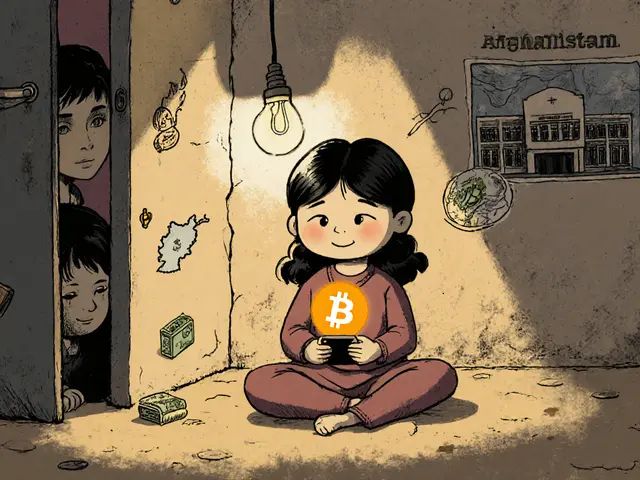
Imagine trying to send money home to your family, but the banks are frozen, the internet is cut off, and the government says digital currency is a sin. For millions of Afghans, this isn't a hypothetical nightmare-it’s daily life. Since the Taliban returned to power in August 2021, Afghanistan has faced severe international sanctions that froze its foreign reserves and crippled its traditional banking system. In response, a hidden economy emerged. Despite a strict ban on cryptocurrency declared in August 2022, underground trading networks have become a lifeline for survival.
This article explores how ordinary citizens navigate these dangerous waters, the technology they use to stay connected, and why the authorities struggle to shut it down completely.
The Ban and Why It Was Issued
To understand the underground market, you first need to know what the official stance is. In August 2022, the Taliban government issued a comprehensive decree banning all forms of cryptocurrency trading, mining, and usage. The justification was religious. They declared crypto haram (forbidden) under Islamic law, arguing that digital assets lack tangible backing and resemble speculative gambling, which is prohibited.
This wasn't just a suggestion; it was an enforcement order. All existing licenses for cryptocurrency exchanges were revoked indefinitely. Authorities began cracking down on traders and miners, leading to arrests and seizures of equipment. By November 2022, recorded transaction values had plummeted from previous highs to roughly $80,000 per month. On paper, the industry seemed dead.
But here’s the catch: you can’t easily ban something that lives on decentralized servers overseas. While the visible layer of exchanges disappeared, the demand didn’t vanish. If anything, it grew. With 97% of the population projected to fall below the poverty line in 2022, people needed ways to move money. Traditional channels were blocked by sanctions, leaving crypto as one of the few viable options.
How the Underground Network Operates
If you can’t use a formal exchange, how do you trade? The answer is Peer-to-Peer (P2P) networks. These systems allow individuals to buy and sell cryptocurrencies directly with each other without a central intermediary holding the funds. In Afghanistan, this has evolved into a sophisticated, albeit risky, shadow economy.
Bitcoin and USDT (Tether) are the primary currencies used. Bitcoin offers store-of-value properties, while USDT provides stability because it is pegged to the US dollar. This is crucial in a country where the local afghani fluctuates wildly.
Here is how a typical transaction might look:
- Identification: A buyer finds a seller through encrypted messaging apps like Telegram or WhatsApp, often using code words to avoid detection.
- Negotiation: They agree on a rate, which usually includes a premium due to the high risk involved.
- Transfer: The buyer sends fiat currency via mobile money services or cash-in-hand, while the seller releases the crypto from their wallet.
- Conversion: Forex dealers, who operate in gray areas, may then help convert the stablecoin into hard currency for larger purchases or savings.
Apps like HesabPay played a role early on, securing over 380,000 users in three months by facilitating transfers between mobile phones. However, as scrutiny increased, many such platforms scaled back or went fully underground, relying on more obscure methods to maintain user bases.
The Role of Remittances in Survival
Why take the risk? For most Afghans, it’s not about getting rich quick; it’s about eating dinner. Remittances-money sent by family members living abroad-are a critical part of the Afghan economy. Before the takeover, these flows were significant. After the Taliban seized power, traditional banking channels became unreliable or inaccessible due to compliance fears among international banks.
Cryptocurrency stepped in to fill the gap. Data shows that crypto transfers from abroad increased by 80% immediately after the Taliban took control. This surge represents families bypassing broken financial infrastructure to support loved ones at home. When food is available but purchasing power is nonexistent, receiving USDT directly to a digital wallet can mean the difference between starvation and survival.
This dynamic creates a powerful incentive for maintaining these networks. Even if the government cracks down, the economic necessity ensures that new traders emerge to replace those arrested. It’s a resilient system driven by desperation rather than speculation.

Internet Blackouts and Connectivity Challenges
You can’t trade crypto without the internet. This is where the situation gets particularly dire. Afghanistan’s digital infrastructure is already fragile, with only about 8.64 million out of 40 million inhabitants having reliable access. But recently, the problem has worsened significantly.
In September 2024, Supreme Leader Hibatullah Akhundzada ordered sweeping internet blackouts across five northern provinces: Kunduz, Badakhshan, Baghlan, Takhar, and Balkh. The stated reason was to combat "vice" and prevent access to immoral content, including pornography. However, the impact was far broader. Nationwide mobile service outages followed, reducing connectivity to less than 1% of normal levels in some areas.
For underground traders, this is catastrophic. You cannot verify transactions, check prices, or communicate with buyers if you’re offline. Traders operating near the border in Pakistan’s Peshawar reported being unable to send product images or confirm payments, halting legitimate cross-border commerce. These restrictions don’t just hurt criminals; they strangle small businesses and humanitarian aid efforts alike.
| Factor | Status Pre-2022 | Current Status (2025-2026) |
|---|---|---|
| Legal Status | Unregulated/Growing | Banned (Haram) |
| Transaction Volume | High | Low (Officially), Stable (Underground) |
| Internet Access | Limited (~21%) | Severely Restricted (<1% during blackouts) |
| Primary Use Case | Investment/Speculation | Remittances/Survival |
| Risk Level | Moderate | Extreme (Arrests/Confiscation) |
Enforcement vs. Reality
The Taliban faces a classic enforcement paradox. They have the authority to arrest people, but they lack the technical capability to monitor every blockchain transaction. Cryptocurrencies are pseudonymous, not anonymous, meaning transactions are public but identities are hidden behind alphanumeric addresses. Without sophisticated chain-analysis tools and cooperation from global exchanges (which are mostly non-compliant in Afghanistan), tracing individual users is difficult.
Furthermore, the nature of P2P trading makes it hard to eradicate. There is no central office to raid. Every smartphone with a wallet app is a potential exchange. While authorities have conducted raids and arrested individuals, these actions tend to drive the market deeper underground rather than eliminating it. Traders simply switch to more secure communication channels or meet in person for cash swaps.
The limited technological literacy in parts of the population also acts as a natural barrier. Not everyone knows how to use a crypto wallet. This limits the scale of the underground market but doesn’t stop it. Digital literacy courses, once focused on general computer skills, have quietly pivoted to include basic cryptocurrency knowledge, teaching people how to protect their keys and execute trades safely.

Broader Context of Digital Control
The crackdown on crypto is part of a larger pattern of digital and social control. In 2025, the Taliban began purging books written by women from universities and eliminated courses on democracy and human rights. The internet bans are justified as moral protections, but critics argue they are tools to isolate the population and suppress dissent.
In this environment, cryptocurrency takes on a symbolic weight beyond finance. It represents autonomy. Using a decentralized network allows Afghans to retain some control over their wealth despite authoritarian oversight. It’s a form of quiet resistance, proving that even in a heavily restricted society, information and value can still flow if there is enough will.
What Comes Next?
The future of underground crypto in Afghanistan remains precarious. The Taliban is likely to intensify its efforts to monitor digital activity, potentially investing in better surveillance technology or imposing stricter penalties. Internet blackouts may become more frequent or widespread.
However, the underlying drivers-economic isolation, banking collapse, and the need for remittances-are structural issues that won’t disappear overnight. As long as traditional financial channels remain blocked, the demand for alternative systems will persist. Innovations like mesh networking or offline transaction protocols could emerge, allowing users to trade even when the internet is down.
For now, the underground market survives on resilience and necessity. It’s a reminder that financial innovation often arises not from boardrooms, but from the urgent need to survive against the odds.
Is it legal to own cryptocurrency in Afghanistan?
No. Since August 2022, the Taliban government has banned all forms of cryptocurrency trading, mining, and usage. Possession and transaction are considered illegal and punishable by arrest or confiscation of assets.
Why do Afghans still use crypto if it's banned?
Due to international sanctions and the collapse of the traditional banking system, conventional methods for sending and receiving money are unreliable. Crypto serves as a vital channel for remittances from family abroad, helping households survive extreme poverty.
Which cryptocurrencies are most popular underground?
Bitcoin and USDT (Tether) are the most commonly used. Bitcoin is valued for its decentralization, while USDT is preferred for its price stability against the US dollar, making it useful for daily transactions and saving value.
How does the internet blackout affect crypto trading?
Internet blackouts severely disrupt trading by preventing users from accessing wallets, verifying transactions, and communicating with counterparts. This has led to significant delays and losses for both informal traders and legitimate cross-border businesses.
Can the Taliban effectively stop crypto usage?
Completely stopping it is difficult due to the decentralized nature of blockchain technology. While they can arrest individuals and seize devices, they cannot delete the ledger or block peer-to-peer connections entirely, especially as users adopt more secure, encrypted methods.